

5
Bacteria and Marine Biogeochemistry
192
continue to be discovered. As an example, sulfate
reducing bacteria able to oxidize aromatic and
aliphatic hydrocarbons have now been isolated,
which shows that anaerobic prokaryotes are able
to degrade important components of crude oil in
the absence of oxygen (Rueter et al. 1994; Rabus
et al. 1996).
The methane forming (methanogenic) archaea
can use only a narrow spectrum of substrates,
primarily H 2 plus CO 2 and acetate (Eqs. 5.21 and
5.23). Within the sulfate zone, which generally
penetrates several meters down into the seabed,
the sulfate reducing bacteria compete successfully with the methanogens for these few
substrates and methanogenesis is, therefore, of
little significance in the sulfate zone. Only a few
‘non-competitive’ substrates such as methylamines are used only by the methanogens and not
by the sulfate reducers (Oremland and Polcin
1982). Below the sulfate zone, however, there are
no available electron acceptors left other than
CO 2 , and methane accumulates here as the main
terminal product of organic matter degradation.
5.5.3
Depth Zonation of Oxidants
The general depth sequence of oxidants used in
the mineralization of organic matter is
O 2 → NO 3
-
→ Mn(IV) → Fe(III) → SO 4
2→ CO 2 .
This sequence corresponds to a gradual decrease
in redox potential of the oxidant (Fig. 5.9) and thus
to a decrease in the free energy available by
respiration with the different electron acceptors
(Table 5.2; cf. Sect. 3.2.5). The ∆G
0
of oxic
Much of the organic mineralization thus takes
place within the anoxic sediment. This anoxic
world is inhabited primarily by prokaryotic
organisms that have a high diversity of metabolic
types (Fig. 5.11). There are denitrifiers and metal
oxide reducers in the suboxic zone that can utilize
a wide range of monomeric organic substances
and can respire these to CO 2 . With depth into the
sediment, however, the energy yield of bacterial
metabolism becomes gradually smaller and the
organisms become narrower in the spectrum of
substrates which they can use. While denitrifiers
are still very versatile with respect to usable
substrates, the sulfate reducers are mostly unable
to respire, for example sugars or amino acids.
Instead, these monomeric compounds are taken
up by fermenting bacteria and converted into a
narrower spectrum of fermentation products that
include primarily volatile fatty acids such as
formate, acetate, propionate and butyrate, as well
as H 2 , lactate, some alcohols and CO 2 . Through a
second fermentation step the products may be
focused even further towards the key products:
acetate, H 2 and CO 2 . The sulfate reducers depend
on these products of fermentation which they can
respire to CO 2 . Several well-known sulfate
reducers such as Desulfovibrio spp. can only
carry out an incomplete oxidation of substrates
such as lactate, and they excrete acetate as a
product. Other sulfate reducers have specialized
on acetate and catalyze the complete oxidation to
CO 2 . The degradative capacity of anaerobic
bacteria seems, however, to be broader than
previously expected and new physiological types
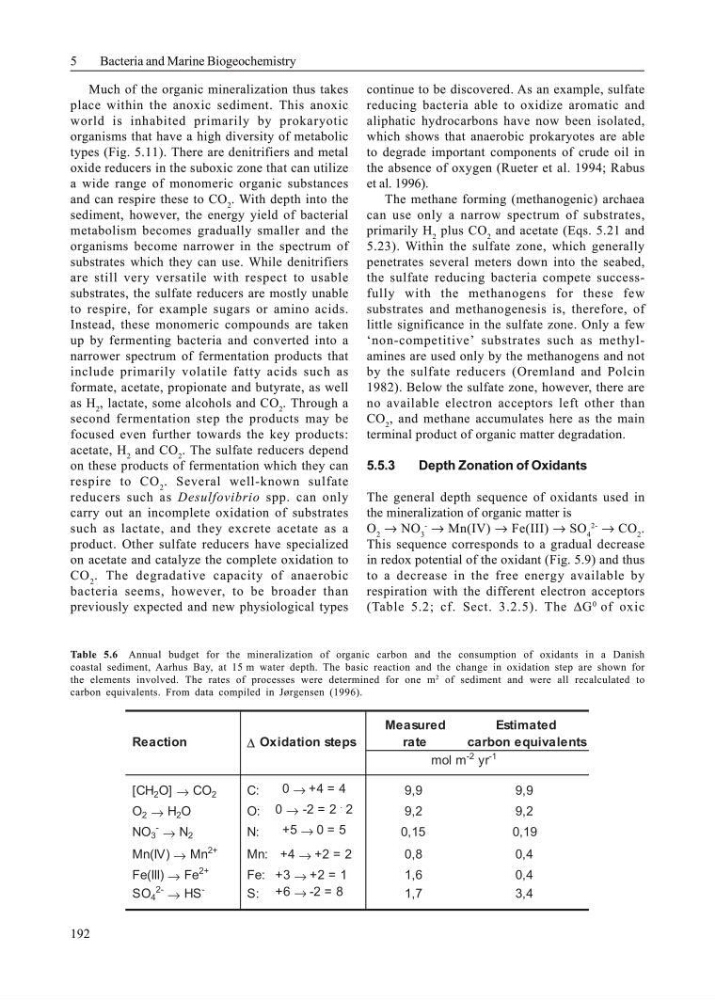
Table 5.6 Annual budget for the mineralization of organic carbon and the consumption of oxidants in a Danish
coastal sediment, Aarhus Bay, at 15 m water depth. The basic reaction and the change in oxidation step are shown for
the elements involved. The rates of processes were determined for one m
2 of sediment and were all recalculated to
carbon equivalents. From data compiled in Jørgensen (1996).
Measured
Estimated
Reaction
∆ Oxidation steps
rate
carbon equivalents
mol m
-2 yr
-1
[CH 2 O] → CO 2
C:
0 → +4 = 4
9,9
9,9
O 2 → H 2 O
O : 0 → -2 = 2
. 2
9,2
9,2
NO 3
- → N 2
N:
+5 → 0 = 5
0,15
0,19
Mn(IV) → Mn
2+
Mn: +4 → +2 = 2
0,8
0,4
Fe(III) → Fe
2+
Fe: +3 → +2 = 1
1,6
0,4
SO 4
2- → HS
-
S: +6 → -2 = 8
1,7
3,4
Bacteria and Marine Biogeochemistry
192
continue to be discovered. As an example, sulfate
reducing bacteria able to oxidize aromatic and
aliphatic hydrocarbons have now been isolated,
which shows that anaerobic prokaryotes are able
to degrade important components of crude oil in
the absence of oxygen (Rueter et al. 1994; Rabus
et al. 1996).
The methane forming (methanogenic) archaea
can use only a narrow spectrum of substrates,
primarily H 2 plus CO 2 and acetate (Eqs. 5.21 and
5.23). Within the sulfate zone, which generally
penetrates several meters down into the seabed,
the sulfate reducing bacteria compete successfully with the methanogens for these few
substrates and methanogenesis is, therefore, of
little significance in the sulfate zone. Only a few
‘non-competitive’ substrates such as methylamines are used only by the methanogens and not
by the sulfate reducers (Oremland and Polcin
1982). Below the sulfate zone, however, there are
no available electron acceptors left other than
CO 2 , and methane accumulates here as the main
terminal product of organic matter degradation.
5.5.3
Depth Zonation of Oxidants
The general depth sequence of oxidants used in
the mineralization of organic matter is
O 2 → NO 3
-
→ Mn(IV) → Fe(III) → SO 4
2→ CO 2 .
This sequence corresponds to a gradual decrease
in redox potential of the oxidant (Fig. 5.9) and thus
to a decrease in the free energy available by
respiration with the different electron acceptors
(Table 5.2; cf. Sect. 3.2.5). The ∆G
0
of oxic
Much of the organic mineralization thus takes
place within the anoxic sediment. This anoxic
world is inhabited primarily by prokaryotic
organisms that have a high diversity of metabolic
types (Fig. 5.11). There are denitrifiers and metal
oxide reducers in the suboxic zone that can utilize
a wide range of monomeric organic substances
and can respire these to CO 2 . With depth into the
sediment, however, the energy yield of bacterial
metabolism becomes gradually smaller and the
organisms become narrower in the spectrum of
substrates which they can use. While denitrifiers
are still very versatile with respect to usable
substrates, the sulfate reducers are mostly unable
to respire, for example sugars or amino acids.
Instead, these monomeric compounds are taken
up by fermenting bacteria and converted into a
narrower spectrum of fermentation products that
include primarily volatile fatty acids such as
formate, acetate, propionate and butyrate, as well
as H 2 , lactate, some alcohols and CO 2 . Through a
second fermentation step the products may be
focused even further towards the key products:
acetate, H 2 and CO 2 . The sulfate reducers depend
on these products of fermentation which they can
respire to CO 2 . Several well-known sulfate
reducers such as Desulfovibrio spp. can only
carry out an incomplete oxidation of substrates
such as lactate, and they excrete acetate as a
product. Other sulfate reducers have specialized
on acetate and catalyze the complete oxidation to
CO 2 . The degradative capacity of anaerobic
bacteria seems, however, to be broader than
previously expected and new physiological types
Table 5.6 Annual budget for the mineralization of organic carbon and the consumption of oxidants in a Danish
coastal sediment, Aarhus Bay, at 15 m water depth. The basic reaction and the change in oxidation step are shown for
the elements involved. The rates of processes were determined for one m
2 of sediment and were all recalculated to
carbon equivalents. From data compiled in Jørgensen (1996).
Measured
Estimated
Reaction
∆ Oxidation steps
rate
carbon equivalents
mol m
-2 yr
-1
[CH 2 O] → CO 2
C:
0 → +4 = 4
9,9
9,9
O 2 → H 2 O
O : 0 → -2 = 2
. 2
9,2
9,2
NO 3
- → N 2
N:
+5 → 0 = 5
0,15
0,19
Mn(IV) → Mn
2+
Mn: +4 → +2 = 2
0,8
0,4
Fe(III) → Fe
2+
Fe: +3 → +2 = 1
1,6
0,4
SO 4
2- → HS
-
S: +6 → -2 = 8
1,7
3,4