

189
play an important role in the sulfur cycle of marine
sediments and for the isotope geochemistry of
sulfur (Jørgensen 1990; Thamdrup et al. 1993;
Canfield and Teske 1996).
In comparison to all other heterotrophs, the
microorganisms oxidizing methane and other C 1
compounds such as methanol, have a unique
metabolic pathway which involves oxygenase
enzymes and thus requires O 2 . Only aerobic
methane-oxidizing bacteria have been isolated and
studied in laboratory culture, yet methane
oxidation in marine sediments is known to take
place mostly anaerobically at the transition to the
sulfate zone. Microbial consortia that oxidize
methane with sulfate have in particular been
studied at methane seeps on the sea floor and the
communities can now also be grown in the
laboratory (Boetius et al. 2000; Orphan et al. 2001;
Nauhaus et al. 2002) Anaerobic methane oxidation
is catalyzed by archaea that use a key enzyme
related to the coenzyme-M reductase of
methanogens, to attack the methane molecule
(Krüger et al. 2003; see Sect. 5.1). The best
studied of these ANME (ANaerobic MEthane
oxidizers) archaea depend on a symbiosis with
sulfate reducing bacteria for a complete methane
oxidation to CO 2 . It is an interesting question
whether some of the ANME archaea can also
reduce sulfate and thus carry out the entire
process within a single cell.
Although the different groups of prokaryotes
may be catagorized in the scheme of Table 5.4, it
should be noted that they are often very diverse
and flexible and may thus fit into different
categories according to their immediate environmental conditions and mode of life. A good
example are the sulfate reducing bacteria which are
typically obligate anaerobes specialized on the
oxidation of a limited range of small organic molecules with sulfate (Postgate 1984; Widdel 1988).
This group has, however, a great diversity in the
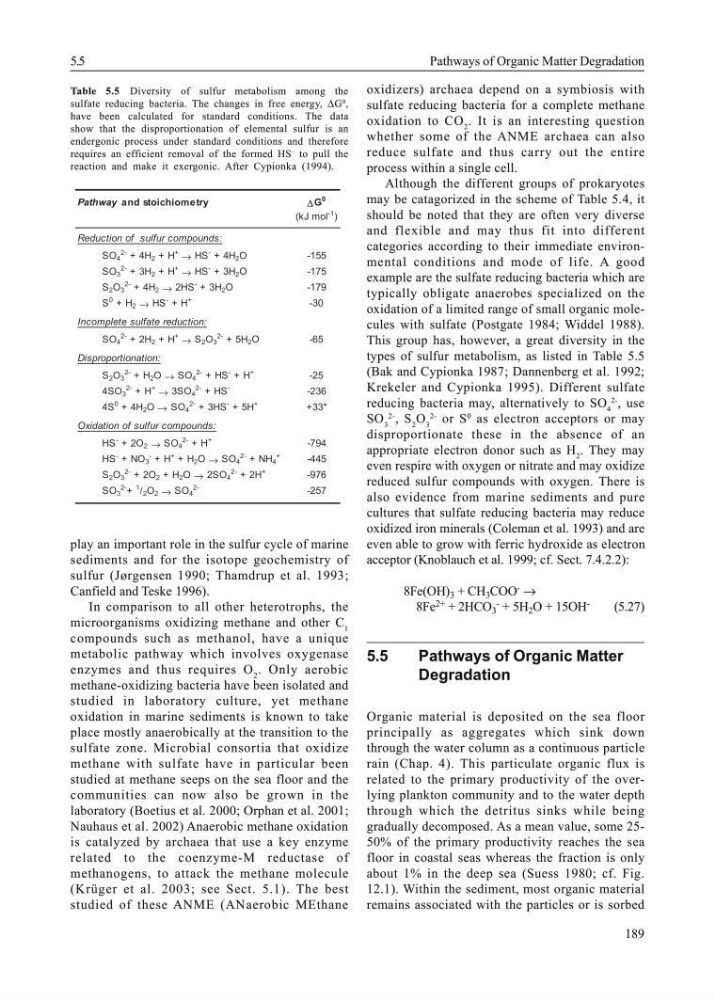
types of sulfur metabolism, as listed in Table 5.5
(Bak and Cypionka 1987; Dannenberg et al. 1992;
Krekeler and Cypionka 1995). Different sulfate
reducing bacteria may, alternatively to SO 4
2, use
SO 3
2, S 2 O 3
2or S
0
as electron acceptors or may
disproportionate these in the absence of an
appropriate electron donor such as H 2 . They may
even respire with oxygen or nitrate and may oxidize
reduced sulfur compounds with oxygen. There is
also evidence from marine sediments and pure
cultures that sulfate reducing bacteria may reduce
oxidized iron minerals (Coleman et al. 1993) and are
even able to grow with ferric hydroxide as electron
acceptor (Knoblauch et al. 1999; cf. Sect. 7.4.2.2):
8Fe(OH) 3 + CH 3 COO - →
8Fe 2+ + 2HCO 3
- + 5H 2 O + 15OH -
(5.27)
5.5
Pathways of Organic Matter
Degradation
Organic material is deposited on the sea floor
principally as aggregates which sink down
through the water column as a continuous particle
rain (Chap. 4). This particulate organic flux is
related to the primary productivity of the overlying plankton community and to the water depth
through which the detritus sinks while being
gradually decomposed. As a mean value, some 2550% of the primary productivity reaches the sea
floor in coastal seas whereas the fraction is only
about 1% in the deep sea (Suess 1980; cf. Fig.
12.1). Within the sediment, most organic material
remains associated with the particles or is sorbed
Table 5.5 Diversity of sulfur metabolism among the
sulfate reducing bacteria. The changes in free energy, ∆G
0 ,
have been calculated for standard conditions. The data
show that the disproportionation of elemental sulfur is an
endergonic process under standard conditions and therefore
requires an efficient removal of the formed HS
– to pull the
reaction and make it exergonic. After Cypionka (1994).
5.5
Pathways of Organic Matter Degradation
Pathway and stoichiometry
∆G
0
(kJ mol
-1 )
Reduction of sulfur compounds:
SO 4
2- + 4H 2 + H
+ → HS
- + 4H 2 O
- 1 5 5
SO 3
2- + 3H 2 + H
+ → HS
- + 3H 2 O
- 1 7 5
S 2 O 3
2- + 4H 2 → 2HS
- + 3H 2 O
- 1 7 9
S
0 + H 2 → HS
- + H
+
-30
Incomplete sulfate reduction:
SO 4
2- + 2H 2 + H
+ → S 2 O 3
2- + 5H 2 O
- 6 5
Disproportionation:
S 2 O 3
2- + H 2 O → SO 4
2- + HS
- + H
+
-25
4SO 3
2- + H
+ → 3SO 4
2- + HS
-
-236
4S
0 + 4H 2 O → SO 4
2- + 3HS
- + 5H
+
+33*
Oxidation of sulfur compounds:
HS
- + 2O 2 → SO 4
2- + H
+
-794
HS
- + NO 3
- + H
+ + H 2 O → SO 4
2- + NH 4
+
-445
S 2 O 3
2- + 2O 2 + H 2 O → 2SO 4
2- + 2H
+
-976
SO 3
2+
1 / 2 O 2 → SO 4
2-257
play an important role in the sulfur cycle of marine
sediments and for the isotope geochemistry of
sulfur (Jørgensen 1990; Thamdrup et al. 1993;
Canfield and Teske 1996).
In comparison to all other heterotrophs, the
microorganisms oxidizing methane and other C 1
compounds such as methanol, have a unique
metabolic pathway which involves oxygenase
enzymes and thus requires O 2 . Only aerobic
methane-oxidizing bacteria have been isolated and
studied in laboratory culture, yet methane
oxidation in marine sediments is known to take
place mostly anaerobically at the transition to the
sulfate zone. Microbial consortia that oxidize
methane with sulfate have in particular been
studied at methane seeps on the sea floor and the
communities can now also be grown in the
laboratory (Boetius et al. 2000; Orphan et al. 2001;
Nauhaus et al. 2002) Anaerobic methane oxidation
is catalyzed by archaea that use a key enzyme
related to the coenzyme-M reductase of
methanogens, to attack the methane molecule
(Krüger et al. 2003; see Sect. 5.1). The best
studied of these ANME (ANaerobic MEthane
oxidizers) archaea depend on a symbiosis with
sulfate reducing bacteria for a complete methane
oxidation to CO 2 . It is an interesting question
whether some of the ANME archaea can also
reduce sulfate and thus carry out the entire
process within a single cell.
Although the different groups of prokaryotes
may be catagorized in the scheme of Table 5.4, it
should be noted that they are often very diverse
and flexible and may thus fit into different
categories according to their immediate environmental conditions and mode of life. A good
example are the sulfate reducing bacteria which are
typically obligate anaerobes specialized on the
oxidation of a limited range of small organic molecules with sulfate (Postgate 1984; Widdel 1988).
This group has, however, a great diversity in the
types of sulfur metabolism, as listed in Table 5.5
(Bak and Cypionka 1987; Dannenberg et al. 1992;
Krekeler and Cypionka 1995). Different sulfate
reducing bacteria may, alternatively to SO 4
2, use
SO 3
2, S 2 O 3
2or S
0
as electron acceptors or may
disproportionate these in the absence of an
appropriate electron donor such as H 2 . They may
even respire with oxygen or nitrate and may oxidize
reduced sulfur compounds with oxygen. There is
also evidence from marine sediments and pure
cultures that sulfate reducing bacteria may reduce
oxidized iron minerals (Coleman et al. 1993) and are
even able to grow with ferric hydroxide as electron
acceptor (Knoblauch et al. 1999; cf. Sect. 7.4.2.2):
8Fe(OH) 3 + CH 3 COO - →
8Fe 2+ + 2HCO 3
- + 5H 2 O + 15OH -
(5.27)
5.5
Pathways of Organic Matter
Degradation
Organic material is deposited on the sea floor
principally as aggregates which sink down
through the water column as a continuous particle
rain (Chap. 4). This particulate organic flux is
related to the primary productivity of the overlying plankton community and to the water depth
through which the detritus sinks while being
gradually decomposed. As a mean value, some 2550% of the primary productivity reaches the sea
floor in coastal seas whereas the fraction is only
about 1% in the deep sea (Suess 1980; cf. Fig.
12.1). Within the sediment, most organic material
remains associated with the particles or is sorbed
Table 5.5 Diversity of sulfur metabolism among the
sulfate reducing bacteria. The changes in free energy, ∆G
0 ,
have been calculated for standard conditions. The data
show that the disproportionation of elemental sulfur is an
endergonic process under standard conditions and therefore
requires an efficient removal of the formed HS
– to pull the
reaction and make it exergonic. After Cypionka (1994).
5.5
Pathways of Organic Matter Degradation
Pathway and stoichiometry
∆G
0
(kJ mol
-1 )
Reduction of sulfur compounds:
SO 4
2- + 4H 2 + H
+ → HS
- + 4H 2 O
- 1 5 5
SO 3
2- + 3H 2 + H
+ → HS
- + 3H 2 O
- 1 7 5
S 2 O 3
2- + 4H 2 → 2HS
- + 3H 2 O
- 1 7 9
S
0 + H 2 → HS
- + H
+
-30
Incomplete sulfate reduction:
SO 4
2- + 2H 2 + H
+ → S 2 O 3
2- + 5H 2 O
- 6 5
Disproportionation:
S 2 O 3
2- + H 2 O → SO 4
2- + HS
- + H
+
-25
4SO 3
2- + H
+ → 3SO 4
2- + HS
-
-236
4S
0 + 4H 2 O → SO 4
2- + 3HS
- + 5H
+
+33*
Oxidation of sulfur compounds:
HS
- + 2O 2 → SO 4
2- + H
+
-794
HS
- + NO 3
- + H
+ + H 2 O → SO 4
2- + NH 4
+
-445
S 2 O 3
2- + 2O 2 + H 2 O → 2SO 4
2- + 2H
+
-976
SO 3
2+
1 / 2 O 2 → SO 4
2-257