

1
The Solid Phase of Marine Sediments
2
1.2.1
Lithogenous Sediments
The main sources of lithogenous sediments are ultimately continental rocks which have been broken up, crushed and dissolved by means of physical and chemical weathering, exposure to frost and
heat, the effects of water and ice, and biological
activity. The nature of the parent rock and the
prevalent climatic conditions determine the intensity at which weathering takes place. Information
about these processes can be stored within the
remnant particulate weathered material, the terrigenous detritus, which is transported by various
routes to the oceans, such as rivers, glaciers and
icebergs, or wind. Volcanic activity also contributes to lithogenous sediment formation, however,
to a lesser extent; volcanism is especially effective
on the active boundaries of the lithospheric
plates, the mid-ocean spreading ridges and the
subduction zones.
The major proportion of weathered material is
transported from the continents into the oceans
by rivers as dissolved or suspension load, i.e. in
the form of solid particulate material. Depending
on the intensity of turbulent flow suspension load
generally consists of particles smaller than 30 microns, finer grained than coarse silt. As the mineral composition depends on the type of parent
rock and the weathering conditions of the catchment area, it will accordingly vary with each river
system under study. Furthermore, the mineral
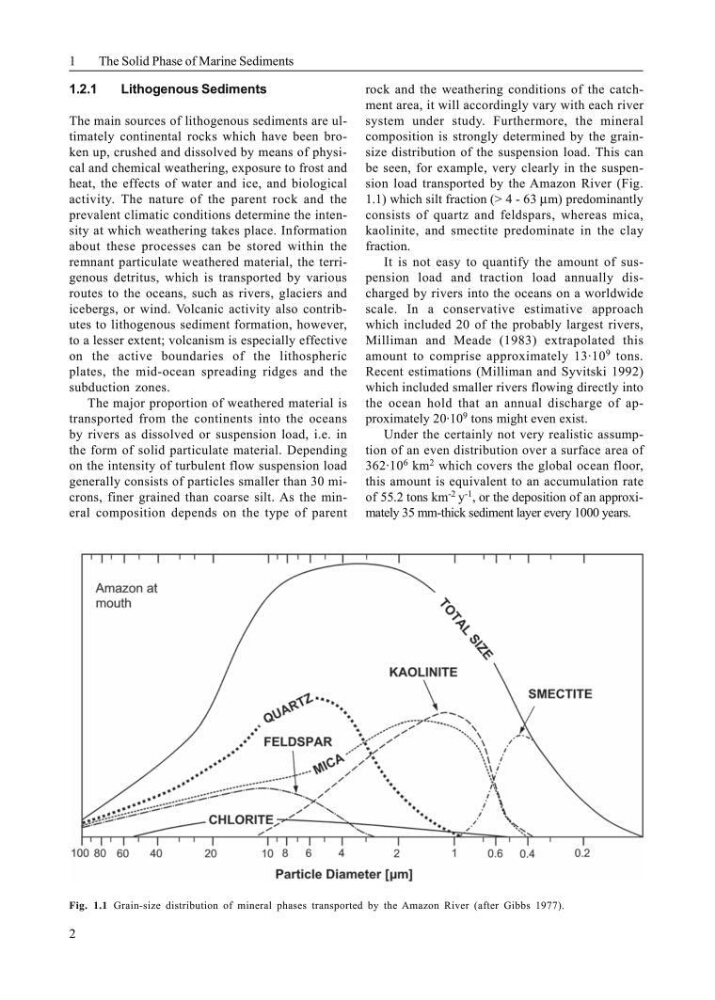
composition is strongly determined by the grainsize distribution of the suspension load. This can
be seen, for example, very clearly in the suspension load transported by the Amazon River (Fig.
1.1) which silt fraction (> 4 - 63 µm) predominantly
consists of quartz and feldspars, whereas mica,
kaolinite, and smectite predominate in the clay
fraction.
It is not easy to quantify the amount of suspension load and traction load annually discharged by rivers into the oceans on a worldwide
scale. In a conservative estimative approach
which included 20 of the probably largest rivers,
Milliman and Meade (1983) extrapolated this
amount to comprise approximately 13·10 9 tons.
Recent estimations (Milliman and Syvitski 1992)
which included smaller rivers flowing directly into
the ocean hold that an annual discharge of approximately 20·10 9 tons might even exist.
Under the certainly not very realistic assumption of an even distribution over a surface area of
362·10 6 km 2 which covers the global ocean floor,
this amount is equivalent to an accumulation rate
of 55.2 tons km -2 y -1 , or the deposition of an approximately 35 mm-thick sediment layer every 1000 years.
Fig. 1.1 Grain-size distribution of mineral phases transported by the Amazon River (after Gibbs 1977).
The Solid Phase of Marine Sediments
2
1.2.1
Lithogenous Sediments
The main sources of lithogenous sediments are ultimately continental rocks which have been broken up, crushed and dissolved by means of physical and chemical weathering, exposure to frost and
heat, the effects of water and ice, and biological
activity. The nature of the parent rock and the
prevalent climatic conditions determine the intensity at which weathering takes place. Information
about these processes can be stored within the
remnant particulate weathered material, the terrigenous detritus, which is transported by various
routes to the oceans, such as rivers, glaciers and
icebergs, or wind. Volcanic activity also contributes to lithogenous sediment formation, however,
to a lesser extent; volcanism is especially effective
on the active boundaries of the lithospheric
plates, the mid-ocean spreading ridges and the
subduction zones.
The major proportion of weathered material is
transported from the continents into the oceans
by rivers as dissolved or suspension load, i.e. in
the form of solid particulate material. Depending
on the intensity of turbulent flow suspension load
generally consists of particles smaller than 30 microns, finer grained than coarse silt. As the mineral composition depends on the type of parent
rock and the weathering conditions of the catchment area, it will accordingly vary with each river
system under study. Furthermore, the mineral
composition is strongly determined by the grainsize distribution of the suspension load. This can
be seen, for example, very clearly in the suspension load transported by the Amazon River (Fig.
1.1) which silt fraction (> 4 - 63 µm) predominantly
consists of quartz and feldspars, whereas mica,
kaolinite, and smectite predominate in the clay
fraction.
It is not easy to quantify the amount of suspension load and traction load annually discharged by rivers into the oceans on a worldwide
scale. In a conservative estimative approach
which included 20 of the probably largest rivers,
Milliman and Meade (1983) extrapolated this
amount to comprise approximately 13·10 9 tons.
Recent estimations (Milliman and Syvitski 1992)
which included smaller rivers flowing directly into
the ocean hold that an annual discharge of approximately 20·10 9 tons might even exist.
Under the certainly not very realistic assumption of an even distribution over a surface area of
362·10 6 km 2 which covers the global ocean floor,
this amount is equivalent to an accumulation rate
of 55.2 tons km -2 y -1 , or the deposition of an approximately 35 mm-thick sediment layer every 1000 years.
Fig. 1.1 Grain-size distribution of mineral phases transported by the Amazon River (after Gibbs 1977).