

145
extractable with organic solvents. Bitumen consists of
nonpolar hydrocarbons and a variety of polar lipids
with a great number of different functional groups, such
as ketones, ethers, esters, alcohols, fatty acids and
corresponding sulfur-bearing compounds.
Fulvic acids and subsequently humic acids
decrease in their concentrations over time as a result
of progressive combination reactions with increasing
diagenesis. This process of kerogen formation concurrently involves the elimination of small molecules like
water, carbon dioxide, ammonia or hydrogen sulfide
(Huc and Durand 1977). As a consequence, the degree
of condensation of the macromolecular kerogen
increases. In terms of elemental composition it becomes
enriched in carbon and hydrogen and depleted in
oxygen, nitrogen and sulfur. This carbon- and
hydrogen-rich kerogen ultimately is the source material
for the formation of petroleum and natural gas which
starts when burial is deep and temperatures are so high
that the carbon-carbon bonds in the kerogen are
thermally cracked. The main phase of oil formation
typically occurs between 90 °C and 120 °C, but the range
largely depends on the heating rate (slow or rapid burial)
and on the chemical structure of the kerogen. For
example, kerogens rich in sulfur start oil formation earlier
because carbon-sulfur bonds are broken more easily
than carbon-carbon bonds. The product, however, is a
heavy oil (high density, high viscosity) rich in sulfur
4.3
Early Diagenesis
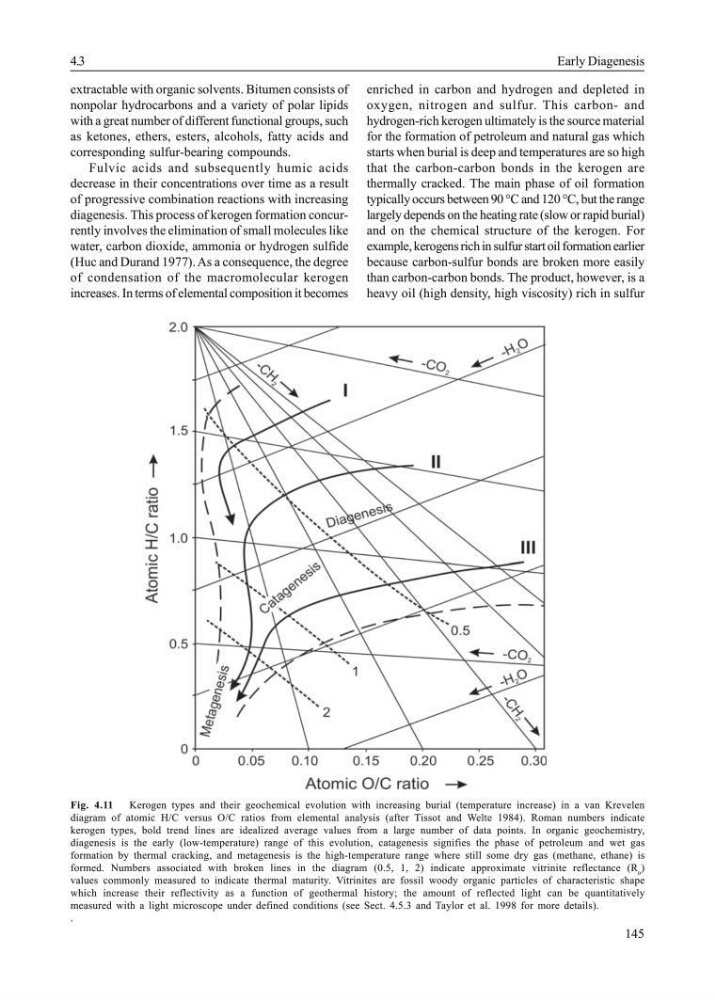
Fig. 4.11
Kerogen types and their geochemical evolution with increasing burial (temperature increase) in a van Krevelen
diagram of atomic H/C versus O/C ratios from elemental analysis (after Tissot and Welte 1984). Roman numbers indicate
kerogen types, bold trend lines are idealized average values from a large number of data points. In organic geochemistry,
diagenesis is the early (low-temperature) range of this evolution, catagenesis signifies the phase of petroleum and wet gas
formation by thermal cracking, and metagenesis is the high-temperature range where still some dry gas (methane, ethane) is
formed. Numbers associated with broken lines in the diagram (0.5, 1, 2) indicate approximate vitrinite reflectance (R o )
values commonly measured to indicate thermal maturity. Vitrinites are fossil woody organic particles of characteristic shape
which increase their reflectivity as a function of geothermal history; the amount of reflected light can be quantitatively
measured with a light microscope under defined conditions (see Sect. 4.5.3 and Taylor et al. 1998 for more details).
.
extractable with organic solvents. Bitumen consists of
nonpolar hydrocarbons and a variety of polar lipids
with a great number of different functional groups, such
as ketones, ethers, esters, alcohols, fatty acids and
corresponding sulfur-bearing compounds.
Fulvic acids and subsequently humic acids
decrease in their concentrations over time as a result
of progressive combination reactions with increasing
diagenesis. This process of kerogen formation concurrently involves the elimination of small molecules like
water, carbon dioxide, ammonia or hydrogen sulfide
(Huc and Durand 1977). As a consequence, the degree
of condensation of the macromolecular kerogen
increases. In terms of elemental composition it becomes
enriched in carbon and hydrogen and depleted in
oxygen, nitrogen and sulfur. This carbon- and
hydrogen-rich kerogen ultimately is the source material
for the formation of petroleum and natural gas which
starts when burial is deep and temperatures are so high
that the carbon-carbon bonds in the kerogen are
thermally cracked. The main phase of oil formation
typically occurs between 90 °C and 120 °C, but the range
largely depends on the heating rate (slow or rapid burial)
and on the chemical structure of the kerogen. For
example, kerogens rich in sulfur start oil formation earlier
because carbon-sulfur bonds are broken more easily
than carbon-carbon bonds. The product, however, is a
heavy oil (high density, high viscosity) rich in sulfur
4.3
Early Diagenesis
Fig. 4.11
Kerogen types and their geochemical evolution with increasing burial (temperature increase) in a van Krevelen
diagram of atomic H/C versus O/C ratios from elemental analysis (after Tissot and Welte 1984). Roman numbers indicate
kerogen types, bold trend lines are idealized average values from a large number of data points. In organic geochemistry,
diagenesis is the early (low-temperature) range of this evolution, catagenesis signifies the phase of petroleum and wet gas
formation by thermal cracking, and metagenesis is the high-temperature range where still some dry gas (methane, ethane) is
formed. Numbers associated with broken lines in the diagram (0.5, 1, 2) indicate approximate vitrinite reflectance (R o )
values commonly measured to indicate thermal maturity. Vitrinites are fossil woody organic particles of characteristic shape
which increase their reflectivity as a function of geothermal history; the amount of reflected light can be quantitatively
measured with a light microscope under defined conditions (see Sect. 4.5.3 and Taylor et al. 1998 for more details).
.