

116
3
Quantification of Early Diagenesis: Dissolved Constituents in Marine Pore Water
observation is sufficiently long, can we
conceive of the bioturbation processes, on
average, as identically effective at all places.
In such cases, a model concept of ‘biodiffusion’ is frequently applied in which Fick’s
laws of diffusion are applied upon introducing an analogous ‘biodiffusion coefficient’. Aller and De Master (1984) reported on
having determined
234
Th and
210
Pb and drew
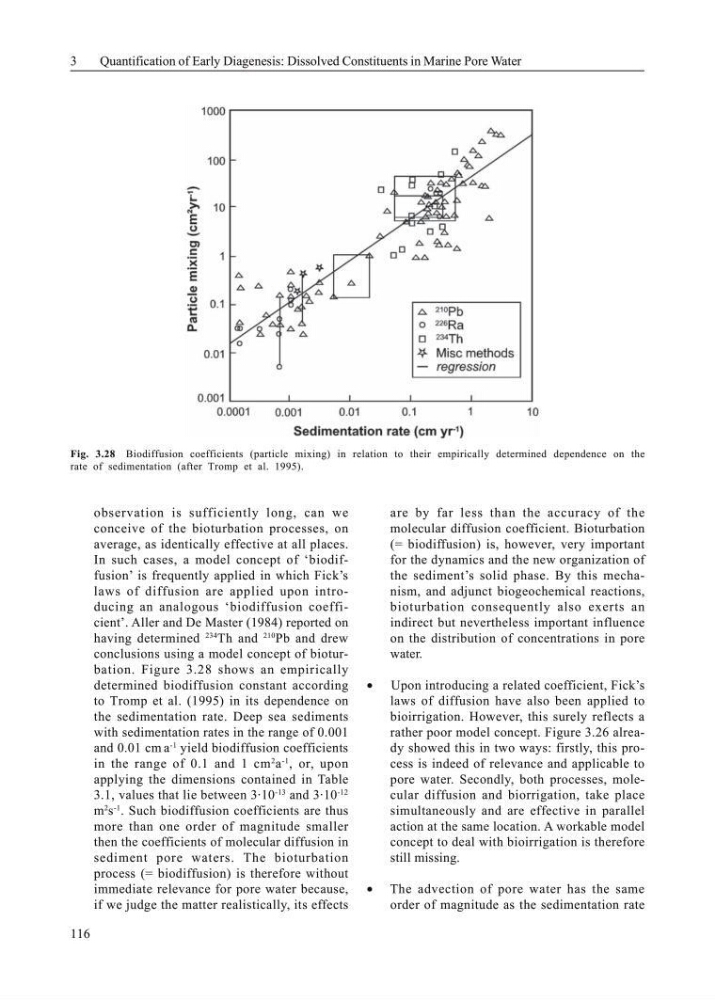
conclusions using a model concept of bioturbation. Figure 3.28 shows an empirically
determined biodiffusion constant according
to Tromp et al. (1995) in its dependence on
the sedimentation rate. Deep sea sediments
with sedimentation rates in the range of 0.001
and 0.01 cm a
-1
yield biodiffusion coefficients
in the range of 0.1 and 1 cm
2
a
-1
, or, upon
applying the dimensions contained in Table
3.1, values that lie between 3·10
-13
and 3·10
-12
m
2
s
-1
. Such biodiffusion coefficients are thus
more than one order of magnitude smaller
then the coefficients of molecular diffusion in
sediment pore waters. The bioturbation
process (= biodiffusion) is therefore without
immediate relevance for pore water because,
if we judge the matter realistically, its effects
are by far less than the accuracy of the
molecular diffusion coefficient. Bioturbation
(= biodiffusion) is, however, very important
for the dynamics and the new organization of
the sediment’s solid phase. By this mechanism, and adjunct biogeochemical reactions,
bioturbation consequently also exerts an
indirect but nevertheless important influence
on the distribution of concentrations in pore
water.
• Upon introducing a related coefficient, Fick’s
laws of diffusion have also been applied to
bioirrigation. However, this surely reflects a
rather poor model concept. Figure 3.26 already showed this in two ways: firstly, this process is indeed of relevance and applicable to
pore water. Secondly, both processes, molecular diffusion and biorrigation, take place
simultaneously and are effective in parallel
action at the same location. A workable model
concept to deal with bioirrigation is therefore
still missing.
• The advection of pore water has the same
order of magnitude as the sedimentation rate
Fig. 3.28 Biodiffusion coefficients (particle mixing) in relation to their empirically determined dependence on the
rate of sedimentation (after Tromp et al. 1995).
3
Quantification of Early Diagenesis: Dissolved Constituents in Marine Pore Water
observation is sufficiently long, can we
conceive of the bioturbation processes, on
average, as identically effective at all places.
In such cases, a model concept of ‘biodiffusion’ is frequently applied in which Fick’s
laws of diffusion are applied upon introducing an analogous ‘biodiffusion coefficient’. Aller and De Master (1984) reported on
having determined
234
Th and
210
Pb and drew
conclusions using a model concept of bioturbation. Figure 3.28 shows an empirically
determined biodiffusion constant according
to Tromp et al. (1995) in its dependence on
the sedimentation rate. Deep sea sediments
with sedimentation rates in the range of 0.001
and 0.01 cm a
-1
yield biodiffusion coefficients
in the range of 0.1 and 1 cm
2
a
-1
, or, upon
applying the dimensions contained in Table
3.1, values that lie between 3·10
-13
and 3·10
-12
m
2
s
-1
. Such biodiffusion coefficients are thus
more than one order of magnitude smaller
then the coefficients of molecular diffusion in
sediment pore waters. The bioturbation
process (= biodiffusion) is therefore without
immediate relevance for pore water because,
if we judge the matter realistically, its effects
are by far less than the accuracy of the
molecular diffusion coefficient. Bioturbation
(= biodiffusion) is, however, very important
for the dynamics and the new organization of
the sediment’s solid phase. By this mechanism, and adjunct biogeochemical reactions,
bioturbation consequently also exerts an
indirect but nevertheless important influence
on the distribution of concentrations in pore
water.
• Upon introducing a related coefficient, Fick’s
laws of diffusion have also been applied to
bioirrigation. However, this surely reflects a
rather poor model concept. Figure 3.26 already showed this in two ways: firstly, this process is indeed of relevance and applicable to
pore water. Secondly, both processes, molecular diffusion and biorrigation, take place
simultaneously and are effective in parallel
action at the same location. A workable model
concept to deal with bioirrigation is therefore
still missing.
• The advection of pore water has the same
order of magnitude as the sedimentation rate
Fig. 3.28 Biodiffusion coefficients (particle mixing) in relation to their empirically determined dependence on the
rate of sedimentation (after Tromp et al. 1995).