

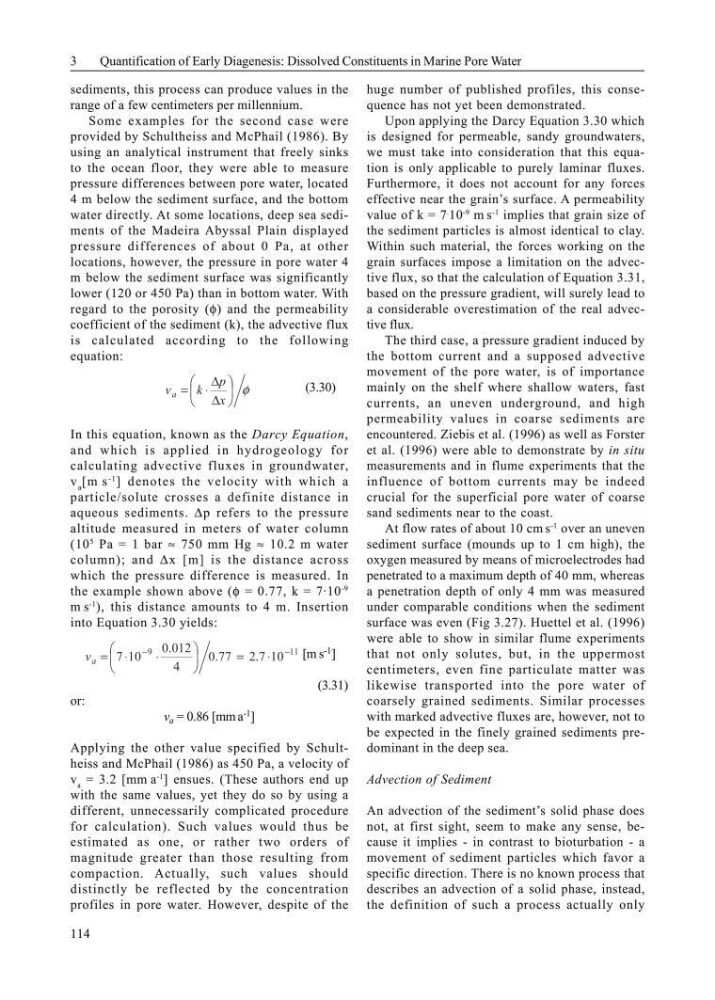
114
3
Quantification of Early Diagenesis: Dissolved Constituents in Marine Pore Water
sediments, this process can produce values in the
range of a few centimeters per millennium.
Some examples for the second case were
provided by Schultheiss and McPhail (1986). By
using an analytical instrument that freely sinks
to the ocean floor, they were able to measure
pressure differences between pore water, located
4 m below the sediment surface, and the bottom
water directly. At some locations, deep sea sediments of the Madeira Abyssal Plain displayed
pressure differences of about 0 Pa, at other
locations, however, the pressure in pore water 4
m below the sediment surface was significantly
lower (120 or 450 Pa) than in bottom water. With
regard to the porosity (φ) and the permeability
coefficient of the sediment (k), the advective flux
is calculated according to the following
equation:
φ
⎟
⎠
⎞
⎜
⎝
⎛
∆
∆
⋅
=
x
p
k
v a
(3.30)
In this equation, known as the Darcy Equation,
and which is applied in hydrogeology for
calculating advective fluxes in groundwater,
v a [m s
-1
] denotes the velocity with which a
particle/solute crosses a definite distance in
aqueous sediments. ∆p refers to the pressure
altitude measured in meters of water column
(10
5
Pa = 1 bar ≈ 750 mm Hg ≈ 10.2 m water
column); and ∆x [m] is the distance across
which the pressure difference is measured. In
the example shown above (φ = 0.77, k = 7·10
-9
m s
-1
), this distance amounts to 4 m. Insertion
into Equation 3.30 yields:
11
9
10
7
.
2
77
.
0
4
012
.
0
10
7
−
−
⋅
=
⎟
⎠
⎞
⎜
⎝
⎛
⋅
⋅
=
a
v
[m s -1 ]
(3.31)
or:
v a = 0.86 [mm a -1 ]
Applying the other value specified by Schultheiss and McPhail (1986) as 450 Pa, a velocity of
v a = 3.2 [mm a
-1
] ensues. (These authors end up
with the same values, yet they do so by using a
different, unnecessarily complicated procedure
for calculation). Such values would thus be
estimated as one, or rather two orders of
magnitude greater than those resulting from
compaction. Actually, such values should
distinctly be reflected by the concentration
profiles in pore water. However, despite of the
huge number of published profiles, this consequence has not yet been demonstrated.
Upon applying the Darcy Equation 3.30 which
is designed for permeable, sandy groundwaters,
we must take into consideration that this equation is only applicable to purely laminar fluxes.
Furthermore, it does not account for any forces
effective near the grain’s surface. A permeability
value of k = 7
.
10
-9
m s
-1
implies that grain size of
the sediment particles is almost identical to clay.
Within such material, the forces working on the
grain surfaces impose a limitation on the advective flux, so that the calculation of Equation 3.31,
based on the pressure gradient, will surely lead to
a considerable overestimation of the real advective flux.
The third case, a pressure gradient induced by
the bottom current and a supposed advective
movement of the pore water, is of importance
mainly on the shelf where shallow waters, fast
currents, an uneven underground, and high
permeability values in coarse sediments are
encountered. Ziebis et al. (1996) as well as Forster
et al. (1996) were able to demonstrate by in situ
measurements and in flume experiments that the
influence of bottom currents may be indeed
crucial for the superficial pore water of coarse
sand sediments near to the coast.
At flow rates of about 10 cm s
-1
over an uneven
sediment surface (mounds up to 1 cm high), the
oxygen measured by means of microelectrodes had
penetrated to a maximum depth of 40 mm, whereas
a penetration depth of only 4 mm was measured
under comparable conditions when the sediment
surface was even (Fig 3.27). Huettel et al. (1996)
were able to show in similar flume experiments
that not only solutes, but, in the uppermost
centimeters, even fine particulate matter was
likewise transported into the pore water of
coarsely grained sediments. Similar processes
with marked advective fluxes are, however, not to
be expected in the finely grained sediments predominant in the deep sea.
Advection of Sediment
An advection of the sediment’s solid phase does
not, at first sight, seem to make any sense, because it implies - in contrast to bioturbation - a
movement of sediment particles which favor a
specific direction. There is no known process that
describes an advection of a solid phase, instead,
the definition of such a process actually only
3
Quantification of Early Diagenesis: Dissolved Constituents in Marine Pore Water
sediments, this process can produce values in the
range of a few centimeters per millennium.
Some examples for the second case were
provided by Schultheiss and McPhail (1986). By
using an analytical instrument that freely sinks
to the ocean floor, they were able to measure
pressure differences between pore water, located
4 m below the sediment surface, and the bottom
water directly. At some locations, deep sea sediments of the Madeira Abyssal Plain displayed
pressure differences of about 0 Pa, at other
locations, however, the pressure in pore water 4
m below the sediment surface was significantly
lower (120 or 450 Pa) than in bottom water. With
regard to the porosity (φ) and the permeability
coefficient of the sediment (k), the advective flux
is calculated according to the following
equation:
φ
⎟
⎠
⎞
⎜
⎝
⎛
∆
∆
⋅
=
x
p
k
v a
(3.30)
In this equation, known as the Darcy Equation,
and which is applied in hydrogeology for
calculating advective fluxes in groundwater,
v a [m s
-1
] denotes the velocity with which a
particle/solute crosses a definite distance in
aqueous sediments. ∆p refers to the pressure
altitude measured in meters of water column
(10
5
Pa = 1 bar ≈ 750 mm Hg ≈ 10.2 m water
column); and ∆x [m] is the distance across
which the pressure difference is measured. In
the example shown above (φ = 0.77, k = 7·10
-9
m s
-1
), this distance amounts to 4 m. Insertion
into Equation 3.30 yields:
11
9
10
7
.
2
77
.
0
4
012
.
0
10
7
−
−
⋅
=
⎟
⎠
⎞
⎜
⎝
⎛
⋅
⋅
=
a
v
[m s -1 ]
(3.31)
or:
v a = 0.86 [mm a -1 ]
Applying the other value specified by Schultheiss and McPhail (1986) as 450 Pa, a velocity of
v a = 3.2 [mm a
-1
] ensues. (These authors end up
with the same values, yet they do so by using a
different, unnecessarily complicated procedure
for calculation). Such values would thus be
estimated as one, or rather two orders of
magnitude greater than those resulting from
compaction. Actually, such values should
distinctly be reflected by the concentration
profiles in pore water. However, despite of the
huge number of published profiles, this consequence has not yet been demonstrated.
Upon applying the Darcy Equation 3.30 which
is designed for permeable, sandy groundwaters,
we must take into consideration that this equation is only applicable to purely laminar fluxes.
Furthermore, it does not account for any forces
effective near the grain’s surface. A permeability
value of k = 7
.
10
-9
m s
-1
implies that grain size of
the sediment particles is almost identical to clay.
Within such material, the forces working on the
grain surfaces impose a limitation on the advective flux, so that the calculation of Equation 3.31,
based on the pressure gradient, will surely lead to
a considerable overestimation of the real advective flux.
The third case, a pressure gradient induced by
the bottom current and a supposed advective
movement of the pore water, is of importance
mainly on the shelf where shallow waters, fast
currents, an uneven underground, and high
permeability values in coarse sediments are
encountered. Ziebis et al. (1996) as well as Forster
et al. (1996) were able to demonstrate by in situ
measurements and in flume experiments that the
influence of bottom currents may be indeed
crucial for the superficial pore water of coarse
sand sediments near to the coast.
At flow rates of about 10 cm s
-1
over an uneven
sediment surface (mounds up to 1 cm high), the
oxygen measured by means of microelectrodes had
penetrated to a maximum depth of 40 mm, whereas
a penetration depth of only 4 mm was measured
under comparable conditions when the sediment
surface was even (Fig 3.27). Huettel et al. (1996)
were able to show in similar flume experiments
that not only solutes, but, in the uppermost
centimeters, even fine particulate matter was
likewise transported into the pore water of
coarsely grained sediments. Similar processes
with marked advective fluxes are, however, not to
be expected in the finely grained sediments predominant in the deep sea.
Advection of Sediment
An advection of the sediment’s solid phase does
not, at first sight, seem to make any sense, because it implies - in contrast to bioturbation - a
movement of sediment particles which favor a
specific direction. There is no known process that
describes an advection of a solid phase, instead,
the definition of such a process actually only