

100
3
Quantification of Early Diagenesis: Dissolved Constituents in Marine Pore Water
taneously filtered through the 0.1µm wide pores,
permitting its analysis without further treatment.
Seeberg-Elverfeldt et al. (2005) applied rhizons
for the first time in marine environments and
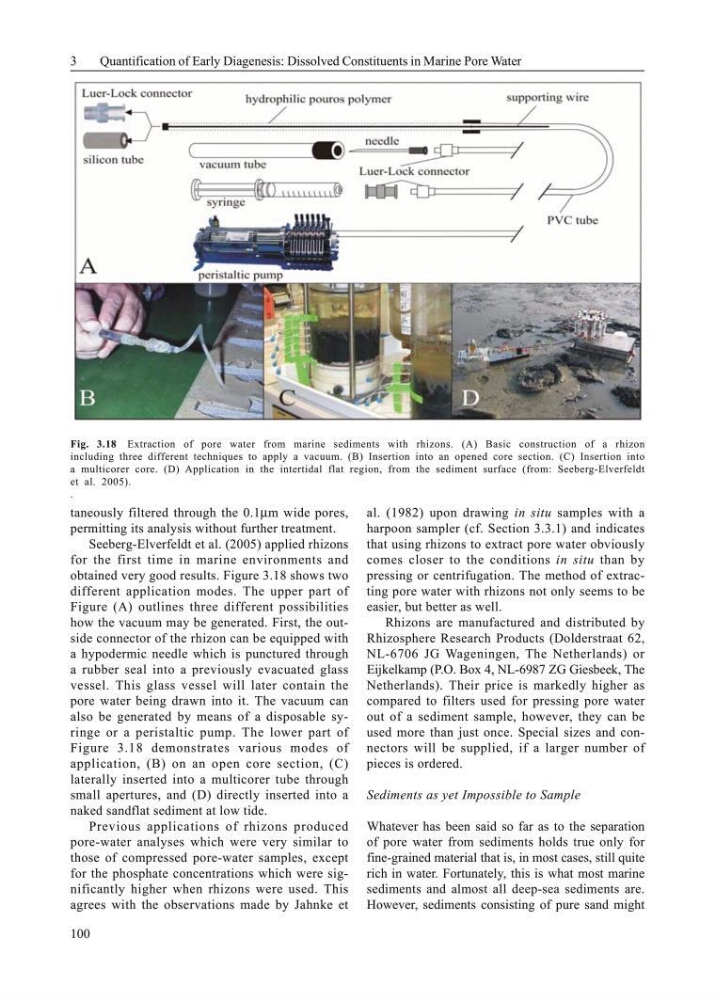
obtained very good results. Figure 3.18 shows two
different application modes. The upper part of
Figure (A) outlines three different possibilities
how the vacuum may be generated. First, the outside connector of the rhizon can be equipped with
a hypodermic needle which is punctured through
a rubber seal into a previously evacuated glass
vessel. This glass vessel will later contain the
pore water being drawn into it. The vacuum can
also be generated by means of a disposable syringe or a peristaltic pump. The lower part of
Figure 3.18 demonstrates various modes of
application, (B) on an open core section, (C)
laterally inserted into a multicorer tube through
small apertures, and (D) directly inserted into a
naked sandflat sediment at low tide.
Previous applications of rhizons produced
pore-water analyses which were very similar to
those of compressed pore-water samples, except
for the phosphate concentrations which were significantly higher when rhizons were used. This
agrees with the observations made by Jahnke et
al. (1982) upon drawing in situ samples with a
harpoon sampler (cf. Section 3.3.1) and indicates
that using rhizons to extract pore water obviously
comes closer to the conditions in situ than by
pressing or centrifugation. The method of extracting pore water with rhizons not only seems to be
easier, but better as well.
Rhizons are manufactured and distributed by
Rhizosphere Research Products (Dolderstraat 62,
NL-6706 JG Wageningen, The Netherlands) or
Eijkelkamp (P.O. Box 4, NL-6987 ZG Giesbeek, The
Netherlands). Their price is markedly higher as
compared to filters used for pressing pore water
out of a sediment sample, however, they can be
used more than just once. Special sizes and connectors will be supplied, if a larger number of
pieces is ordered.
Sediments as yet Impossible to Sample
Whatever has been said so far as to the separation
of pore water from sediments holds true only for
fine-grained material that is, in most cases, still quite
rich in water. Fortunately, this is what most marine
sediments and almost all deep-sea sediments are.
However, sediments consisting of pure sand might
Fig. 3.18 Extraction of pore water from marine sediments with rhizons. (A) Basic construction of a rhizon
including three different techniques to apply a vacuum. (B) Insertion into an opened core section. (C) Insertion into
a multicorer core. (D) Application in the intertidal flat region, from the sediment surface (from: Seeberg-Elverfeldt
et al. 2005).
.
3
Quantification of Early Diagenesis: Dissolved Constituents in Marine Pore Water
taneously filtered through the 0.1µm wide pores,
permitting its analysis without further treatment.
Seeberg-Elverfeldt et al. (2005) applied rhizons
for the first time in marine environments and
obtained very good results. Figure 3.18 shows two
different application modes. The upper part of
Figure (A) outlines three different possibilities
how the vacuum may be generated. First, the outside connector of the rhizon can be equipped with
a hypodermic needle which is punctured through
a rubber seal into a previously evacuated glass
vessel. This glass vessel will later contain the
pore water being drawn into it. The vacuum can
also be generated by means of a disposable syringe or a peristaltic pump. The lower part of
Figure 3.18 demonstrates various modes of
application, (B) on an open core section, (C)
laterally inserted into a multicorer tube through
small apertures, and (D) directly inserted into a
naked sandflat sediment at low tide.
Previous applications of rhizons produced
pore-water analyses which were very similar to
those of compressed pore-water samples, except
for the phosphate concentrations which were significantly higher when rhizons were used. This
agrees with the observations made by Jahnke et
al. (1982) upon drawing in situ samples with a
harpoon sampler (cf. Section 3.3.1) and indicates
that using rhizons to extract pore water obviously
comes closer to the conditions in situ than by
pressing or centrifugation. The method of extracting pore water with rhizons not only seems to be
easier, but better as well.
Rhizons are manufactured and distributed by
Rhizosphere Research Products (Dolderstraat 62,
NL-6706 JG Wageningen, The Netherlands) or
Eijkelkamp (P.O. Box 4, NL-6987 ZG Giesbeek, The
Netherlands). Their price is markedly higher as
compared to filters used for pressing pore water
out of a sediment sample, however, they can be
used more than just once. Special sizes and connectors will be supplied, if a larger number of
pieces is ordered.
Sediments as yet Impossible to Sample
Whatever has been said so far as to the separation
of pore water from sediments holds true only for
fine-grained material that is, in most cases, still quite
rich in water. Fortunately, this is what most marine
sediments and almost all deep-sea sediments are.
However, sediments consisting of pure sand might
Fig. 3.18 Extraction of pore water from marine sediments with rhizons. (A) Basic construction of a rhizon
including three different techniques to apply a vacuum. (B) Insertion into an opened core section. (C) Insertion into
a multicorer core. (D) Application in the intertidal flat region, from the sediment surface (from: Seeberg-Elverfeldt
et al. 2005).
.