

b 31.5(%.)
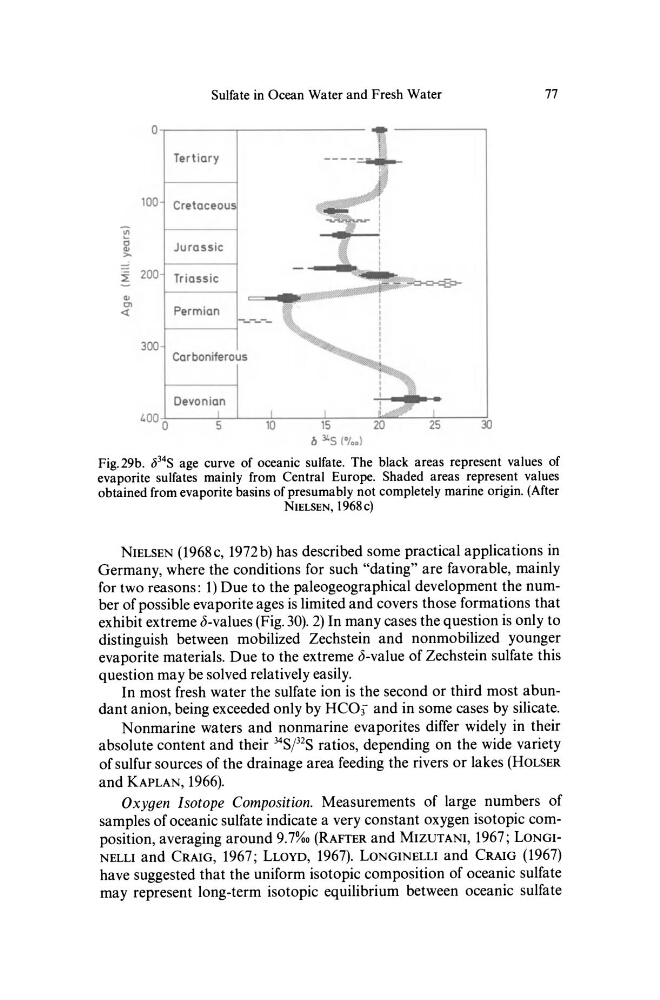
Fig. 29b. 0 34 S age curve of oceanic sulfate. The black areas represent values of
evaporite sulfates mainly from Central Europe. Shaded areas represent values
obtained from evaporite basins of presumably not completely marine origin. (After
NIELSEN, \968c)
NIELSEN (1968 c, 1972 b) has described some practical applications in
Germany, where the conditions for such "dating" are favorable, mainly
for two reasons: 1) Due to the paleogeographical development the number of possible evaporite ages is limited and covers those formations that
exhibit extreme o-values (Fig. 30).2) In many cases the question is only to
distinguish between mobilized Zechstein and nonmobilized younger
evaporite materials. Due to the extreme o-value of Zechstein sulfate this
question may be solved relatively easily.
In most fresh water the sulfate ion is the second or third most abundant anion, being exceeded only by HCO) and in some cases by silicate.
Nonmarine waters and nonmarine evaporites differ widely in their
absolute content and their 34SP2S ratios, depending on the wide variety
of sulfur sources of the drainage area feeding the rivers or lakes (HOLSER
and KAPLAN, 1966).
Oxygen Isotope Composition. Measurements of large numbers of
samples of oceanic sulfate indicate a very constant oxygen isotopic composition, averaging around 9.7%0 (RAFTER and MIZUTANI, 1967; LONGINELLI and CRAIG, 1967; LLOYD, 1967). LONGINELLI and CRAIG (1967)
have suggested that the uniform isotopic composition of oceanic sulfate
may represent long-term isotopic equilibrium between oceanic sulfate
Fig. 29b. 0 34 S age curve of oceanic sulfate. The black areas represent values of
evaporite sulfates mainly from Central Europe. Shaded areas represent values
obtained from evaporite basins of presumably not completely marine origin. (After
NIELSEN, \968c)
NIELSEN (1968 c, 1972 b) has described some practical applications in
Germany, where the conditions for such "dating" are favorable, mainly
for two reasons: 1) Due to the paleogeographical development the number of possible evaporite ages is limited and covers those formations that
exhibit extreme o-values (Fig. 30).2) In many cases the question is only to
distinguish between mobilized Zechstein and nonmobilized younger
evaporite materials. Due to the extreme o-value of Zechstein sulfate this
question may be solved relatively easily.
In most fresh water the sulfate ion is the second or third most abundant anion, being exceeded only by HCO) and in some cases by silicate.
Nonmarine waters and nonmarine evaporites differ widely in their
absolute content and their 34SP2S ratios, depending on the wide variety
of sulfur sources of the drainage area feeding the rivers or lakes (HOLSER
and KAPLAN, 1966).
Oxygen Isotope Composition. Measurements of large numbers of
samples of oceanic sulfate indicate a very constant oxygen isotopic composition, averaging around 9.7%0 (RAFTER and MIZUTANI, 1967; LONGINELLI and CRAIG, 1967; LLOYD, 1967). LONGINELLI and CRAIG (1967)
have suggested that the uniform isotopic composition of oceanic sulfate
may represent long-term isotopic equilibrium between oceanic sulfate