

-.
~
0
00
72
C. Variations of Stable Isotope Ratios in Nature
100r-------------------------------------------------~
o
-100
-200
-300
-50
(%.)
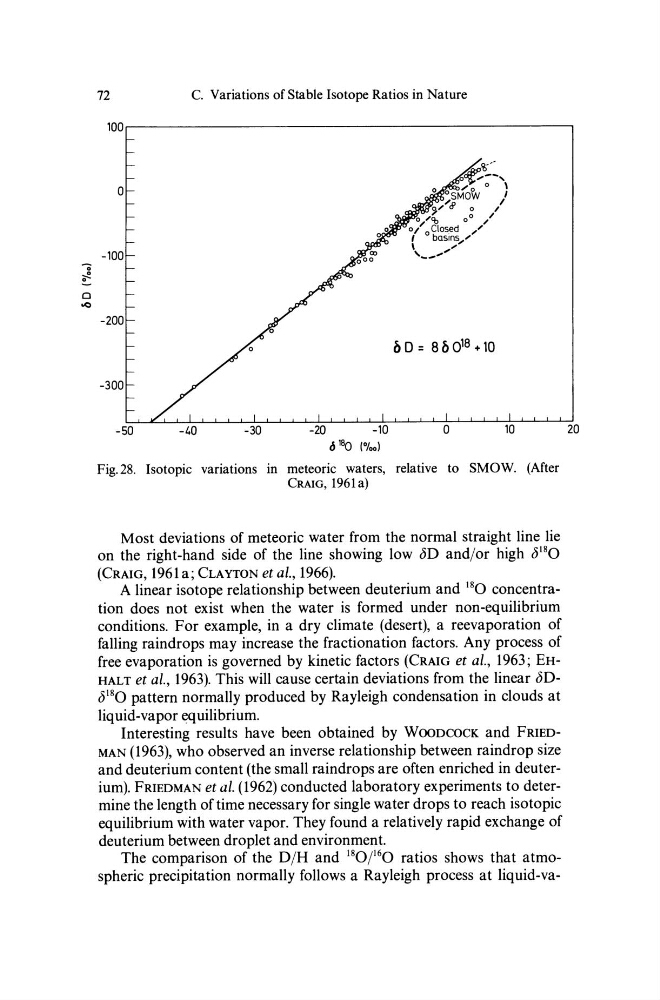
Fig. 28. Isotopic variations in meteoric waters, relative to SMOW. (After
CRAIG, 1961 a)
Most deviations of meteoric water from the normal straight line lie
on the right-hand side of the line showing low <5D and/or high <5 18 0
(CRAIG, 1961a; CLAYTON et al., 1966).
A linear isotope relationship between deuterium and 18 0 concentration does not exist when the water is formed under non-equilibrium
conditions. For example, in a dry climate (desert), a reevaporation of
falling raindrops may increase the fractionation factors. Any process of
free evaporation is governed by kinetic factors (CRAIG et aI., 1963; EHHALT et aI., 1963). This will cause certain deviations from the linear <5D<5 18 0 pattern normally produced by Rayleigh condensation in clouds at
liquid-vapor equilibrium.
Interesting results have been obtained by WOODCOCK and FRIEDMAN (1963), who observed an inverse relationship between raindrop size
and deuterium content (the small raindrops are often enriched in deuterium). FRIEDMAN et al. (1962) conducted laboratory experiments to determine the length of time necessary for single water drops to reach isotopic
equilibrium with water vapor. They found a relatively rapid exchange of
deuterium between droplet and environment.
The comparison of the D/H and 180j160 ratios shows that atmospheric precipitation normally follows a Rayleigh process at liquid-va20
~
0
00
72
C. Variations of Stable Isotope Ratios in Nature
100r-------------------------------------------------~
o
-100
-200
-300
-50
(%.)
Fig. 28. Isotopic variations in meteoric waters, relative to SMOW. (After
CRAIG, 1961 a)
Most deviations of meteoric water from the normal straight line lie
on the right-hand side of the line showing low <5D and/or high <5 18 0
(CRAIG, 1961a; CLAYTON et al., 1966).
A linear isotope relationship between deuterium and 18 0 concentration does not exist when the water is formed under non-equilibrium
conditions. For example, in a dry climate (desert), a reevaporation of
falling raindrops may increase the fractionation factors. Any process of
free evaporation is governed by kinetic factors (CRAIG et aI., 1963; EHHALT et aI., 1963). This will cause certain deviations from the linear <5D<5 18 0 pattern normally produced by Rayleigh condensation in clouds at
liquid-vapor equilibrium.
Interesting results have been obtained by WOODCOCK and FRIEDMAN (1963), who observed an inverse relationship between raindrop size
and deuterium content (the small raindrops are often enriched in deuterium). FRIEDMAN et al. (1962) conducted laboratory experiments to determine the length of time necessary for single water drops to reach isotopic
equilibrium with water vapor. They found a relatively rapid exchange of
deuterium between droplet and environment.
The comparison of the D/H and 180j160 ratios shows that atmospheric precipitation normally follows a Rayleigh process at liquid-va20