

64
C. Variations of Stable Isotope Ratios in Nature
, Th_e,r_m_arl_W,a_te_r,l_~,e_llO_W,s_t,on_e~p~ar~k~~,--.~ __ ~!-,~1'0:
~~V4A,
• ..1.1]
i
I
i
:
Thermal water l New Zealand
:
I.LJ ; 10
iii CH4
:
5
" - ' __ '60~ __ co,2 __ '50' __ '-~~L-r--~~~,~mL,'~A~' __ '~ i
0
-70
-40
-30
-20
-10
0
b 13e (0'001
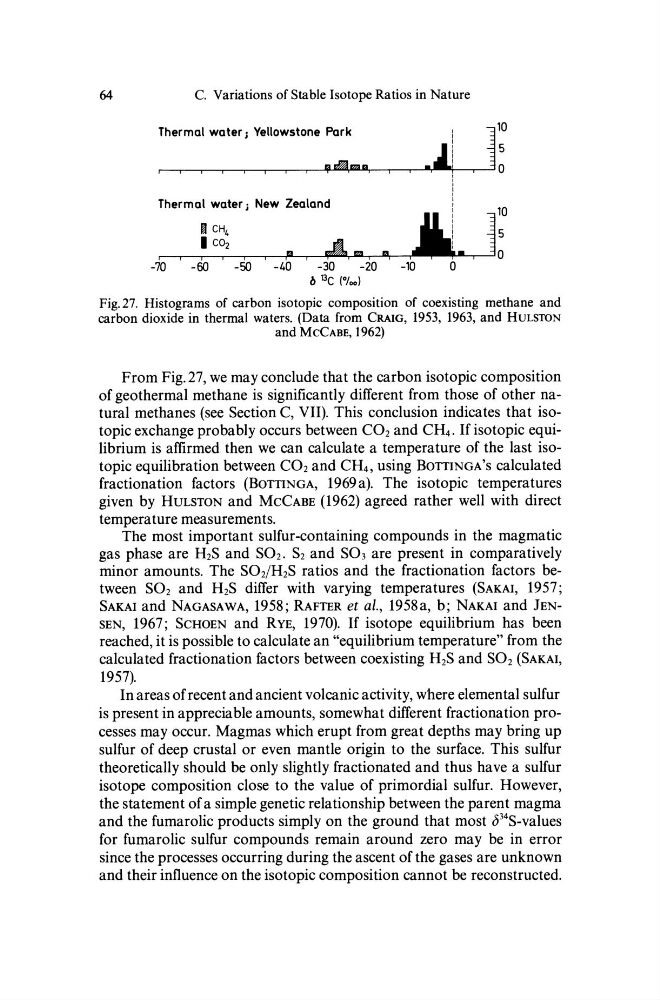
Fig. 27. Histograms of carbon isotopic composition of coexisting methane and
carbon dioxide in thermal waters. (Data from CRAIG, 1953, 1963, and HULSTON
and MCCABE, 1962)
From Fig. 27, we may conclude that the carbon isotopic composition
of geothermal methane is significantly different from those of other natural methanes (see Section C, VII). This conclusion indicates that isotopic exchange probably occurs between CO2 and CH4. If isotopic equilibrium is affirmed then we can calculate a temperature of the last isotopic equilibration between CO2 and CH4, using BOTTINGA'S calculated
fractionation factors (BOTTINGA, 1969 a). The isotopic temperatures
given by HULSTON and MCCABE (1962) agreed rather well with direct
temperature measurements.
The most important sulfur-containing compounds in the magmatic
gas phase are H2S and S02. S2 and S03 are present in comparatively
minor amounts. The S02/H2S ratios and the fractionation factors between S02 and H2S differ with varying temperatures (SAKAI, 1957;
SAKAI and NAGASAWA, 1958; RAFTER et al., 1958a, b; NAKAI and JENSEN, 1967; SCHOEN and RYE, 1970). If isotope equilibrium has been
reached, it is possible to calculate an "equilibrium temperature" from the
calculated fractionation factors between coexisting H2S and S02 (SAKAI,
1957).
In areas of recent and ancient volcanic activity, where elemental sulfur
is present in appreciable amounts, somewhat different fractionation processes may occur. Magmas which erupt from great depths may bring up
sulfur of deep crustal or even mantle origin to the surface. This sulfur
theoretically should be only slightly fractionated and thus have a sulfur
isotope composition close to the value of primordial sulfur. However,
the statement of a simple genetic relationship between the parent magma
and the fumarolic products simply on the ground that most !5 34 S-values
for fumarolic sulfur compounds remain around zero may be in error
since the processes occurring during the ascent of the gases are unknown
and their influence on the isotopic composition cannot be reconstructed.
C. Variations of Stable Isotope Ratios in Nature
, Th_e,r_m_arl_W,a_te_r,l_~,e_llO_W,s_t,on_e~p~ar~k~~,--.~ __ ~!-,~1'0:
~~V4A,
• ..1.1]
i
I
i
:
Thermal water l New Zealand
:
I.LJ ; 10
iii CH4
:
5
" - ' __ '60~ __ co,2 __ '50' __ '-~~L-r--~~~,~mL,'~A~' __ '~ i
0
-70
-40
-30
-20
-10
0
b 13e (0'001
Fig. 27. Histograms of carbon isotopic composition of coexisting methane and
carbon dioxide in thermal waters. (Data from CRAIG, 1953, 1963, and HULSTON
and MCCABE, 1962)
From Fig. 27, we may conclude that the carbon isotopic composition
of geothermal methane is significantly different from those of other natural methanes (see Section C, VII). This conclusion indicates that isotopic exchange probably occurs between CO2 and CH4. If isotopic equilibrium is affirmed then we can calculate a temperature of the last isotopic equilibration between CO2 and CH4, using BOTTINGA'S calculated
fractionation factors (BOTTINGA, 1969 a). The isotopic temperatures
given by HULSTON and MCCABE (1962) agreed rather well with direct
temperature measurements.
The most important sulfur-containing compounds in the magmatic
gas phase are H2S and S02. S2 and S03 are present in comparatively
minor amounts. The S02/H2S ratios and the fractionation factors between S02 and H2S differ with varying temperatures (SAKAI, 1957;
SAKAI and NAGASAWA, 1958; RAFTER et al., 1958a, b; NAKAI and JENSEN, 1967; SCHOEN and RYE, 1970). If isotope equilibrium has been
reached, it is possible to calculate an "equilibrium temperature" from the
calculated fractionation factors between coexisting H2S and S02 (SAKAI,
1957).
In areas of recent and ancient volcanic activity, where elemental sulfur
is present in appreciable amounts, somewhat different fractionation processes may occur. Magmas which erupt from great depths may bring up
sulfur of deep crustal or even mantle origin to the surface. This sulfur
theoretically should be only slightly fractionated and thus have a sulfur
isotope composition close to the value of primordial sulfur. However,
the statement of a simple genetic relationship between the parent magma
and the fumarolic products simply on the ground that most !5 34 S-values
for fumarolic sulfur compounds remain around zero may be in error
since the processes occurring during the ascent of the gases are unknown
and their influence on the isotopic composition cannot be reconstructed.