

Igneous Rocks
57
Such relationships are explained if post-crystallization oxygen exchange
had occurred between the mineral assemblage and a H20-rich fluid
phase, with the feldspar undergoing exchange more easily than the coexisting quartz or pyroxene. Typical examples of oxygen-isotope exchange
are the feldspars in red-rock granophyres, which are therefore not suitable for the search of oxygen-isotope changes that occur as a result of
fractional crystallization in gabbro-granophyre complexes.
Oxygen-isotope variations can accompany magmatic differentiation.
For example, the sequence of crystallization of minerals will influence
the oxygen-isotope composition in the melt phase. It is logical that early
crystallization of magnetite (a low- 18 0 mineral) should enrich the melt in
18 0, whereas early crystallization of quartz will deplete the melt in 18 0.
During the last stages of crystallization 18 0/ 6 0 ratios may be different
from the major portion of the igneous body. Good examples for such a
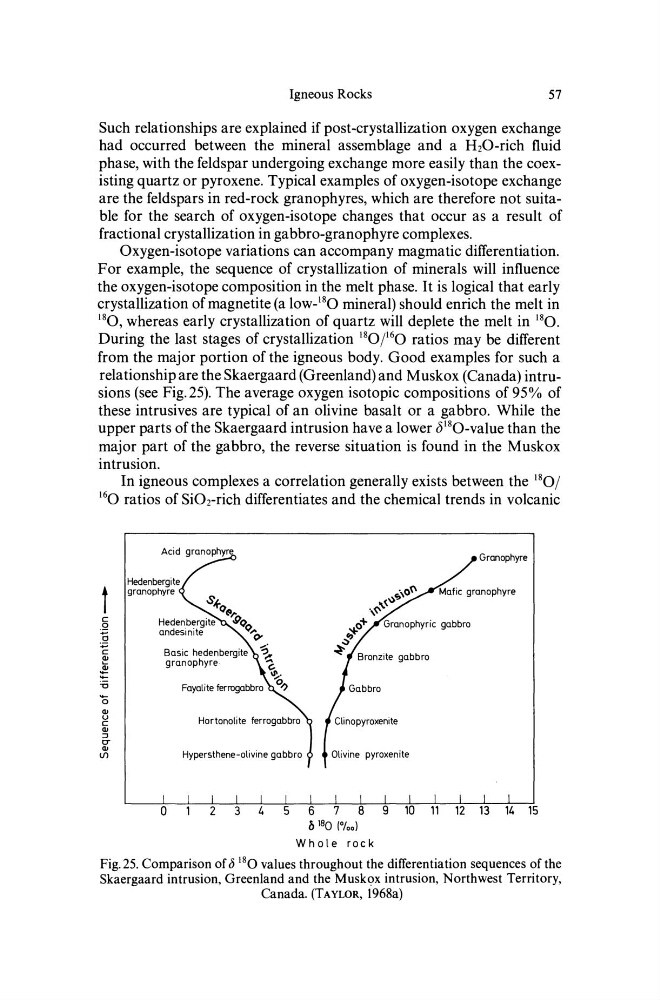
relationship are the Skaergaard (Greenland) and Muskox (Canada) intrusions (see Fig. 25). The average oxygen isotopic compositions of 95% of
these intrusives are typical of an olivine basalt or a gabbro. While the
upper parts of the Skaergaard intrusion have a lower b l8 0-value than the
major part of the gabbro, the reverse situation is found in the Muskox
intrusion.
In igneous complexes a correlation generally exists between the 18 0/
16 0 ratios of Si02-rich differentiates and the chemical trends in volcanic
t c
.Q
"0
~
CIJ
£
"tJ
'0
CIJ
u
c
CIJ
::J
cr
CIJ
(f)
Hedenbergite
granophyre
Hypersthene-olivine gabbro
b 180 (0/00)
Whole rock
Granophyre
Fig. 25. Comparison of b 18 0 values throughout the differentiation sequences of the
Skaergaard intrusion, Greenland and the Muskox intrusion, Northwest Territory,
Canada. (TAYLOR, 1968a)
57
Such relationships are explained if post-crystallization oxygen exchange
had occurred between the mineral assemblage and a H20-rich fluid
phase, with the feldspar undergoing exchange more easily than the coexisting quartz or pyroxene. Typical examples of oxygen-isotope exchange
are the feldspars in red-rock granophyres, which are therefore not suitable for the search of oxygen-isotope changes that occur as a result of
fractional crystallization in gabbro-granophyre complexes.
Oxygen-isotope variations can accompany magmatic differentiation.
For example, the sequence of crystallization of minerals will influence
the oxygen-isotope composition in the melt phase. It is logical that early
crystallization of magnetite (a low- 18 0 mineral) should enrich the melt in
18 0, whereas early crystallization of quartz will deplete the melt in 18 0.
During the last stages of crystallization 18 0/ 6 0 ratios may be different
from the major portion of the igneous body. Good examples for such a
relationship are the Skaergaard (Greenland) and Muskox (Canada) intrusions (see Fig. 25). The average oxygen isotopic compositions of 95% of
these intrusives are typical of an olivine basalt or a gabbro. While the
upper parts of the Skaergaard intrusion have a lower b l8 0-value than the
major part of the gabbro, the reverse situation is found in the Muskox
intrusion.
In igneous complexes a correlation generally exists between the 18 0/
16 0 ratios of Si02-rich differentiates and the chemical trends in volcanic
t c
.Q
"0
~
CIJ
£
"tJ
'0
CIJ
u
c
CIJ
::J
cr
CIJ
(f)
Hedenbergite
granophyre
Hypersthene-olivine gabbro
b 180 (0/00)
Whole rock
Granophyre
Fig. 25. Comparison of b 18 0 values throughout the differentiation sequences of the
Skaergaard intrusion, Greenland and the Muskox intrusion, Northwest Territory,
Canada. (TAYLOR, 1968a)