

-5
Igneous Rocks
..... Ultramafic rocks
I--0oI Basalts, gabbros, andesites
trachites, syenites
~-----... Granitic rocks
10---. . . 1 Rhyolites and dacites
Rocks in the Skaergaard and Scottish Tertiary intrusions
1
1
o
5
10
15
b 18 0 (relative to SMOW)
53
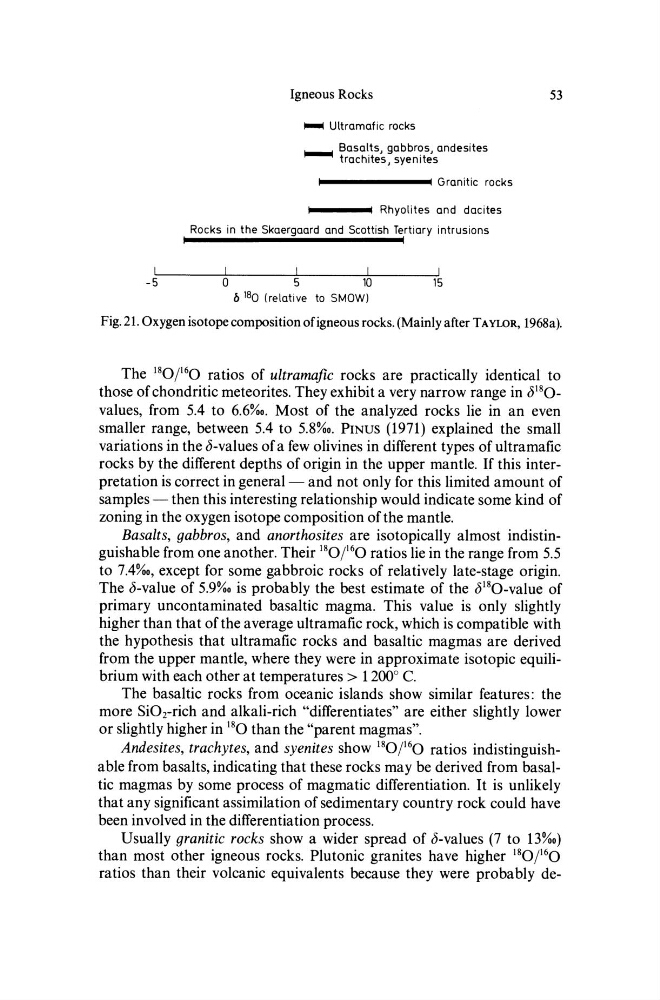
Fig. 21. Ox ygen isotope composi tion of igneous rocks. (Mainly after T A YWR, 1968a).
The 180rO ratios of ultramafic rocks are practically identical to
those of chondritic meteorites. They exhibit a very narrow range in J I8 0_
values, from 5.4 to 6.6%0. Most of the analyzed rocks lie in an even
smaller range, between 5.4 to 5.8%0. PINUS (1971) explained the small
variations in the J-values of a few olivines in different types of ultramafic
rocks by the different depths of origin in the upper mantle. If this interpretation is correct in general- and not only for this limited amount of
samples - then this interesting relationship would indicate some kind of
zoning in the oxygen isotope composition of the mantle.
Basalts, gabbros, and anorthosites are isotopically almost indistinguishable from one another. Their 180rO ratios lie in the range from 5.5
to 7.4%0, except for some gabbroic rocks of relatively late-stage origin.
The J-value of 5.9%0 is probably the best estimate of the Jl80-value of
primary uncontaminated basaltic magma. This value is only slightly
higher than that of the average ultramafic rock, which is compatible with
the hypothesis that ultramafic rocks and basaltic magmas are derived
from the upper mantle, where they were in approximate isotopic equilibrium with each other at temperatures> 1200° C.
The basaltic rocks from oceanic islands show similar features: the
more SiOrrich and alkali-rich "differentiates" are either slightly lower
or slightly higher in 18 0 than the "parent magmas".
Andesites, trachytes, and syenites show 180rO ratios indistinguishable from basalts, indicating that these rocks may be derived from basaltic magmas by some process of magmatic differentiation. It is unlikely
that any significant assimilation of sedimentary country rock could have
been involved in the differentiation process.
Usually granitic rocks show a wider spread of J-values (7 to 13%0)
than most other igneous rocks. Plutonic granites have higher 180rO
ratios than their volcanic equivalents because they were probably de-
Igneous Rocks
..... Ultramafic rocks
I--0oI Basalts, gabbros, andesites
trachites, syenites
~-----... Granitic rocks
10---. . . 1 Rhyolites and dacites
Rocks in the Skaergaard and Scottish Tertiary intrusions
1
1
o
5
10
15
b 18 0 (relative to SMOW)
53
Fig. 21. Ox ygen isotope composi tion of igneous rocks. (Mainly after T A YWR, 1968a).
The 180rO ratios of ultramafic rocks are practically identical to
those of chondritic meteorites. They exhibit a very narrow range in J I8 0_
values, from 5.4 to 6.6%0. Most of the analyzed rocks lie in an even
smaller range, between 5.4 to 5.8%0. PINUS (1971) explained the small
variations in the J-values of a few olivines in different types of ultramafic
rocks by the different depths of origin in the upper mantle. If this interpretation is correct in general- and not only for this limited amount of
samples - then this interesting relationship would indicate some kind of
zoning in the oxygen isotope composition of the mantle.
Basalts, gabbros, and anorthosites are isotopically almost indistinguishable from one another. Their 180rO ratios lie in the range from 5.5
to 7.4%0, except for some gabbroic rocks of relatively late-stage origin.
The J-value of 5.9%0 is probably the best estimate of the Jl80-value of
primary uncontaminated basaltic magma. This value is only slightly
higher than that of the average ultramafic rock, which is compatible with
the hypothesis that ultramafic rocks and basaltic magmas are derived
from the upper mantle, where they were in approximate isotopic equilibrium with each other at temperatures> 1200° C.
The basaltic rocks from oceanic islands show similar features: the
more SiOrrich and alkali-rich "differentiates" are either slightly lower
or slightly higher in 18 0 than the "parent magmas".
Andesites, trachytes, and syenites show 180rO ratios indistinguishable from basalts, indicating that these rocks may be derived from basaltic magmas by some process of magmatic differentiation. It is unlikely
that any significant assimilation of sedimentary country rock could have
been involved in the differentiation process.
Usually granitic rocks show a wider spread of J-values (7 to 13%0)
than most other igneous rocks. Plutonic granites have higher 180rO
ratios than their volcanic equivalents because they were probably de-