

50
C. Variations of Stable Isotope Ratios in Nature
-5
o
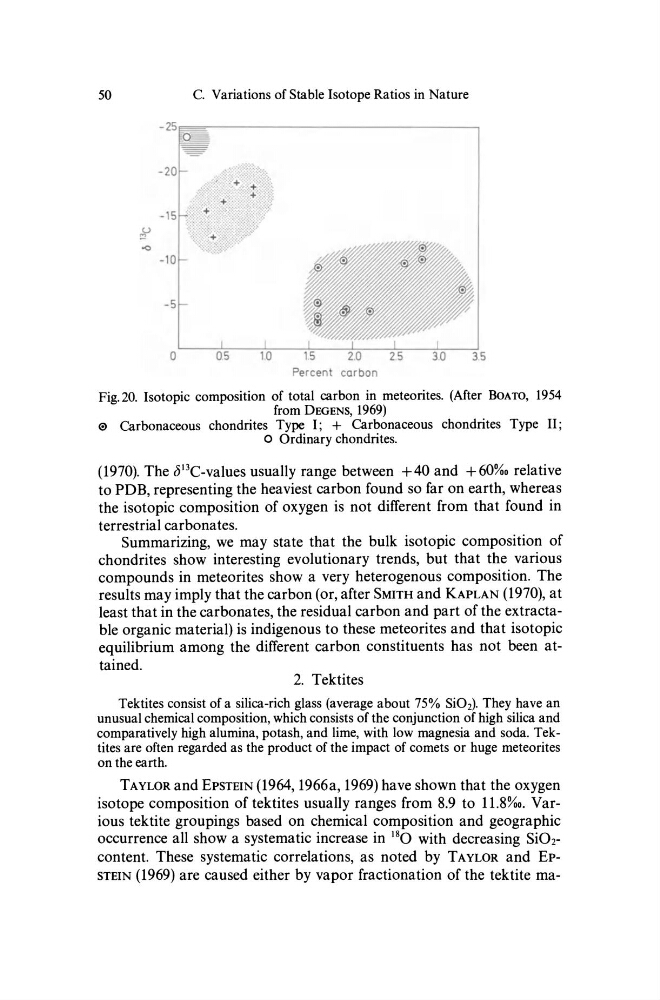
Percent carbon
Fig. 20. Isotopic composition of total carbon in meteorites. (After BoATO, 1954
from DEGENS, 1969)
® Carbonaceous chondrites Type I; + Carbonaceous chondrites Type II;
o Ordinary chondrites.
(1970). The J l3 C-values usually range between + 40 and + 60%0 relative
to PDB, representing the heaviest carbon found so far on earth, whereas
the isotopic composition of oxygen is not different from that found in
terrestrial carbonates.
Summarizing, we may state that the bulk isotopic composition of
chondrites show interesting evolutionary trends, but that the various
compounds in meteorites show a very heterogenous composition. The
results may imply that the carbon (or, after SMITH and KAPLAN (1970), at
least that in the carbonates, the residual carbon and part of the extractable organic material) is indigenous to these meteorites and that isotopic
equilibrium among the different carbon constituents has not been attained.
2. Tektites
Tektites consist of a silica-rich glass (average about 75% Si02). They have an
unusual chemical composition, which consists of the conjunction of high silica and
comparatively high alumina, potash, and lime, with low magnesia and soda. Tektites are often regarded as the product of the impact of comets or huge meteorites
on the earth.
TAYLOR and EpSTEIN (1964, 1966a, 1969) have shown that the oxygen
isotope composition of tektites usually ranges from 8.9 to 11.8%0. Various tektite groupings based on chemical composition and geographic
occurrence all show a systematic increase in 18 0 with decreasing Si02content. These systematic correlations, as noted by TAYLOR and EpSTEIN (1969) are caused either by vapor fractionation of the tektite ma-
C. Variations of Stable Isotope Ratios in Nature
-5
o
Percent carbon
Fig. 20. Isotopic composition of total carbon in meteorites. (After BoATO, 1954
from DEGENS, 1969)
® Carbonaceous chondrites Type I; + Carbonaceous chondrites Type II;
o Ordinary chondrites.
(1970). The J l3 C-values usually range between + 40 and + 60%0 relative
to PDB, representing the heaviest carbon found so far on earth, whereas
the isotopic composition of oxygen is not different from that found in
terrestrial carbonates.
Summarizing, we may state that the bulk isotopic composition of
chondrites show interesting evolutionary trends, but that the various
compounds in meteorites show a very heterogenous composition. The
results may imply that the carbon (or, after SMITH and KAPLAN (1970), at
least that in the carbonates, the residual carbon and part of the extractable organic material) is indigenous to these meteorites and that isotopic
equilibrium among the different carbon constituents has not been attained.
2. Tektites
Tektites consist of a silica-rich glass (average about 75% Si02). They have an
unusual chemical composition, which consists of the conjunction of high silica and
comparatively high alumina, potash, and lime, with low magnesia and soda. Tektites are often regarded as the product of the impact of comets or huge meteorites
on the earth.
TAYLOR and EpSTEIN (1964, 1966a, 1969) have shown that the oxygen
isotope composition of tektites usually ranges from 8.9 to 11.8%0. Various tektite groupings based on chemical composition and geographic
occurrence all show a systematic increase in 18 0 with decreasing Si02content. These systematic correlations, as noted by TAYLOR and EpSTEIN (1969) are caused either by vapor fractionation of the tektite ma-