

42
B. Fractionation Mechanisms of Selected Elements
VIII. Silicon
Silicon has three stable isotopes, with the following abundances
(BAINBRIDGE and NIER, 1950):
28Si:
92.27% ,
29Si:
4.68% ,
30Si:
3.05% .
Silicates are stable over the whole temperature range and are of interest
in stable isotope research. We might expect small fractionations, small,
because no geologically important gaseous silicon compound is known
and because the liquid components are of minor importance. Variations
of the stable isotopes of silicon have received little attention, which
seems to be due mainly to analytical difficulties.
TILLES (1961 a) extracted the silicon by fusion with sodium carbonate
flux. The silicon was converted into BaSiF6 , which was decomposed by
heating to give SiF4 , and admitted to the ion source.
Measurements by ALLEN BY (1954) and REYNOLDS and VERHOOGEN
(1953), using single collection of ions, differed by a factor of about 5 in
the observed difference among similar kinds of samples. TILLES (1961 a,
b) found a total variation of 30Sij28Si ratios of about 5 %0.
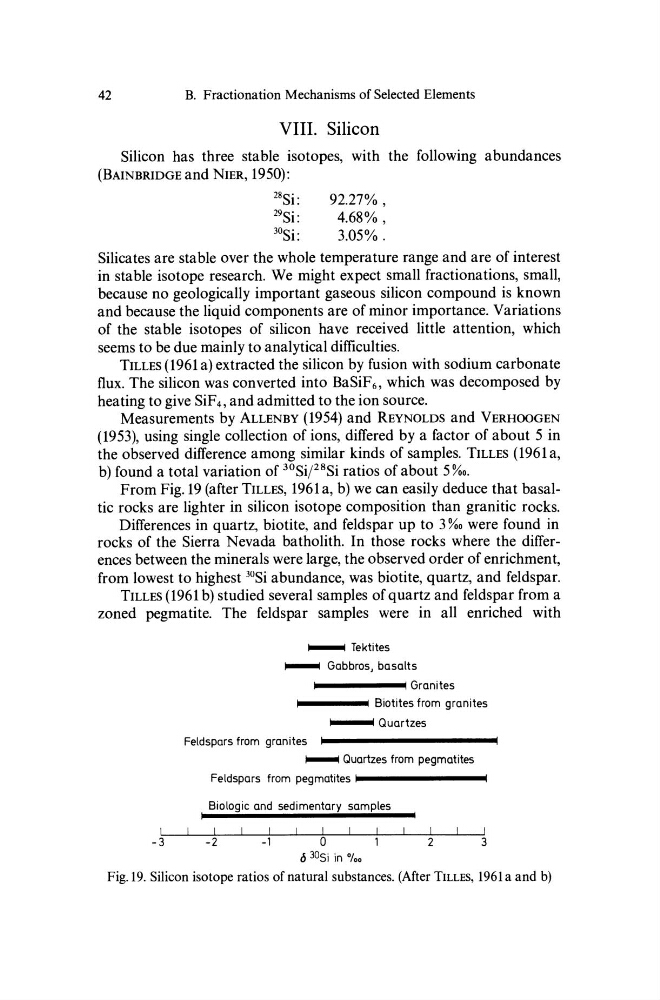
From Fig. 19 (after TILLES, 1961a, b) we can easily deduce that basaltic rocks are lighter in silicon isotope composition than granitic rocks.
Differences in quartz, biotite, and feldspar up to 3 %0 were found in
rocks of the Sierra Nevada batholith. In those rocks where the differences between the minerals were large, the observed order of enrichment,
from lowest to highest 30Si abundance, was biotite, quartz, and feldspar.
TILLES (1961 b) studied several samples of quartz and feldspar from a
zoned pegmatite. The feldspar samples were in all enriched with
-3
....... Tektites
~ Gabbros, basalts
... ----.1 Granites
~--"'I Biotites from granites
~Quartzes
Feldspars from granites I
... ---------~
~ Quartzes from pegmatites
Feldspars from pegmatites I~------.
Biologic and sedimentary samples
1
-2
-1
o
c5 30Si in "10.
2
3
Fig. 19. Silicon isotope ratios of natural substances. (After TILLES, 1961 a and b)
B. Fractionation Mechanisms of Selected Elements
VIII. Silicon
Silicon has three stable isotopes, with the following abundances
(BAINBRIDGE and NIER, 1950):
28Si:
92.27% ,
29Si:
4.68% ,
30Si:
3.05% .
Silicates are stable over the whole temperature range and are of interest
in stable isotope research. We might expect small fractionations, small,
because no geologically important gaseous silicon compound is known
and because the liquid components are of minor importance. Variations
of the stable isotopes of silicon have received little attention, which
seems to be due mainly to analytical difficulties.
TILLES (1961 a) extracted the silicon by fusion with sodium carbonate
flux. The silicon was converted into BaSiF6 , which was decomposed by
heating to give SiF4 , and admitted to the ion source.
Measurements by ALLEN BY (1954) and REYNOLDS and VERHOOGEN
(1953), using single collection of ions, differed by a factor of about 5 in
the observed difference among similar kinds of samples. TILLES (1961 a,
b) found a total variation of 30Sij28Si ratios of about 5 %0.
From Fig. 19 (after TILLES, 1961a, b) we can easily deduce that basaltic rocks are lighter in silicon isotope composition than granitic rocks.
Differences in quartz, biotite, and feldspar up to 3 %0 were found in
rocks of the Sierra Nevada batholith. In those rocks where the differences between the minerals were large, the observed order of enrichment,
from lowest to highest 30Si abundance, was biotite, quartz, and feldspar.
TILLES (1961 b) studied several samples of quartz and feldspar from a
zoned pegmatite. The feldspar samples were in all enriched with
-3
....... Tektites
~ Gabbros, basalts
... ----.1 Granites
~--"'I Biotites from granites
~Quartzes
Feldspars from granites I
... ---------~
~ Quartzes from pegmatites
Feldspars from pegmatites I~------.
Biologic and sedimentary samples
1
-2
-1
o
c5 30Si in "10.
2
3
Fig. 19. Silicon isotope ratios of natural substances. (After TILLES, 1961 a and b)