

40
B. Fractionation Mechanisms of Selected Elements
Rocks and minerals
Seawater
SCHWARCZ et al.
III
Pacific
Atlantic
(1969)
1m
•
I Arctic
SHIMA (1963)
~ 1m
FINLEYet at.
(1964)
1m
1m ~ 1m 1m
1m
3.9
4.0
4.1
4.2 1181 lOS
-30
-20 -10
0
10
20
30
40
50
60
70
80
b 118 (0100)
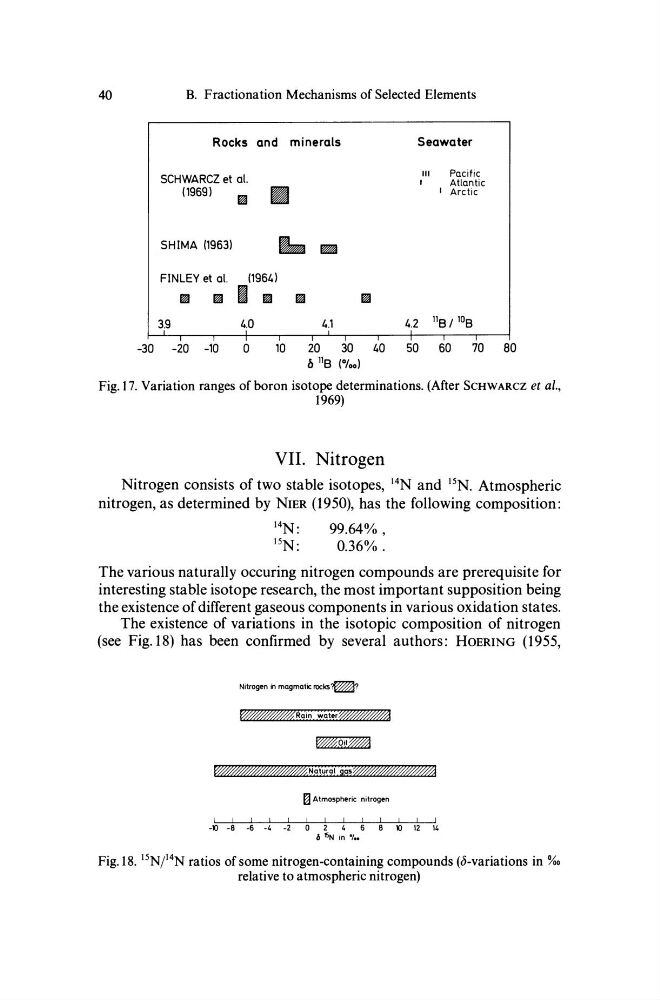
Fig. 17. Variation ranges of boron isotope determinations. (After SCHWARCZ et aI.,
1969)
VII. Nitrogen
Nitrogen consists of two stable isotopes, 14N and 15N. Atmospheric
nitrogen, as determined by NIER (1950), has the following composition:
14N:
99.64% ,
15N:
0.36%.
The various naturally occuring nitrogen compounds are prerequisite for
interesting stable isotope research, the most important supposition being
the existence of different gaseous components in various oxidation states.
The existence of variations in the isotopic composition of nitrogen
(see Fig. 18) has been confirmed by several authors: HOERING (1955,
Nitrogen in magmatic rocks~
~Rain water~
!%%Oil§%®
~NQturQlgQS~
~ Atmospheric nitrogen
!
I
I
!
!
I
I
I
I
I
I
I
!
-IJ -8 -6 -4 -2
0
2
4
6
8
IJ 12
14
/)15N In %.
Fig. 18. 15NrN ratios of some nitrogen-containing compounds (b-variations in %0
relative to atmospheric nitrogen)
B. Fractionation Mechanisms of Selected Elements
Rocks and minerals
Seawater
SCHWARCZ et al.
III
Pacific
Atlantic
(1969)
1m
•
I Arctic
SHIMA (1963)
~ 1m
FINLEYet at.
(1964)
1m
1m ~ 1m 1m
1m
3.9
4.0
4.1
4.2 1181 lOS
-30
-20 -10
0
10
20
30
40
50
60
70
80
b 118 (0100)
Fig. 17. Variation ranges of boron isotope determinations. (After SCHWARCZ et aI.,
1969)
VII. Nitrogen
Nitrogen consists of two stable isotopes, 14N and 15N. Atmospheric
nitrogen, as determined by NIER (1950), has the following composition:
14N:
99.64% ,
15N:
0.36%.
The various naturally occuring nitrogen compounds are prerequisite for
interesting stable isotope research, the most important supposition being
the existence of different gaseous components in various oxidation states.
The existence of variations in the isotopic composition of nitrogen
(see Fig. 18) has been confirmed by several authors: HOERING (1955,
Nitrogen in magmatic rocks~
~Rain water~
!%%Oil§%®
~NQturQlgQS~
~ Atmospheric nitrogen
!
I
I
!
!
I
I
I
I
I
I
I
!
-IJ -8 -6 -4 -2
0
2
4
6
8
IJ 12
14
/)15N In %.
Fig. 18. 15NrN ratios of some nitrogen-containing compounds (b-variations in %0
relative to atmospheric nitrogen)