

Preparation Technique
33
to positively charged sulfates. From these facts it is quite clear that sulfur
is of special interest in stable isotope geochemistry.
THODE et al. (1949) and TROFIMOV (1949) were the first to observe
wide variations in the abundances of sulfur isotopes.
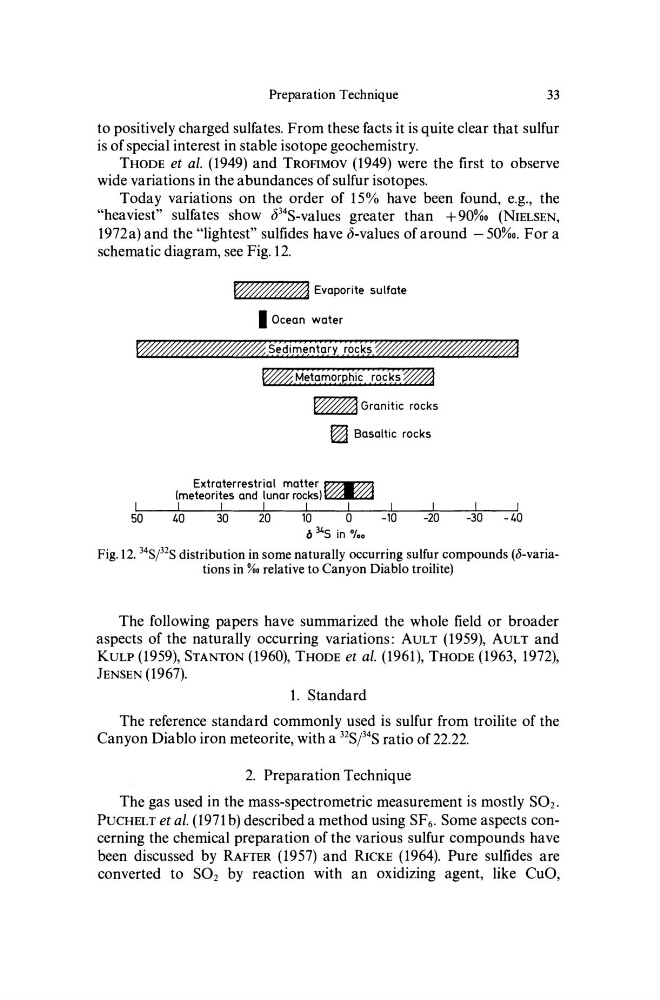
Today variations on the order of 15% have been found, e.g., the
"heaviest" sulfates show (534S-values greater than + 90%0 (NIELSEN,
1972a) and the "lightest" sulfides have (5-values of around - 50%0. For a
schematic diagram, see Fig. 12.
~ Evaporite sulfate
I Ocean water
~,s'~~),0kntg;y .ro(;'k~~
l0%~etamorehic ,rqc~;;%®
50
~ Granitic rocks
~ Basaltic rocks
Extraterrestrial matter r//~//A
(meteorites and lunar rocks)V// ..... ///l
I
I
I
I
I
I
40
30
20
10
0
-10
{) 3~S in %.
-20
I
!
-30
- 40
Fig. 12. 34S/32S distribution in some naturally occurring sulfur compounds (b-variations in %0 relative to Canyon Diablo troilite)
The following papers have summarized the whole field or broader
aspects of the naturally occurring variations: AULT (1959), AULT and
KULP (1959), STANTON (1960), THODE et al. (1961), THODE (1963, 1972),
JENSEN (1967).
1. Standard
The reference standard commonly used is sulfur from troilite of the
Canyon Diablo iron meteorite, with a 32SrS ratio of 22.22.
2. Preparation Technique
The gas used in the mass-spectrometric measurement is mostly S02.
PUCHELT et al. (1971 b) described a method using SF6• Some aspects concerning the chemical preparation of the various sulfur compounds have
been discussed by RAFTER (1957) and RICKE (1964). Pure sulfides are
converted to S02 by reaction with an oxidizing agent, like CuO,
33
to positively charged sulfates. From these facts it is quite clear that sulfur
is of special interest in stable isotope geochemistry.
THODE et al. (1949) and TROFIMOV (1949) were the first to observe
wide variations in the abundances of sulfur isotopes.
Today variations on the order of 15% have been found, e.g., the
"heaviest" sulfates show (534S-values greater than + 90%0 (NIELSEN,
1972a) and the "lightest" sulfides have (5-values of around - 50%0. For a
schematic diagram, see Fig. 12.
~ Evaporite sulfate
I Ocean water
~,s'~~),0kntg;y .ro(;'k~~
l0%~etamorehic ,rqc~;;%®
50
~ Granitic rocks
~ Basaltic rocks
Extraterrestrial matter r//~//A
(meteorites and lunar rocks)V// ..... ///l
I
I
I
I
I
I
40
30
20
10
0
-10
{) 3~S in %.
-20
I
!
-30
- 40
Fig. 12. 34S/32S distribution in some naturally occurring sulfur compounds (b-variations in %0 relative to Canyon Diablo troilite)
The following papers have summarized the whole field or broader
aspects of the naturally occurring variations: AULT (1959), AULT and
KULP (1959), STANTON (1960), THODE et al. (1961), THODE (1963, 1972),
JENSEN (1967).
1. Standard
The reference standard commonly used is sulfur from troilite of the
Canyon Diablo iron meteorite, with a 32SrS ratio of 22.22.
2. Preparation Technique
The gas used in the mass-spectrometric measurement is mostly S02.
PUCHELT et al. (1971 b) described a method using SF6• Some aspects concerning the chemical preparation of the various sulfur compounds have
been discussed by RAFTER (1957) and RICKE (1964). Pure sulfides are
converted to S02 by reaction with an oxidizing agent, like CuO,