

Fractionations Due to Kinetic Processes
31
for analysis, has been called "external thermometry" (ONUMA et al.,
1972 b).
In recent years some laboratory calibration curves have been worked
out. The starting materials are chosen so that in one set of experiments
the mineral approaches equilibrium by going through successively more
180_rich compositions, while in another set of experiments the reverse
approach is taken. These two approaches are not always practical because laboratory exchange rates between most minerals and aqueous
solutions are slow, even at high temperatures.
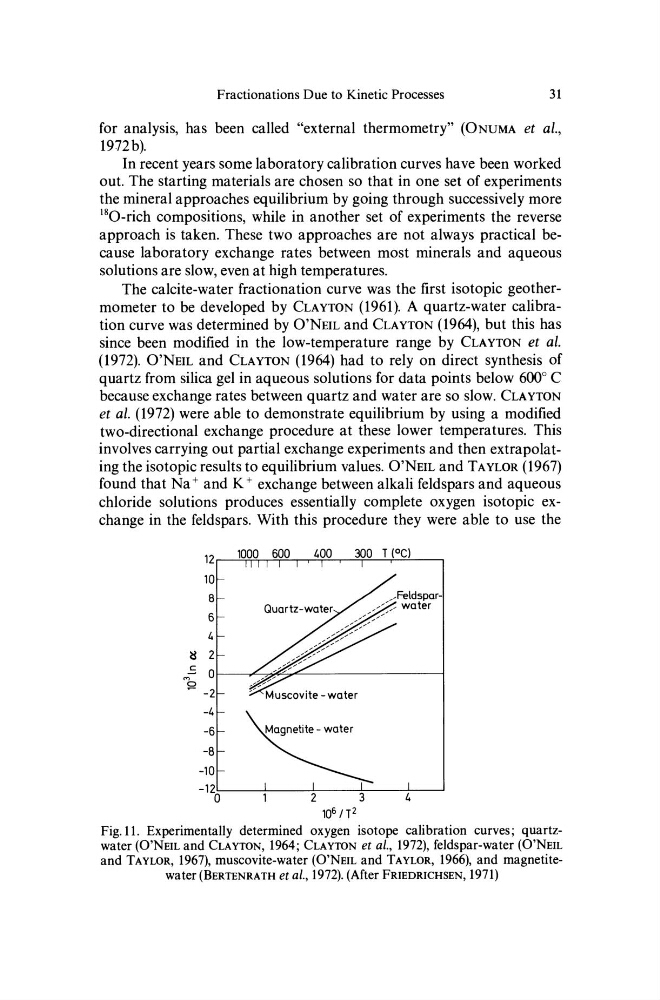
The calcite-water fractionation curve was the first isotopic geothermometer to be developed by CLAYTON (1961). A quartz-water calibration curve was determined by O'NEIL and CLAYTON (1964), but this has
since been modified in the low-temperature range by CLAYTON et al.
(1972). O'NEIL and CLAYTON (1964) had to rely on direct synthesis of
quartz from silica gel in aqueous solutions for data points below 600° C
because exchange rates between quartz and water are so slow. CLAYTON
et al. (1972) were able to demonstrate equilibrium by using a modified
two-directional exchange procedure at these lower temperatures. This
involves carrying out partial exchange experiments and then extrapolating the isotopic results to equilibrium values. O'NEIL and TAYLOR (1967)
found that Na + and K + exchange between alkali feldspars and aqueous
chloride solutions produces essentially complete oxygen isotopic exchange in the feldspars. With this procedure they were able to use the
~
.s
'" Q
12r-~rr,,~-.~~~~~Tr(O~C~) __ -,
10
B
6
4
2
0
-2
-4
-6
-8
-10
-12
0
106 1T2
Fig.l!. Experimentally determined oxygen isotope calibration curves; quartzwater (O'NEIL and CLAYTON, 1964; CLAYTON et at., 1972), feldspar-water (O'NEIL
and TAYLOR, 1967), muscovite-water (O'NEIL and TAYLOR, 1966), and magnetitewater (BERTENRATH et aI., 1972). (After FRIEDRICHSEN, 1971)
31
for analysis, has been called "external thermometry" (ONUMA et al.,
1972 b).
In recent years some laboratory calibration curves have been worked
out. The starting materials are chosen so that in one set of experiments
the mineral approaches equilibrium by going through successively more
180_rich compositions, while in another set of experiments the reverse
approach is taken. These two approaches are not always practical because laboratory exchange rates between most minerals and aqueous
solutions are slow, even at high temperatures.
The calcite-water fractionation curve was the first isotopic geothermometer to be developed by CLAYTON (1961). A quartz-water calibration curve was determined by O'NEIL and CLAYTON (1964), but this has
since been modified in the low-temperature range by CLAYTON et al.
(1972). O'NEIL and CLAYTON (1964) had to rely on direct synthesis of
quartz from silica gel in aqueous solutions for data points below 600° C
because exchange rates between quartz and water are so slow. CLAYTON
et al. (1972) were able to demonstrate equilibrium by using a modified
two-directional exchange procedure at these lower temperatures. This
involves carrying out partial exchange experiments and then extrapolating the isotopic results to equilibrium values. O'NEIL and TAYLOR (1967)
found that Na + and K + exchange between alkali feldspars and aqueous
chloride solutions produces essentially complete oxygen isotopic exchange in the feldspars. With this procedure they were able to use the
~
.s
'" Q
12r-~rr,,~-.~~~~~Tr(O~C~) __ -,
10
B
6
4
2
0
-2
-4
-6
-8
-10
-12
0
106 1T2
Fig.l!. Experimentally determined oxygen isotope calibration curves; quartzwater (O'NEIL and CLAYTON, 1964; CLAYTON et at., 1972), feldspar-water (O'NEIL
and TAYLOR, 1967), muscovite-water (O'NEIL and TAYLOR, 1966), and magnetitewater (BERTENRATH et aI., 1972). (After FRIEDRICHSEN, 1971)