

Preparation Techniques
27
(1951), EpSTEIN (1959), CLAYTON (1963a), EpSTEIN and TAYLOR (1967),
TAYLOR (1968a), and GARLICK (1969).
Oxygen has three stable isotopes with the following abundances
(GARLICK,1969):
16 0 = 99.763 %,
17 0 = 0.0375%,
18 0 = 0.1995%.
Because of the higher abundance and the greater mass difference, the
180rO ratio is normally determined.
1. Preparation Techniques
In almost all cases, CO2 is the gas used in the mass-spectrometric
measurement. Different methods are necessary to liberate the oxygen
from the various oxygen-containing compounds.
The oxygen in silicates and oxides is usually converted to CO2 through fluorination with F2 or BrF5 in nickel-tubes at 500 to 600° C. Decomposition by carbon
reduction at 1000 to 2000° C is suitable only for quartz and iron oxides but not
for silicates (CLAYTON and EpSTEIN, 1958).
The liberation of oxygen through F 2 or BrF 5 is described by TAYLOR and
EpSTEIN (1962a) and CLAYTON and MAYEDA (1963). Unwanted product gases are
removed from the oxygen by cold traps, and excess F2 is removed by reaction with
hot KBr to KF and condensable Br2. The oxygen is combusted to CO 2 over a
resistance-heated graphite rod.
Care must be taken to ensure quantitative oxygen yields. Low yields caused by
inadequate reaction temperatures or reaction times result in anomalously low 18 0/
16 0 ratios.
Phosphates may be treated as above with a modified technique described by
TUDGE (1960).
Sulfates are precipitated as BaS04, and then reduced at 1000° C with carbon to
C02 and CO. The CO is converted to C02 by sparking between platinum electrodes (LONGINELLI and CRAIG, 1967).
Carbonates are reacted with 100% phosphoric acid at 25° C, first described by
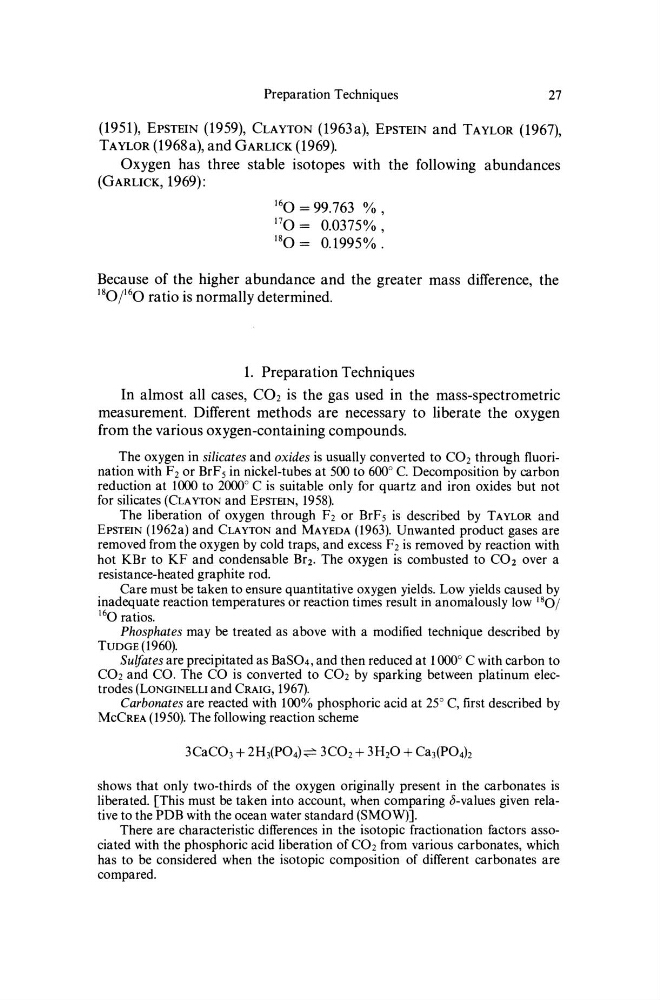
MCCREA (1950). The following reaction scheme
shows that only two-thirds of the oxygen originally present in the carbonates is
liberated. [This must be taken into account, when comparing b-values given relative to the PDB with the ocean water standard (SMOW)].
There are characteristic differences in the isotopic fractionation factors associated with the phosphoric acid liberation of CO2 from various carbonates, which
has to be considered when the isotopic composition of different carbonates are
compared.
27
(1951), EpSTEIN (1959), CLAYTON (1963a), EpSTEIN and TAYLOR (1967),
TAYLOR (1968a), and GARLICK (1969).
Oxygen has three stable isotopes with the following abundances
(GARLICK,1969):
16 0 = 99.763 %,
17 0 = 0.0375%,
18 0 = 0.1995%.
Because of the higher abundance and the greater mass difference, the
180rO ratio is normally determined.
1. Preparation Techniques
In almost all cases, CO2 is the gas used in the mass-spectrometric
measurement. Different methods are necessary to liberate the oxygen
from the various oxygen-containing compounds.
The oxygen in silicates and oxides is usually converted to CO2 through fluorination with F2 or BrF5 in nickel-tubes at 500 to 600° C. Decomposition by carbon
reduction at 1000 to 2000° C is suitable only for quartz and iron oxides but not
for silicates (CLAYTON and EpSTEIN, 1958).
The liberation of oxygen through F 2 or BrF 5 is described by TAYLOR and
EpSTEIN (1962a) and CLAYTON and MAYEDA (1963). Unwanted product gases are
removed from the oxygen by cold traps, and excess F2 is removed by reaction with
hot KBr to KF and condensable Br2. The oxygen is combusted to CO 2 over a
resistance-heated graphite rod.
Care must be taken to ensure quantitative oxygen yields. Low yields caused by
inadequate reaction temperatures or reaction times result in anomalously low 18 0/
16 0 ratios.
Phosphates may be treated as above with a modified technique described by
TUDGE (1960).
Sulfates are precipitated as BaS04, and then reduced at 1000° C with carbon to
C02 and CO. The CO is converted to C02 by sparking between platinum electrodes (LONGINELLI and CRAIG, 1967).
Carbonates are reacted with 100% phosphoric acid at 25° C, first described by
MCCREA (1950). The following reaction scheme
shows that only two-thirds of the oxygen originally present in the carbonates is
liberated. [This must be taken into account, when comparing b-values given relative to the PDB with the ocean water standard (SMOW)].
There are characteristic differences in the isotopic fractionation factors associated with the phosphoric acid liberation of CO2 from various carbonates, which
has to be considered when the isotopic composition of different carbonates are
compared.