

Equilibrium Exchange Reactions
21
H 20, the concentration of D is higher in the liquid phase than in the
vapor, and higher in the solid phase than in the liquid, when water
undergoes a phase change under equilibrium conditions.
The physical processes responsible for the fractionation of hydrogen
isotopes in water and the distribution of the resulting fractions in nature
are the same as those applying to the fractionation of oxygen isotopes in
water. Therefore, the fractionation of D parallels that of 180 in most
cases.
b) Equilibrium Exchange Reactions
BOTTINGA (1969a) has calculated the fractionation factors for water,
hydrogen, and hydrogen-methane. Large fractionations (more than 70%0
at about 350
0
C) occur in the system water-vapor and methane. Deuterium exchange between H2S and H 20 is utilized commercially in the
production of heavy water.
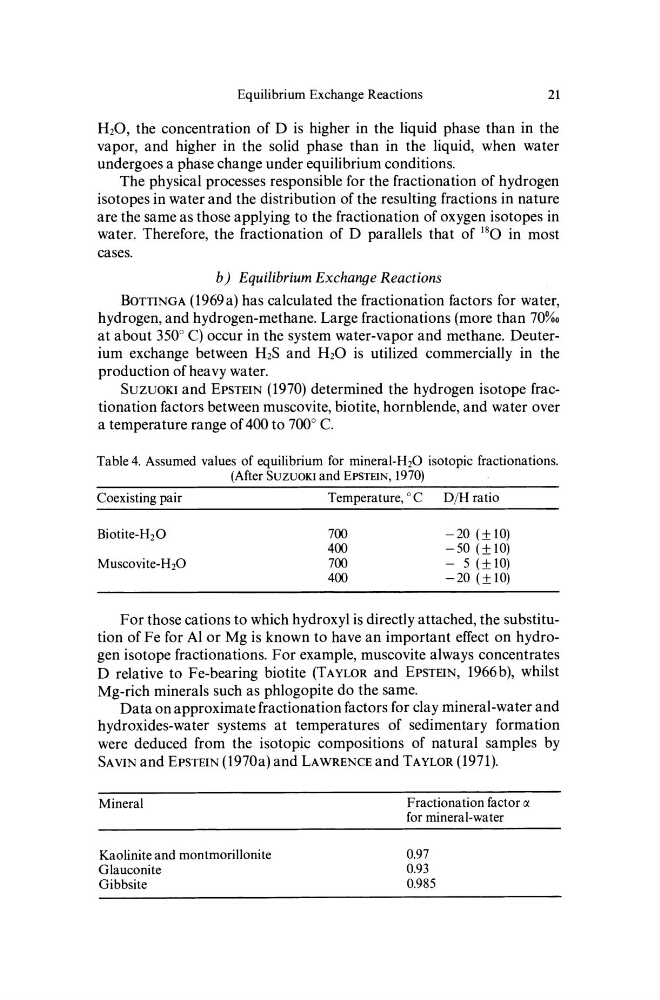
SUZUOKI and EpSTEIN (1970) determined the hydrogen isotope fractionation factors between muscovite, biotite, hornblende, and water over
a temperature range of 400 to 700
0
C.
Table 4. Assumed values of equilibrium for mineral-H20 isotopic fractionations.
(After SUZUOKI and EpSTEIN, 1970)
Coexisting pair
Temperature,oC
DjH ratio
700
- 20 (± 10)
400
- 50 (± 10)
Muscovite-H20
700
- 5 (±1~
400
- 20 (± 10)
For those cations to which hydroxyl is directly attached, the substitution of Fe for Al or Mg is known to have an important effect on hydrogen isotope fractionations. For example, muscovite always concentrates
D relative to Fe-bearing biotite (TAYLOR and EpSTEIN, 1966b), whilst
Mg-rich minerals such as phlogopite do the same.
Data on approximate fractionation factors for clay mineral-water and
hydroxides-water systems at temperatures of sedimentary formation
were deduced from the isotopic compositions of natural samples by
SAVIN and EpSTEIN (1970a) and LAWRENCE and TAYLOR (1971).
Mineral
Kaolinite and montmorillonite
Glauconite
Gibbsite
Fractionation factor IX
for mineral-water
0.97
0.93
0.985
21
H 20, the concentration of D is higher in the liquid phase than in the
vapor, and higher in the solid phase than in the liquid, when water
undergoes a phase change under equilibrium conditions.
The physical processes responsible for the fractionation of hydrogen
isotopes in water and the distribution of the resulting fractions in nature
are the same as those applying to the fractionation of oxygen isotopes in
water. Therefore, the fractionation of D parallels that of 180 in most
cases.
b) Equilibrium Exchange Reactions
BOTTINGA (1969a) has calculated the fractionation factors for water,
hydrogen, and hydrogen-methane. Large fractionations (more than 70%0
at about 350
0
C) occur in the system water-vapor and methane. Deuterium exchange between H2S and H 20 is utilized commercially in the
production of heavy water.
SUZUOKI and EpSTEIN (1970) determined the hydrogen isotope fractionation factors between muscovite, biotite, hornblende, and water over
a temperature range of 400 to 700
0
C.
Table 4. Assumed values of equilibrium for mineral-H20 isotopic fractionations.
(After SUZUOKI and EpSTEIN, 1970)
Coexisting pair
Temperature,oC
DjH ratio
700
- 20 (± 10)
400
- 50 (± 10)
Muscovite-H20
700
- 5 (±1~
400
- 20 (± 10)
For those cations to which hydroxyl is directly attached, the substitution of Fe for Al or Mg is known to have an important effect on hydrogen isotope fractionations. For example, muscovite always concentrates
D relative to Fe-bearing biotite (TAYLOR and EpSTEIN, 1966b), whilst
Mg-rich minerals such as phlogopite do the same.
Data on approximate fractionation factors for clay mineral-water and
hydroxides-water systems at temperatures of sedimentary formation
were deduced from the isotopic compositions of natural samples by
SAVIN and EpSTEIN (1970a) and LAWRENCE and TAYLOR (1971).
Mineral
Kaolinite and montmorillonite
Glauconite
Gibbsite
Fractionation factor IX
for mineral-water
0.97
0.93
0.985