

Isotope Fractionation Processes
7
hydrogen, where rotational energies cannot be neglected), it is sufficient
to take into account a modified vibrational partition function Q'.
The dependence of the equilibrium constant K on temperature is
the most important property for geological purposes. It is interesting
to note that for changes in temperature, the equilibrium constant K
sometimes changes from values larger than unity to values smaller than
unity and vice versa. This is known as crossing over.
Finally, approaching 0 OK the equilibrium constant K tends towards
zero or infinity, corresponding to complete isotope separation. This
condition is never reached in practice, due to the slow rate of exchange
at low temperatures. As the equilibrium differences in chemical properties
of isotopes vanish at high temperatures, the effects disappear as the
temperature tends towards infinity.
We have seen that, for the calculation of a partition function ratio
for a pair of isotopic molecules, we have to know the vibrational frequencies of each. When solid materials are considered, the evaluation
of partition function ratios becomes even more complicated, because it is
necessary not only to take into account the independent vibrations of
each molecule, but also to consider the lattice vibrations.
Usually we are interested in the fractionation factor, rather than in
the equilibrium constant. The fractionation factor (J. is defined as the
ratio of the numbers of any two isotopes in one chemical compound
divided by the corresponding ratio for the other chemical species. At
equilibrium, in general (J. = Kiln, where n is the maximum number of
exchangeable atoms. But this equation does not hold true in compounds
where the isotopes of hydrogen are considered, or where the different
positions of several atoms of a single element are not equivalent.
Note that for a reaction such as
H 2 18 0 + 1/3CaC 16 0 3 ¢H/ 6 0 + 1/3CaC 18 0 3 ,
at equilibrium K = (J..
2) The second main phenomena producing isotope fractionations
are kinetic effects. For example, in a gas phase the molecules containing
the light isotope move more rapidly than those with the heavy isotope.
The translational velocities of gas molecules are inversely proportional
to the square root of the ratio of the molecular weights. For example,
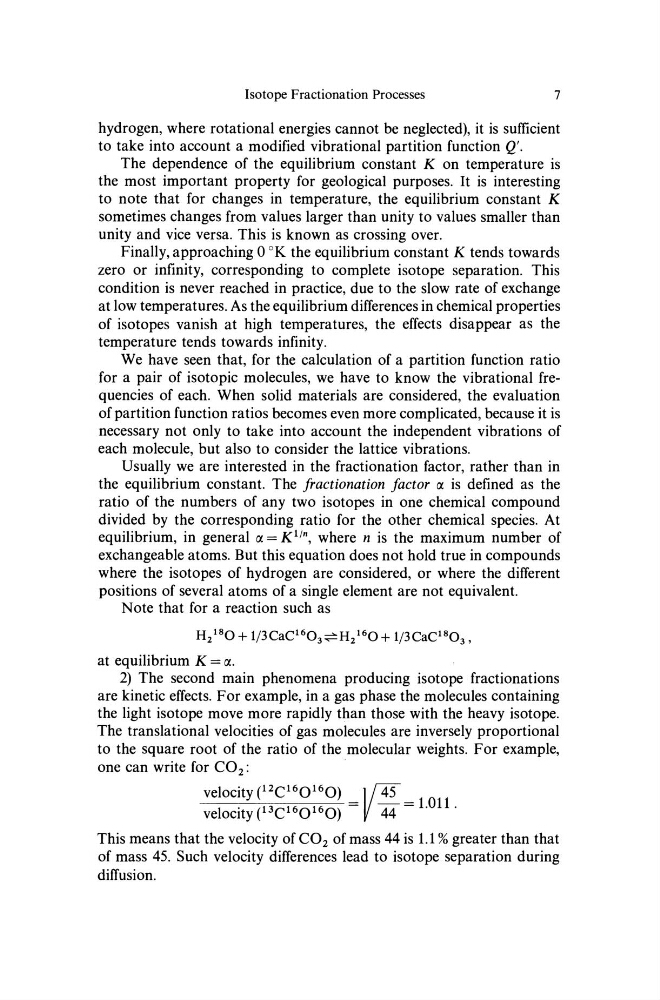
one can write for CO 2 :
velocitye2Cl60160) _ V 45 _
velocity (13CI60160) -
44 - 1.011 .
This means that the velocity of CO 2 of mass 44 is 1.1 % greater than that
of mass 45. Such velocity differences lead to isotope separation during
diffusion.
7
hydrogen, where rotational energies cannot be neglected), it is sufficient
to take into account a modified vibrational partition function Q'.
The dependence of the equilibrium constant K on temperature is
the most important property for geological purposes. It is interesting
to note that for changes in temperature, the equilibrium constant K
sometimes changes from values larger than unity to values smaller than
unity and vice versa. This is known as crossing over.
Finally, approaching 0 OK the equilibrium constant K tends towards
zero or infinity, corresponding to complete isotope separation. This
condition is never reached in practice, due to the slow rate of exchange
at low temperatures. As the equilibrium differences in chemical properties
of isotopes vanish at high temperatures, the effects disappear as the
temperature tends towards infinity.
We have seen that, for the calculation of a partition function ratio
for a pair of isotopic molecules, we have to know the vibrational frequencies of each. When solid materials are considered, the evaluation
of partition function ratios becomes even more complicated, because it is
necessary not only to take into account the independent vibrations of
each molecule, but also to consider the lattice vibrations.
Usually we are interested in the fractionation factor, rather than in
the equilibrium constant. The fractionation factor (J. is defined as the
ratio of the numbers of any two isotopes in one chemical compound
divided by the corresponding ratio for the other chemical species. At
equilibrium, in general (J. = Kiln, where n is the maximum number of
exchangeable atoms. But this equation does not hold true in compounds
where the isotopes of hydrogen are considered, or where the different
positions of several atoms of a single element are not equivalent.
Note that for a reaction such as
H 2 18 0 + 1/3CaC 16 0 3 ¢H/ 6 0 + 1/3CaC 18 0 3 ,
at equilibrium K = (J..
2) The second main phenomena producing isotope fractionations
are kinetic effects. For example, in a gas phase the molecules containing
the light isotope move more rapidly than those with the heavy isotope.
The translational velocities of gas molecules are inversely proportional
to the square root of the ratio of the molecular weights. For example,
one can write for CO 2 :
velocitye2Cl60160) _ V 45 _
velocity (13CI60160) -
44 - 1.011 .
This means that the velocity of CO 2 of mass 44 is 1.1 % greater than that
of mass 45. Such velocity differences lead to isotope separation during
diffusion.