

4
A. Theoretical and Instrumental Background
Radioactive decay is one process that produces isotope abundance
variations. The second process is that of isotopic fractionation caused by
small chemical and physical differences between the isotopes of an element. It is exclusively with this process that we are dealing with in the
following chapters.
II. Isotope Effects
It is well-known that the extranuclear structure of an element essentially determines its chemical behavior, whereas the nucleus is more or
less responsible for its physical properties. Because all isotopes of a given
element contain the same number and arrangement of electrons, a farreaching similarity in chemical behavior is the logical consequence. But
this similarity is not unlimited; there exist certain differences in physicochemical properties due to the mass differences of different isotopes.
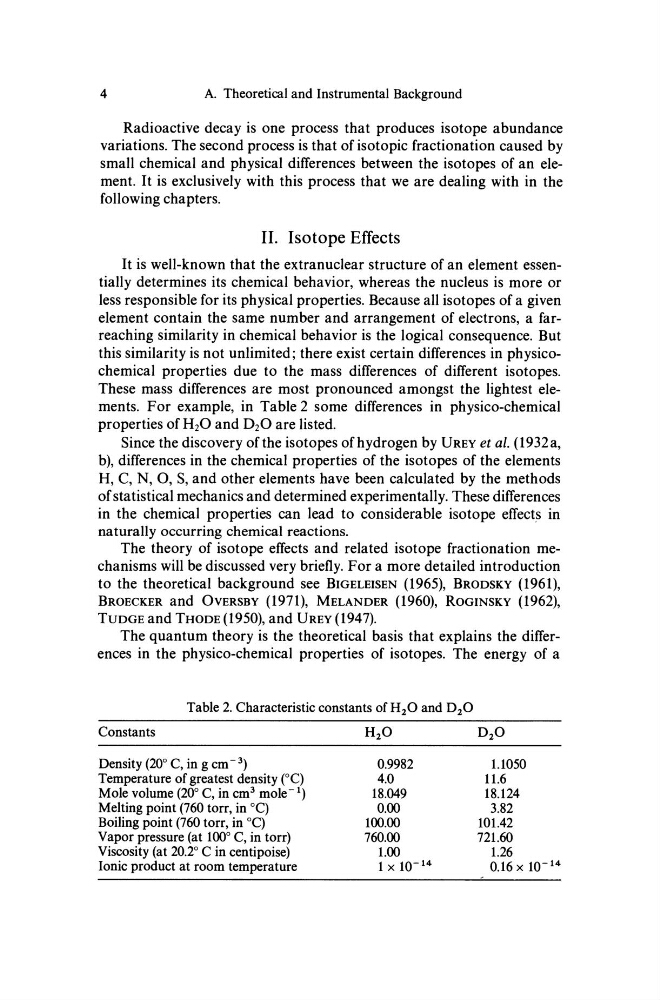
These mass differences are most pronounced amongst the lightest elements. For example, in Table 2 some differences in physico-chemical
properties of H 20 and 0 2 0 are listed.
Since the discovery of the isotopes of hydrogen by UREY et al. (1932a,
b), differences in the chemical properties of the isotopes of the elements
H, C, N, 0, S, and other elements have been calculated by the methods
of statistical mechanics and determined experimentally. These differences
in the chemical properties can lead to considerable isotope effects in
naturally occurring chemical reactions.
The theory of isotope effects and related isotope fractionation mechanisms will be discussed very briefly. For a more detailed introduction
to the theoretical background see BIGELEISEN (1965), BRODSKY (1961),
BROECKER and OVERSBY (1971), MELANDER (1960), ROGINSKY (1962),
TUDGE and THODE (1950), and UREY (1947).
The quantum theory is the theoretical basis that explains the differences in the physico-chemical properties of isotopes. The energy of a
Table 2. Characteristic constants of H 2 0 and D 2 0
Constants
Density (20° C, in g cm - 3)
Temperature of greatest density (0C)
Mole volume (20° C, in cm 3 mole- 1 )
Melting point (760 torr, in 0C)
Boiling point (760 torr, in 0C)
Vapor pressure (at 100° C, in torr)
Viscosity (at 20.2° C in centipoise)
Ionic product at room temperature
0.9982
4.0
18.049
0.00
100.00
760.00
1.00
1X1O- 14
1.1050
11.6
18.124
3.82
101.42
721.60
1.26
0.16 x 10- 14
A. Theoretical and Instrumental Background
Radioactive decay is one process that produces isotope abundance
variations. The second process is that of isotopic fractionation caused by
small chemical and physical differences between the isotopes of an element. It is exclusively with this process that we are dealing with in the
following chapters.
II. Isotope Effects
It is well-known that the extranuclear structure of an element essentially determines its chemical behavior, whereas the nucleus is more or
less responsible for its physical properties. Because all isotopes of a given
element contain the same number and arrangement of electrons, a farreaching similarity in chemical behavior is the logical consequence. But
this similarity is not unlimited; there exist certain differences in physicochemical properties due to the mass differences of different isotopes.
These mass differences are most pronounced amongst the lightest elements. For example, in Table 2 some differences in physico-chemical
properties of H 20 and 0 2 0 are listed.
Since the discovery of the isotopes of hydrogen by UREY et al. (1932a,
b), differences in the chemical properties of the isotopes of the elements
H, C, N, 0, S, and other elements have been calculated by the methods
of statistical mechanics and determined experimentally. These differences
in the chemical properties can lead to considerable isotope effects in
naturally occurring chemical reactions.
The theory of isotope effects and related isotope fractionation mechanisms will be discussed very briefly. For a more detailed introduction
to the theoretical background see BIGELEISEN (1965), BRODSKY (1961),
BROECKER and OVERSBY (1971), MELANDER (1960), ROGINSKY (1962),
TUDGE and THODE (1950), and UREY (1947).
The quantum theory is the theoretical basis that explains the differences in the physico-chemical properties of isotopes. The energy of a
Table 2. Characteristic constants of H 2 0 and D 2 0
Constants
Density (20° C, in g cm - 3)
Temperature of greatest density (0C)
Mole volume (20° C, in cm 3 mole- 1 )
Melting point (760 torr, in 0C)
Boiling point (760 torr, in 0C)
Vapor pressure (at 100° C, in torr)
Viscosity (at 20.2° C in centipoise)
Ionic product at room temperature
0.9982
4.0
18.049
0.00
100.00
760.00
1.00
1X1O- 14
1.1050
11.6
18.124
3.82
101.42
721.60
1.26
0.16 x 10- 14