

-140
108
C. Variations of Stable Isotope Ratios in Nature
Sierra Nevada granitic igneous rocks (GODFREY, 1962)
biotite
1111111111111111111*1111
Mafic and ultramafic igneous rocks (TAYLOR and EPSTEIN, 1966 b)
biotite
I I I I
I
Regional metamorphic rocks (TAYLOR and EPSTEIN, 1966 b)
muscovite
chlorite
biotite
Santa Rosa Range, Nevada
muscovite Ischist)
I I
muscovite (intrusion)
I-H
Birch Creek, Deep Springs Valley, California (SHIEH and TAVlOR,1969 a)
biotite Ischist)
I
II
I I
I I
biotite lintrusion)
I I
I
Santa Rosa Range, Nevada
biotite Ischist)
1-1 ---+l-II---i
biotite I intrusion)
hornblende
Eldora, Colorado
biotite
1----1
-130
-120
-110
III
I I I
H
-100
-90
-80
b D', ••
-70
- 60
-50
-40
-30
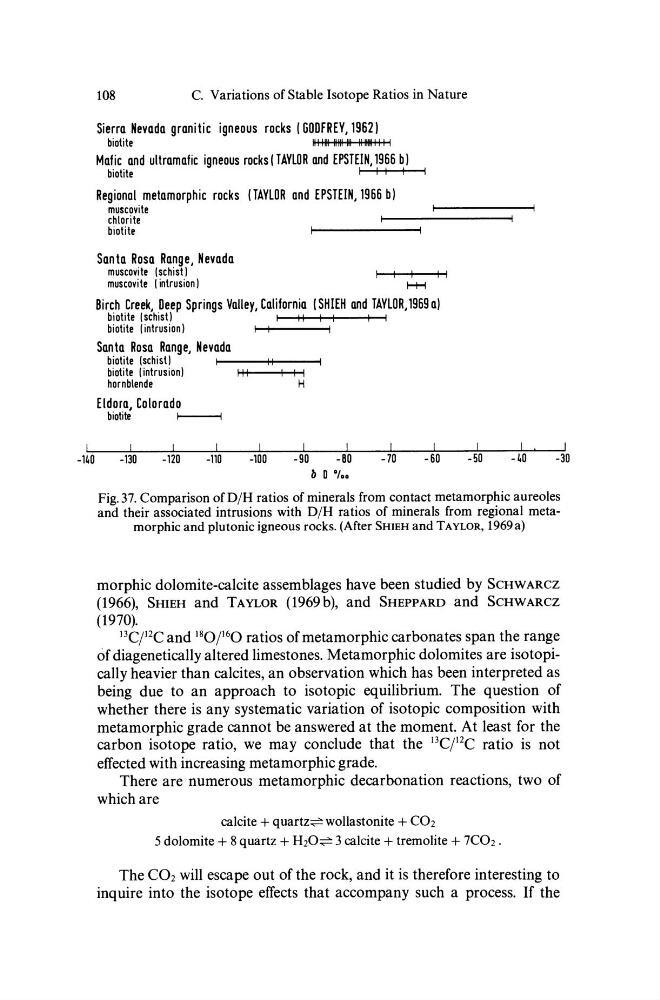
Fig. 37. Comparison ofD/H ratios of minerals from contact metamorphic aureoles
and their associated intrusions with D/H ratios of minerals from regional metamorphic and plutonic igneous rocks. (After SHIEH and TAYLOR, 1969 a)
morphic dolomite-calcite assemblages have been studied by SCHWARCZ
(1966), SHIEH and TAYLOR (1969b), and SHEPPARD and SCHWARCZ
(1970).
13C/l2C and 180j160 ratios of metamorphic carbonates span the range
of diagenetically altered limestones. Metamorphic dolomites are isotopically heavier than calcites, an observation which has been interpreted as
being due to an approach to isotopic equilibrium. The question of
whether there is any systematic variation of isotopic composition with
metamorphic grade cannot be answered at the moment. At least for the
carbon isotope ratio, we may conclude that the 13C/l2C ratio is not
effected with increasing metamorphic grade.
There are numerous metamorphic decarbonation reactions, two of
which are
calcite + quartz¢ wollastonite + C02
5 dolomite + 8 quartz + H20¢ 3 calcite + tremolite + 7C02 .
The CO2 will escape out of the rock, and it is therefore interesting to
inquire into the isotope effects that accompany such a process. If the
108
C. Variations of Stable Isotope Ratios in Nature
Sierra Nevada granitic igneous rocks (GODFREY, 1962)
biotite
1111111111111111111*1111
Mafic and ultramafic igneous rocks (TAYLOR and EPSTEIN, 1966 b)
biotite
I I I I
I
Regional metamorphic rocks (TAYLOR and EPSTEIN, 1966 b)
muscovite
chlorite
biotite
Santa Rosa Range, Nevada
muscovite Ischist)
I I
muscovite (intrusion)
I-H
Birch Creek, Deep Springs Valley, California (SHIEH and TAVlOR,1969 a)
biotite Ischist)
I
II
I I
I I
biotite lintrusion)
I I
I
Santa Rosa Range, Nevada
biotite Ischist)
1-1 ---+l-II---i
biotite I intrusion)
hornblende
Eldora, Colorado
biotite
1----1
-130
-120
-110
III
I I I
H
-100
-90
-80
b D', ••
-70
- 60
-50
-40
-30
Fig. 37. Comparison ofD/H ratios of minerals from contact metamorphic aureoles
and their associated intrusions with D/H ratios of minerals from regional metamorphic and plutonic igneous rocks. (After SHIEH and TAYLOR, 1969 a)
morphic dolomite-calcite assemblages have been studied by SCHWARCZ
(1966), SHIEH and TAYLOR (1969b), and SHEPPARD and SCHWARCZ
(1970).
13C/l2C and 180j160 ratios of metamorphic carbonates span the range
of diagenetically altered limestones. Metamorphic dolomites are isotopically heavier than calcites, an observation which has been interpreted as
being due to an approach to isotopic equilibrium. The question of
whether there is any systematic variation of isotopic composition with
metamorphic grade cannot be answered at the moment. At least for the
carbon isotope ratio, we may conclude that the 13C/l2C ratio is not
effected with increasing metamorphic grade.
There are numerous metamorphic decarbonation reactions, two of
which are
calcite + quartz¢ wollastonite + C02
5 dolomite + 8 quartz + H20¢ 3 calcite + tremolite + 7C02 .
The CO2 will escape out of the rock, and it is therefore interesting to
inquire into the isotope effects that accompany such a process. If the