

94
C. Variations of Stable Isotope Ratios in Nature
to know the quantitative mineralogical and isotope composition of the
pure phases. Quartz in ocean sediments seems to be mostly of detrital
origin. SAVIN and EpSTEIN (1970b) assigned a <5 18 0-value of + 18%0.
Feldspar, too, appears to be mostly of detrital origin and probably has a
<5-value between + 7 and + 10%0. Very few results have been obtained on
the 18 0 j1 6 0 ratios of iron and manganese oxides. SA YIN and EpSTEIN
(1970b) assumed that the isotopic composition of the oxides are similar
to the manganese nodule analyzed W 8 0: + 15%0). With these data, the
average composition of marine shales being relatively similar in mineralogy and chemistry to recent ocean sediments can be calculated. SA YIN
and EpSTEIN (1970b) found a variation range of + 14 to + 19%0 for the
oxygen isotope composition in shales.
<5D-values on the carbonate-free fractions of ocean core samples from
nearly all over the world range from - 55 to - 87%0 (SA YIN and EpSTEIN, 1970b). There is only inconclusive evidence for hydrogen isotopic
exchange between these samples and ocean water.
2. Carbonates
a) Marine Carbonates
The question of the isotopic composition of carbonates is intimately
linked with the term "paleotemperature".
In 1946 UREY presented a paper concerning the thermodynamics of
isotopic systems and suggested that variations in precipitation temperatures of calcium carbonate from water should lead to measurable variations in the 180rO ratio of the calcium carbonate. He postulated that
the determination of temperatures of the ancient oceans should be possible, in principle, by measuring the 180-content of fossil calcite shells.
(One can reasonably assume that only the 180rO ratio of the carbonate
will be temperature dependent, because the amount of water in the
oceans is so much greater than the amount of dissolved carbonate.)
At known water temperatures, EpSTEIN et al. (1953) have shown experimentally that marine organisms such as abalones do secret calcareous shells in chemical equilibrium. EpSTEIN and coworkers obtained the
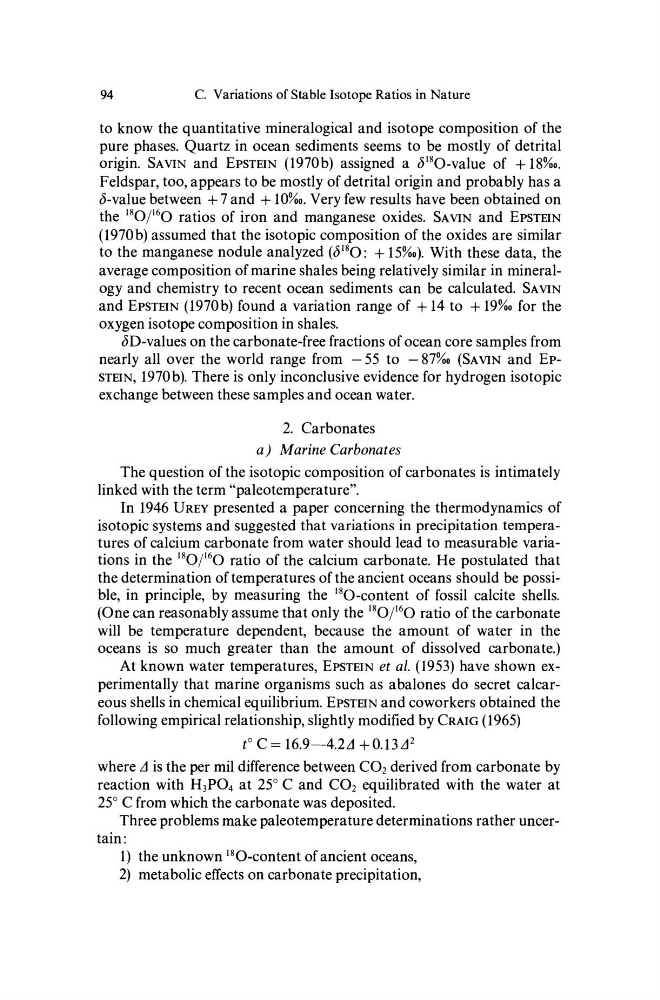
following empirical relationship, slightly modified by CRAIG (1965)
to C = 16.9-4.2,1 + 0.13,12
where ,1 is the per mil difference between CO2 derived from carbonate by
reaction with H3P04 at 25° C and CO2 equilibrated with the water at
2SO C from which the carbonate was deposited.
Three problems make paleotemperature determinations rather uncertain:
1) the unknown 180-content of ancient oceans,
2) metabolic effects on carbonate precipitation,
C. Variations of Stable Isotope Ratios in Nature
to know the quantitative mineralogical and isotope composition of the
pure phases. Quartz in ocean sediments seems to be mostly of detrital
origin. SAVIN and EpSTEIN (1970b) assigned a <5 18 0-value of + 18%0.
Feldspar, too, appears to be mostly of detrital origin and probably has a
<5-value between + 7 and + 10%0. Very few results have been obtained on
the 18 0 j1 6 0 ratios of iron and manganese oxides. SA YIN and EpSTEIN
(1970b) assumed that the isotopic composition of the oxides are similar
to the manganese nodule analyzed W 8 0: + 15%0). With these data, the
average composition of marine shales being relatively similar in mineralogy and chemistry to recent ocean sediments can be calculated. SA YIN
and EpSTEIN (1970b) found a variation range of + 14 to + 19%0 for the
oxygen isotope composition in shales.
<5D-values on the carbonate-free fractions of ocean core samples from
nearly all over the world range from - 55 to - 87%0 (SA YIN and EpSTEIN, 1970b). There is only inconclusive evidence for hydrogen isotopic
exchange between these samples and ocean water.
2. Carbonates
a) Marine Carbonates
The question of the isotopic composition of carbonates is intimately
linked with the term "paleotemperature".
In 1946 UREY presented a paper concerning the thermodynamics of
isotopic systems and suggested that variations in precipitation temperatures of calcium carbonate from water should lead to measurable variations in the 180rO ratio of the calcium carbonate. He postulated that
the determination of temperatures of the ancient oceans should be possible, in principle, by measuring the 180-content of fossil calcite shells.
(One can reasonably assume that only the 180rO ratio of the carbonate
will be temperature dependent, because the amount of water in the
oceans is so much greater than the amount of dissolved carbonate.)
At known water temperatures, EpSTEIN et al. (1953) have shown experimentally that marine organisms such as abalones do secret calcareous shells in chemical equilibrium. EpSTEIN and coworkers obtained the
following empirical relationship, slightly modified by CRAIG (1965)
to C = 16.9-4.2,1 + 0.13,12
where ,1 is the per mil difference between CO2 derived from carbonate by
reaction with H3P04 at 25° C and CO2 equilibrated with the water at
2SO C from which the carbonate was deposited.
Three problems make paleotemperature determinations rather uncertain:
1) the unknown 180-content of ancient oceans,
2) metabolic effects on carbonate precipitation,