

5 Discussion
The main goal of this study was to conduct and compare synchronous acoustical
and optical measurements. A comparison of different methods is required to assess
more thorough information, as each sampling tool suffers its own inefficiencies.
Such concurrent measurements have a great potential to describe zooplankton
assemblages over large scales and have advantage over single method studies.
Acoustic sounding delivers information on distribution of scatterers in the water
column, but exact sizes and abundance remain unknown. LOPC measurements
produce data on size spectra of particles suspended in the water. Additional measurements of environmental parameters (e.g. temperature, salinity) are helpful in
discerning water masses of different properties.
time intervals (5 sec)
depth [m]
50
100 150 200 250 300 350
5
10
15
20
25
30
35
40
Sv [dB]
-90
-85
-80
-75
-70
-65
-60
-55
-50
-45
-40
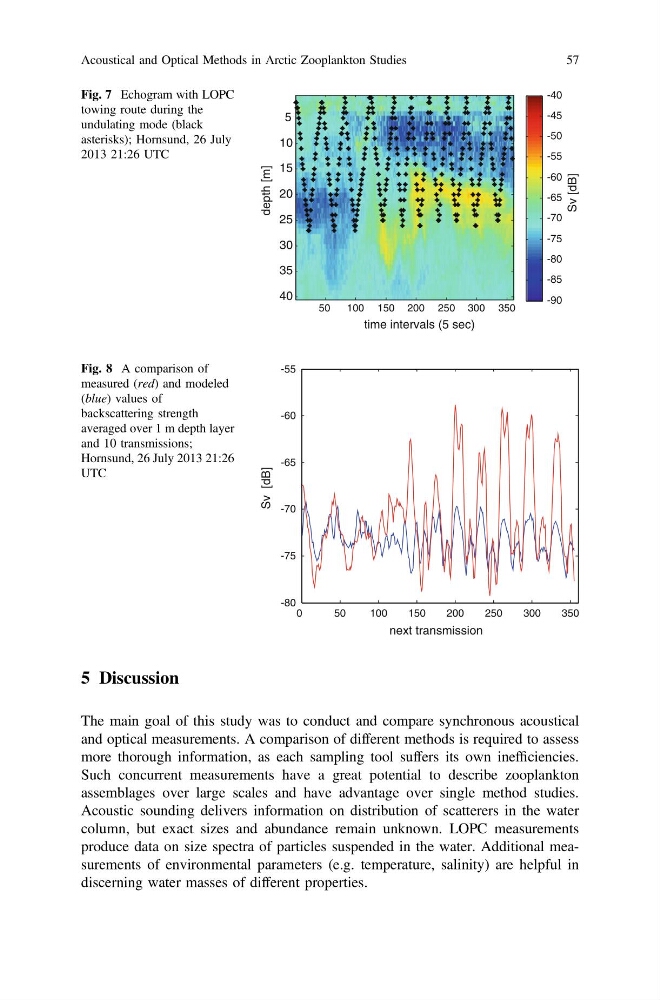
Fig. 7 Echogram with LOPC
towing route during the
undulating mode (black
asterisks); Hornsund, 26 July
2013 21:26 UTC
0
50
100
150
200
250
300
350
-80
-75
-70
-65
-60
-55
Sv [dB]
next transmission
Fig. 8 A comparison of
measured (red) and modeled
(blue) values of
backscattering strength
averaged over 1 m depth layer
and 10 transmissions;
Hornsund, 26 July 2013 21:26
UTC
Acoustical and Optical Methods in Arctic Zooplankton Studies
57
The main goal of this study was to conduct and compare synchronous acoustical
and optical measurements. A comparison of different methods is required to assess
more thorough information, as each sampling tool suffers its own inefficiencies.
Such concurrent measurements have a great potential to describe zooplankton
assemblages over large scales and have advantage over single method studies.
Acoustic sounding delivers information on distribution of scatterers in the water
column, but exact sizes and abundance remain unknown. LOPC measurements
produce data on size spectra of particles suspended in the water. Additional measurements of environmental parameters (e.g. temperature, salinity) are helpful in
discerning water masses of different properties.
time intervals (5 sec)
depth [m]
50
100 150 200 250 300 350
5
10
15
20
25
30
35
40
Sv [dB]
-90
-85
-80
-75
-70
-65
-60
-55
-50
-45
-40
Fig. 7 Echogram with LOPC
towing route during the
undulating mode (black
asterisks); Hornsund, 26 July
2013 21:26 UTC
0
50
100
150
200
250
300
350
-80
-75
-70
-65
-60
-55
Sv [dB]
next transmission
Fig. 8 A comparison of
measured (red) and modeled
(blue) values of
backscattering strength
averaged over 1 m depth layer
and 10 transmissions;
Hornsund, 26 July 2013 21:26
UTC
Acoustical and Optical Methods in Arctic Zooplankton Studies
57