

value was fixed at 2 Hz. The output of the echosounder was a volume backscattering strength S V , which is a logarithmic measure of the volume backscattering
coefficient s V , being the sum of the backscattering cross-sections of all scatterers
enclosed in the ensonified water volume. The output S V values were averaged over
1 m depth layers and 5 s time intervals (including 10 transmissions). The 420 kHz
transducer produces an acoustic signal of about 3 mm wave length, thus it is
possible to detect with this instrument individual zooplankters with the equivalent
spherical radius of 0.5 mm, assuming the criterion of detectability: 2π radius/
wavelength > 1 (Medwin and Clay 1998).
Concurrently with the echosounding, Laser Optical Plankton Counter—LOPC
(Brook Ocean Technology Dartmouth, Canada) was hauled alongside the ship,
performing continuous measurements during cruising. LOPC is the in situ instrument which provides data on abundance and size structure of particles and plankton
in the water. The system used in this study allows us to obtain information on size
spectra for particles (including particulate matter and plankton) in the size range
from 100 μm to 35 mm Equivalent Spherical Diameter (ESD). LOPC was working
in an undulating mode from the surface to 25 m depth (occasionally reaching 50 m
depth) with the pulse rate fixed at 2 Hz. Additionally, during the LOPC survey,
distribution of other environmental parameters such as salinity, temperature and
fluorescence, were measured by the probes mounted on the same towing body.
Establishing quantitative relationship between the acoustic backscattered signal
and the zooplankton abundance, its size and taxonomic structure is a complex
problem. The acoustic scattering intensity depends on the wave frequency and the
scatterers’ size, shape, age, concentration, orientation, and material properties
(sound speed and density ratios). Because of this complexity, development of
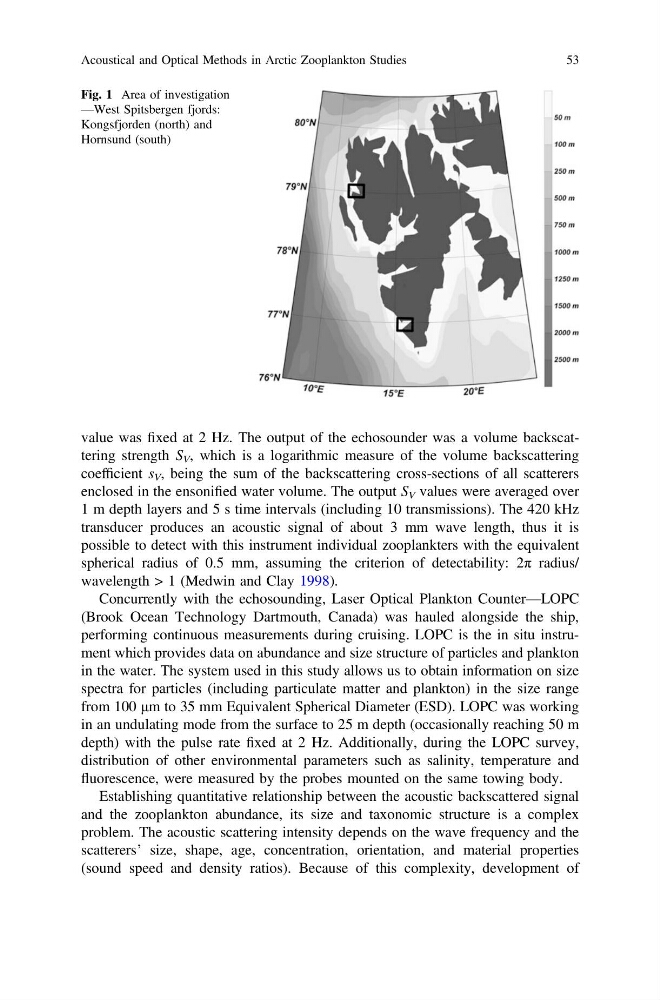
Fig. 1 Area of investigation
—West Spitsbergen fjords:
Kongsfjorden (north) and
Hornsund (south)
Acoustical and Optical Methods in Arctic Zooplankton Studies
53
coefficient s V , being the sum of the backscattering cross-sections of all scatterers
enclosed in the ensonified water volume. The output S V values were averaged over
1 m depth layers and 5 s time intervals (including 10 transmissions). The 420 kHz
transducer produces an acoustic signal of about 3 mm wave length, thus it is
possible to detect with this instrument individual zooplankters with the equivalent
spherical radius of 0.5 mm, assuming the criterion of detectability: 2π radius/
wavelength > 1 (Medwin and Clay 1998).
Concurrently with the echosounding, Laser Optical Plankton Counter—LOPC
(Brook Ocean Technology Dartmouth, Canada) was hauled alongside the ship,
performing continuous measurements during cruising. LOPC is the in situ instrument which provides data on abundance and size structure of particles and plankton
in the water. The system used in this study allows us to obtain information on size
spectra for particles (including particulate matter and plankton) in the size range
from 100 μm to 35 mm Equivalent Spherical Diameter (ESD). LOPC was working
in an undulating mode from the surface to 25 m depth (occasionally reaching 50 m
depth) with the pulse rate fixed at 2 Hz. Additionally, during the LOPC survey,
distribution of other environmental parameters such as salinity, temperature and
fluorescence, were measured by the probes mounted on the same towing body.
Establishing quantitative relationship between the acoustic backscattered signal
and the zooplankton abundance, its size and taxonomic structure is a complex
problem. The acoustic scattering intensity depends on the wave frequency and the
scatterers’ size, shape, age, concentration, orientation, and material properties
(sound speed and density ratios). Because of this complexity, development of
Fig. 1 Area of investigation
—West Spitsbergen fjords:
Kongsfjorden (north) and
Hornsund (south)
Acoustical and Optical Methods in Arctic Zooplankton Studies
53