

4 Conclusions
The results obtained from our studies indicate strong shift in aerosol size distribution due to the impact of the wave breaking. Despite small number of measurement points due to adverse weather conditions (cloudiness) with very
advantageous wind directions and speeds during the five measurement days we
were able to show a local change in the aerosol ensemble. During all studied days
we registered AOD of an order of magnitude higher at the CRS station than at the
AERONET station in Birkenes a day before (with wind speed and direction this
should have been the same air mass). With high breaking waves and a large
breaking zone (500 m) local production of sea salt must have been significantly
increased. This is confirmed by a relatively low Ängström values around 0.6–0.7,
versus around 1.7 in Birkenes. Such situation changes the local aerosol situation
and thus their radiative properties which directly influence the radiative forcing.
Even though we show a local phenomenon, it may have a more spatial impact and
this needs further studies.
Acknowledgments The support for this study was partly provided by the project Satellite
Monitoring of the Baltic Sea Environment—SatBałtyk founded by European Union through
European Regional Development Fund contract No. POIG 01.01.02-22-011/09. It has also been
made within the framework of the NASA/AERONET Program.
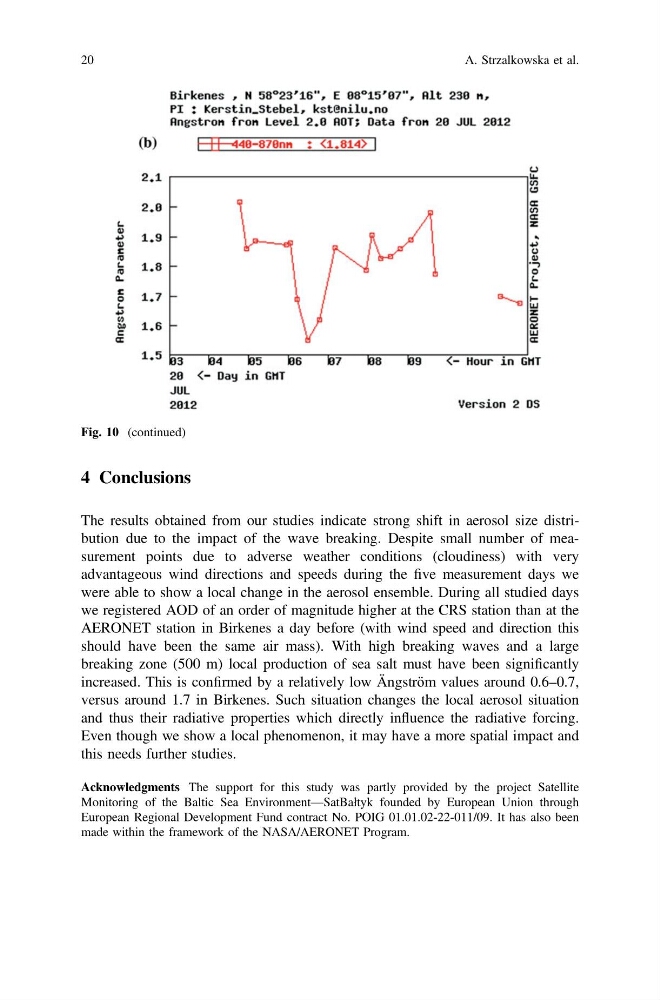
Fig. 10 (continued)
20
A. Strzalkowska et al.
The results obtained from our studies indicate strong shift in aerosol size distribution due to the impact of the wave breaking. Despite small number of measurement points due to adverse weather conditions (cloudiness) with very
advantageous wind directions and speeds during the five measurement days we
were able to show a local change in the aerosol ensemble. During all studied days
we registered AOD of an order of magnitude higher at the CRS station than at the
AERONET station in Birkenes a day before (with wind speed and direction this
should have been the same air mass). With high breaking waves and a large
breaking zone (500 m) local production of sea salt must have been significantly
increased. This is confirmed by a relatively low Ängström values around 0.6–0.7,
versus around 1.7 in Birkenes. Such situation changes the local aerosol situation
and thus their radiative properties which directly influence the radiative forcing.
Even though we show a local phenomenon, it may have a more spatial impact and
this needs further studies.
Acknowledgments The support for this study was partly provided by the project Satellite
Monitoring of the Baltic Sea Environment—SatBałtyk founded by European Union through
European Regional Development Fund contract No. POIG 01.01.02-22-011/09. It has also been
made within the framework of the NASA/AERONET Program.
Fig. 10 (continued)
20
A. Strzalkowska et al.