

NOAA HYSPLIT Trajectory Model shows that the air masses were advected to
the CRS station from the west. The air masses passed two AERONET station on the
way, the Birkenes station and the Palgrunden station (on 16 July the average AOD
was 0.068 at 555 nm). Similar to 17 July 2012 the average daily wind speed of
20 km/h on 18 July the same air masses passed the AERONET station in Birkenes
some 35 h before the CRS station. The AOD and Ängström exponent measured at
the Birkenes station on 17 July are presented in Fig. 6a, b.
The average AOD at 500 nm at the Birkenes station was 0.050 and the Ängström
exponent—1.803. These values indicate clear air and with presence of rather small
particles. This situation is confirmed by the fine (0.045) to coarse ratio (0.006) for
that day. Again these values are one order of magnitude lower than those obtained
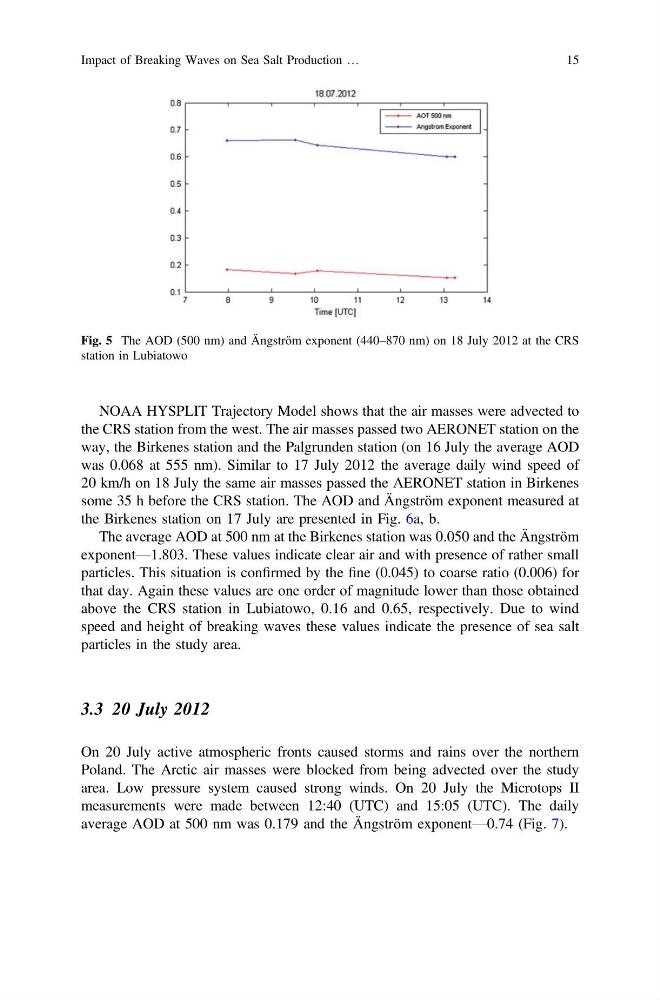
above the CRS station in Lubiatowo, 0.16 and 0.65, respectively. Due to wind
speed and height of breaking waves these values indicate the presence of sea salt
particles in the study area.
3.3 20 July 2012
On 20 July active atmospheric fronts caused storms and rains over the northern
Poland. The Arctic air masses were blocked from being advected over the study
area. Low pressure system caused strong winds. On 20 July the Microtops II
measurements were made between 12:40 (UTC) and 15:05 (UTC). The daily
average AOD at 500 nm was 0.179 and the Ängström exponent—0.74 (Fig. 7).
Fig. 5 The AOD (500 nm) and Ängström exponent (440–870 nm) on 18 July 2012 at the CRS
station in Lubiatowo
Impact of Breaking Waves on Sea Salt Production …
15
the CRS station from the west. The air masses passed two AERONET station on the
way, the Birkenes station and the Palgrunden station (on 16 July the average AOD
was 0.068 at 555 nm). Similar to 17 July 2012 the average daily wind speed of
20 km/h on 18 July the same air masses passed the AERONET station in Birkenes
some 35 h before the CRS station. The AOD and Ängström exponent measured at
the Birkenes station on 17 July are presented in Fig. 6a, b.
The average AOD at 500 nm at the Birkenes station was 0.050 and the Ängström
exponent—1.803. These values indicate clear air and with presence of rather small
particles. This situation is confirmed by the fine (0.045) to coarse ratio (0.006) for
that day. Again these values are one order of magnitude lower than those obtained
above the CRS station in Lubiatowo, 0.16 and 0.65, respectively. Due to wind
speed and height of breaking waves these values indicate the presence of sea salt
particles in the study area.
3.3 20 July 2012
On 20 July active atmospheric fronts caused storms and rains over the northern
Poland. The Arctic air masses were blocked from being advected over the study
area. Low pressure system caused strong winds. On 20 July the Microtops II
measurements were made between 12:40 (UTC) and 15:05 (UTC). The daily
average AOD at 500 nm was 0.179 and the Ängström exponent—0.74 (Fig. 7).
Fig. 5 The AOD (500 nm) and Ängström exponent (440–870 nm) on 18 July 2012 at the CRS
station in Lubiatowo
Impact of Breaking Waves on Sea Salt Production …
15