

masses passed the AERONET station some 35 h before the CRS station. The
average daily AOD at 500 nm (Level 2) on 16 July in Birkenes was 0.053 and the
Angstrom exponent (440–870 nm) equaled to 1.469, indicating presence of rather
small particles in the air (Fig. 4a, b). This observation is also supported by a
dominating role of fine mode over the coarse particles measured in Birkenes.
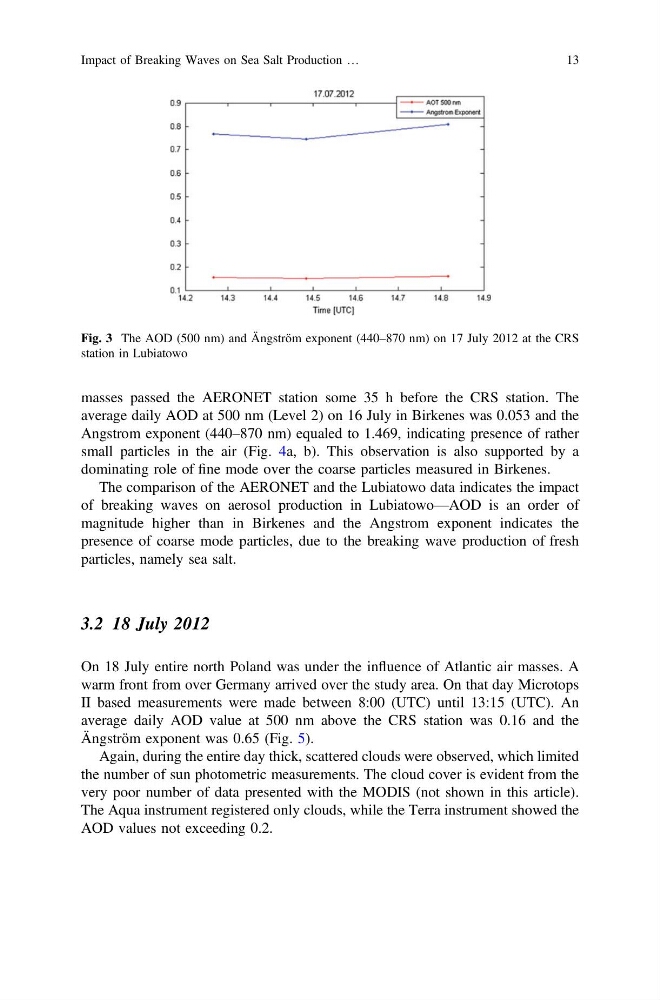
The comparison of the AERONET and the Lubiatowo data indicates the impact
of breaking waves on aerosol production in Lubiatowo—AOD is an order of
magnitude higher than in Birkenes and the Angstrom exponent indicates the
presence of coarse mode particles, due to the breaking wave production of fresh
particles, namely sea salt.
3.2 18 July 2012
On 18 July entire north Poland was under the influence of Atlantic air masses. A
warm front from over Germany arrived over the study area. On that day Microtops
II based measurements were made between 8:00 (UTC) until 13:15 (UTC). An
average daily AOD value at 500 nm above the CRS station was 0.16 and the
Ängström exponent was 0.65 (Fig. 5).
Again, during the entire day thick, scattered clouds were observed, which limited
the number of sun photometric measurements. The cloud cover is evident from the
very poor number of data presented with the MODIS (not shown in this article).
The Aqua instrument registered only clouds, while the Terra instrument showed the
AOD values not exceeding 0.2.
Fig. 3 The AOD (500 nm) and Ängström exponent (440–870 nm) on 17 July 2012 at the CRS
station in Lubiatowo
Impact of Breaking Waves on Sea Salt Production …
13
average daily AOD at 500 nm (Level 2) on 16 July in Birkenes was 0.053 and the
Angstrom exponent (440–870 nm) equaled to 1.469, indicating presence of rather
small particles in the air (Fig. 4a, b). This observation is also supported by a
dominating role of fine mode over the coarse particles measured in Birkenes.
The comparison of the AERONET and the Lubiatowo data indicates the impact
of breaking waves on aerosol production in Lubiatowo—AOD is an order of
magnitude higher than in Birkenes and the Angstrom exponent indicates the
presence of coarse mode particles, due to the breaking wave production of fresh
particles, namely sea salt.
3.2 18 July 2012
On 18 July entire north Poland was under the influence of Atlantic air masses. A
warm front from over Germany arrived over the study area. On that day Microtops
II based measurements were made between 8:00 (UTC) until 13:15 (UTC). An
average daily AOD value at 500 nm above the CRS station was 0.16 and the
Ängström exponent was 0.65 (Fig. 5).
Again, during the entire day thick, scattered clouds were observed, which limited
the number of sun photometric measurements. The cloud cover is evident from the
very poor number of data presented with the MODIS (not shown in this article).
The Aqua instrument registered only clouds, while the Terra instrument showed the
AOD values not exceeding 0.2.
Fig. 3 The AOD (500 nm) and Ängström exponent (440–870 nm) on 17 July 2012 at the CRS
station in Lubiatowo
Impact of Breaking Waves on Sea Salt Production …
13