

seafloor, and the dilution by the non-carbonate fraction (Peterson et al. 2000;
Bozzano et al. 2002; Jansen et al. 1998; Richter et al. 2006; Łącka et al. 2014).
During interglacial conditions, this concentration is mainly controlled by the
productivity of carbonate secreting organisms, such as foraminifera and coccolithophores (Hebbeln et al. 1998; Matthiessen et al. 2001). Ca/K and Ca/Ti ratios
may be used as a preliminary down-core overview of sedimentary variability and
for stratigraphic correlations between unprocessed marine cores (Hennekam and de
Lange 2012). MS and Fe records exhibit similar patterns (i.e., high MS corresponds
to high Fe intensity) because both signals reflect the concentration of iron (oxide)bearing minerals (Westerhold et al. 2008; Łącka et al. 2014).
3 Summary
In recent years, numerous new proxies have been developed for the reconstruction
of past environmental conditions in the Arctic region. Some (e.g., IP 25 and PIP 25 )
have been created specifically for this region, while others have been successfully
adapted to the polar regions after additional calibrations. For example, U
K
37 was used
in polar waters in the 1990s but gave false results with anomalously high temperatures during the Last Glacial Maximum (Rosell-Melé and Comes 1999), while
it is currently used successfully in the Arctic. However, several established proxies
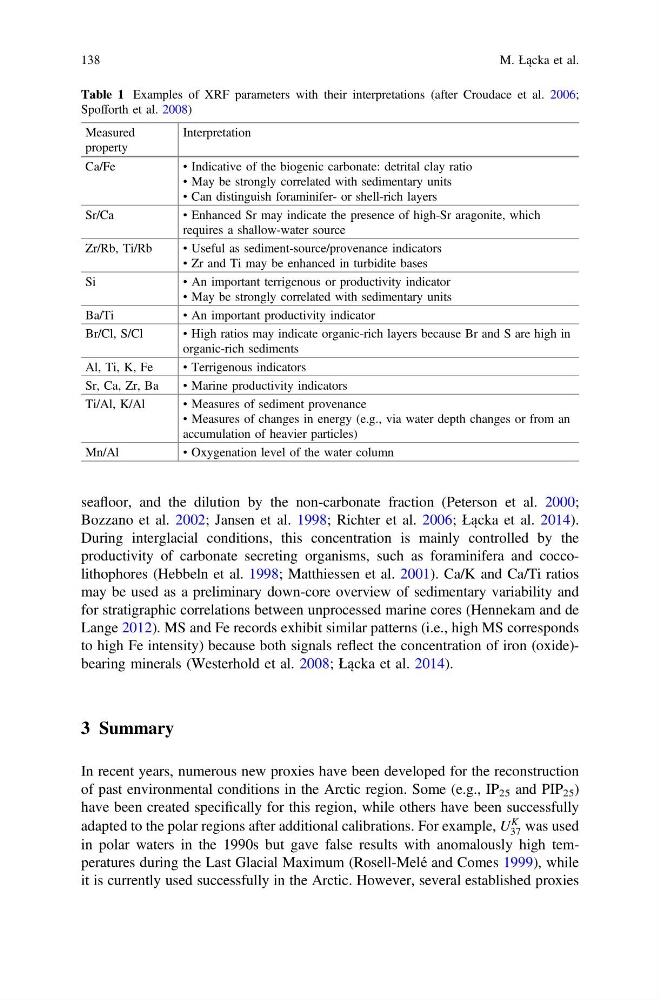
Table 1 Examples of XRF parameters with their interpretations (after Croudace et al. 2006;
Spofforth et al. 2008)
Measured
property
Interpretation
Ca/Fe
• Indicative of the biogenic carbonate: detrital clay ratio
• May be strongly correlated with sedimentary units
• Can distinguish foraminifer- or shell-rich layers
Sr/Ca
• Enhanced Sr may indicate the presence of high-Sr aragonite, which
requires a shallow-water source
Zr/Rb, Ti/Rb
• Useful as sediment-source/provenance indicators
• Zr and Ti may be enhanced in turbidite bases
Si
• An important terrigenous or productivity indicator
• May be strongly correlated with sedimentary units
Ba/Ti
• An important productivity indicator
Br/Cl, S/Cl
• High ratios may indicate organic-rich layers because Br and S are high in
organic-rich sediments
Al, Ti, K, Fe
• Terrigenous indicators
Sr, Ca, Zr, Ba
• Marine productivity indicators
Ti/Al, K/Al
• Measures of sediment provenance
• Measures of changes in energy (e.g., via water depth changes or from an
accumulation of heavier particles)
Mn/Al
• Oxygenation level of the water column
138
M. Łącka et al.
Bozzano et al. 2002; Jansen et al. 1998; Richter et al. 2006; Łącka et al. 2014).
During interglacial conditions, this concentration is mainly controlled by the
productivity of carbonate secreting organisms, such as foraminifera and coccolithophores (Hebbeln et al. 1998; Matthiessen et al. 2001). Ca/K and Ca/Ti ratios
may be used as a preliminary down-core overview of sedimentary variability and
for stratigraphic correlations between unprocessed marine cores (Hennekam and de
Lange 2012). MS and Fe records exhibit similar patterns (i.e., high MS corresponds
to high Fe intensity) because both signals reflect the concentration of iron (oxide)bearing minerals (Westerhold et al. 2008; Łącka et al. 2014).
3 Summary
In recent years, numerous new proxies have been developed for the reconstruction
of past environmental conditions in the Arctic region. Some (e.g., IP 25 and PIP 25 )
have been created specifically for this region, while others have been successfully
adapted to the polar regions after additional calibrations. For example, U
K
37 was used
in polar waters in the 1990s but gave false results with anomalously high temperatures during the Last Glacial Maximum (Rosell-Melé and Comes 1999), while
it is currently used successfully in the Arctic. However, several established proxies
Table 1 Examples of XRF parameters with their interpretations (after Croudace et al. 2006;
Spofforth et al. 2008)
Measured
property
Interpretation
Ca/Fe
• Indicative of the biogenic carbonate: detrital clay ratio
• May be strongly correlated with sedimentary units
• Can distinguish foraminifer- or shell-rich layers
Sr/Ca
• Enhanced Sr may indicate the presence of high-Sr aragonite, which
requires a shallow-water source
Zr/Rb, Ti/Rb
• Useful as sediment-source/provenance indicators
• Zr and Ti may be enhanced in turbidite bases
Si
• An important terrigenous or productivity indicator
• May be strongly correlated with sedimentary units
Ba/Ti
• An important productivity indicator
Br/Cl, S/Cl
• High ratios may indicate organic-rich layers because Br and S are high in
organic-rich sediments
Al, Ti, K, Fe
• Terrigenous indicators
Sr, Ca, Zr, Ba
• Marine productivity indicators
Ti/Al, K/Al
• Measures of sediment provenance
• Measures of changes in energy (e.g., via water depth changes or from an
accumulation of heavier particles)
Mn/Al
• Oxygenation level of the water column
138
M. Łącka et al.