

waters was noted. Similar hydrological conditions were observed by Iversen and
Seuthe (2011) in Kongsfjorden in July 2006.
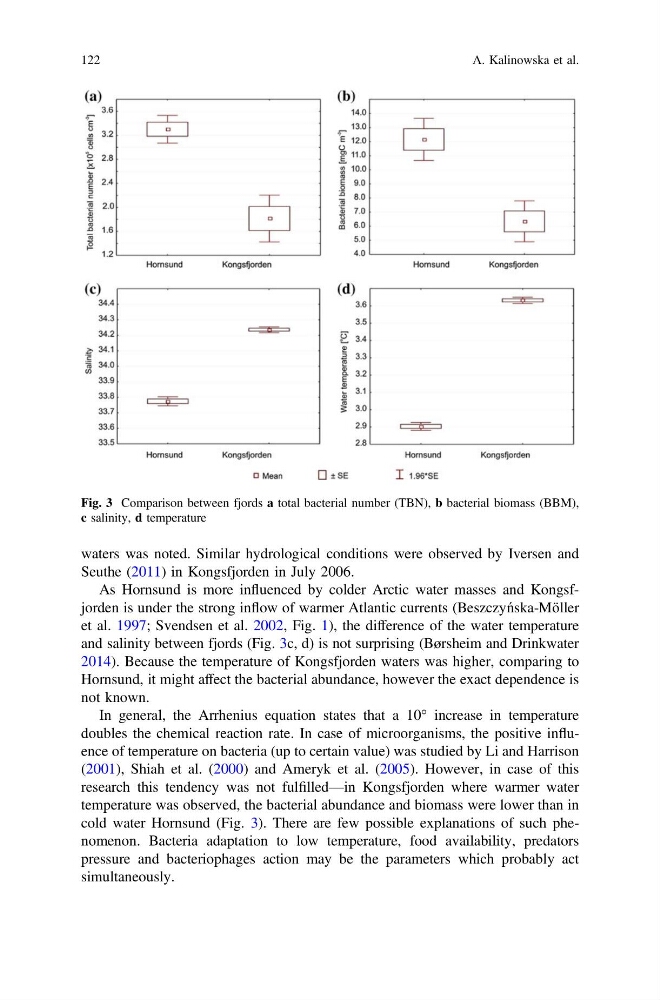
As Hornsund is more influenced by colder Arctic water masses and Kongsfjorden is under the strong inflow of warmer Atlantic currents (Beszczyńska-Möller
et al. 1997; Svendsen et al. 2002, Fig. 1), the difference of the water temperature
and salinity between fjords (Fig. 3c, d) is not surprising (Børsheim and Drinkwater
2014). Because the temperature of Kongsfjorden waters was higher, comparing to
Hornsund, it might affect the bacterial abundance, however the exact dependence is
not known.
In general, the Arrhenius equation states that a 10° increase in temperature
doubles the chemical reaction rate. In case of microorganisms, the positive influence of temperature on bacteria (up to certain value) was studied by Li and Harrison
(2001), Shiah et al. (2000) and Ameryk et al. (2005). However, in case of this
research this tendency was not fulfilled—in Kongsfjorden where warmer water
temperature was observed, the bacterial abundance and biomass were lower than in
cold water Hornsund (Fig. 3). There are few possible explanations of such phenomenon. Bacteria adaptation to low temperature, food availability, predators
pressure and bacteriophages action may be the parameters which probably act
simultaneously.
Fig. 3 Comparison between fjords a total bacterial number (TBN), b bacterial biomass (BBM),
c salinity, d temperature
122
A. Kalinowska et al.
Seuthe (2011) in Kongsfjorden in July 2006.
As Hornsund is more influenced by colder Arctic water masses and Kongsfjorden is under the strong inflow of warmer Atlantic currents (Beszczyńska-Möller
et al. 1997; Svendsen et al. 2002, Fig. 1), the difference of the water temperature
and salinity between fjords (Fig. 3c, d) is not surprising (Børsheim and Drinkwater
2014). Because the temperature of Kongsfjorden waters was higher, comparing to
Hornsund, it might affect the bacterial abundance, however the exact dependence is
not known.
In general, the Arrhenius equation states that a 10° increase in temperature
doubles the chemical reaction rate. In case of microorganisms, the positive influence of temperature on bacteria (up to certain value) was studied by Li and Harrison
(2001), Shiah et al. (2000) and Ameryk et al. (2005). However, in case of this
research this tendency was not fulfilled—in Kongsfjorden where warmer water
temperature was observed, the bacterial abundance and biomass were lower than in
cold water Hornsund (Fig. 3). There are few possible explanations of such phenomenon. Bacteria adaptation to low temperature, food availability, predators
pressure and bacteriophages action may be the parameters which probably act
simultaneously.
Fig. 3 Comparison between fjords a total bacterial number (TBN), b bacterial biomass (BBM),
c salinity, d temperature
122
A. Kalinowska et al.