

2 Materials and Methods
2.1 Investigated Area
A microbiological study described in this paper was conducted on Spitsbergen
(Svalbard) between the 27th of July and the 9th of August 2013, in the framework
of the Growth of Arctic Marine Ecosystem project (GAME) from onboard the r/v
Oceania (Institute of Oceanology, Polish Academy of Sciences). A research survey
was conducted in two Arctic glacial fjords: Kongsfjorden and Hornsund. They are
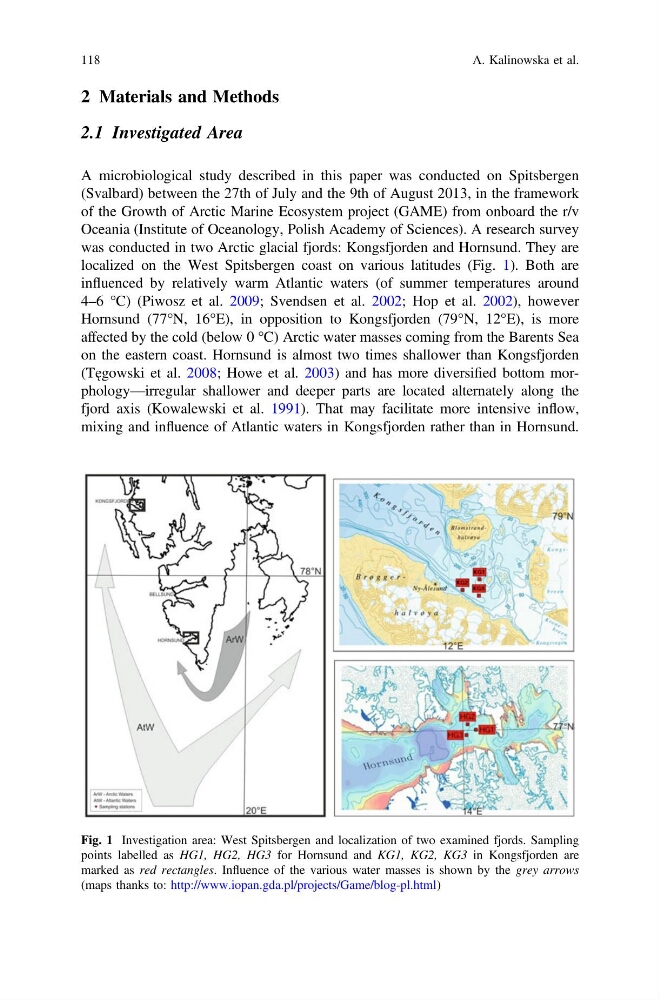
localized on the West Spitsbergen coast on various latitudes (Fig. 1). Both are
influenced by relatively warm Atlantic waters (of summer temperatures around
4–6 °C) (Piwosz et al. 2009; Svendsen et al. 2002; Hop et al. 2002), however
Hornsund (77°N, 16°E), in opposition to Kongsfjorden (79°N, 12°E), is more
affected by the cold (below 0 °C) Arctic water masses coming from the Barents Sea
on the eastern coast. Hornsund is almost two times shallower than Kongsfjorden
(Tęgowski et al. 2008; Howe et al. 2003) and has more diversified bottom morphology—irregular shallower and deeper parts are located alternately along the
fjord axis (Kowalewski et al. 1991). That may facilitate more intensive inflow,
mixing and influence of Atlantic waters in Kongsfjorden rather than in Hornsund.
Fig. 1 Investigation area: West Spitsbergen and localization of two examined fjords. Sampling
points labelled as HG1, HG2, HG3 for Hornsund and KG1, KG2, KG3 in Kongsfjorden are
marked as red rectangles. Influence of the various water masses is shown by the grey arrows
(maps thanks to: http://www.iopan.gda.pl/projects/Game/blog-pl.html)
118
A. Kalinowska et al.
2.1 Investigated Area
A microbiological study described in this paper was conducted on Spitsbergen
(Svalbard) between the 27th of July and the 9th of August 2013, in the framework
of the Growth of Arctic Marine Ecosystem project (GAME) from onboard the r/v
Oceania (Institute of Oceanology, Polish Academy of Sciences). A research survey
was conducted in two Arctic glacial fjords: Kongsfjorden and Hornsund. They are
localized on the West Spitsbergen coast on various latitudes (Fig. 1). Both are
influenced by relatively warm Atlantic waters (of summer temperatures around
4–6 °C) (Piwosz et al. 2009; Svendsen et al. 2002; Hop et al. 2002), however
Hornsund (77°N, 16°E), in opposition to Kongsfjorden (79°N, 12°E), is more
affected by the cold (below 0 °C) Arctic water masses coming from the Barents Sea
on the eastern coast. Hornsund is almost two times shallower than Kongsfjorden
(Tęgowski et al. 2008; Howe et al. 2003) and has more diversified bottom morphology—irregular shallower and deeper parts are located alternately along the
fjord axis (Kowalewski et al. 1991). That may facilitate more intensive inflow,
mixing and influence of Atlantic waters in Kongsfjorden rather than in Hornsund.
Fig. 1 Investigation area: West Spitsbergen and localization of two examined fjords. Sampling
points labelled as HG1, HG2, HG3 for Hornsund and KG1, KG2, KG3 in Kongsfjorden are
marked as red rectangles. Influence of the various water masses is shown by the grey arrows
(maps thanks to: http://www.iopan.gda.pl/projects/Game/blog-pl.html)
118
A. Kalinowska et al.