

Section 14.3: Singular Spectrum Analysis
263
of a "signal" vector, reflected by a few components, and a "noise" vector
reflected by the flat tail of the eigenvalue spectrum. The truncation to the
significant components provides an approximation of the attractor as a flat
subspace of the delay-coordinate space. In the original-coordinate space, this
flat subspace is distorted by the nonlinearity of the embedding IP, leading to
a more general approximation of the attractor by a smooth manifold of the
same dimension as the number of significant directions.
This "macroscopic" approximation has, however, a dynamical implication
that is not shared by classical EOF analysis. Since each principal component
is a linear combination of the value of Xt,i taken at different lags, cancelling
one component automatically leads to the assumption that the time series
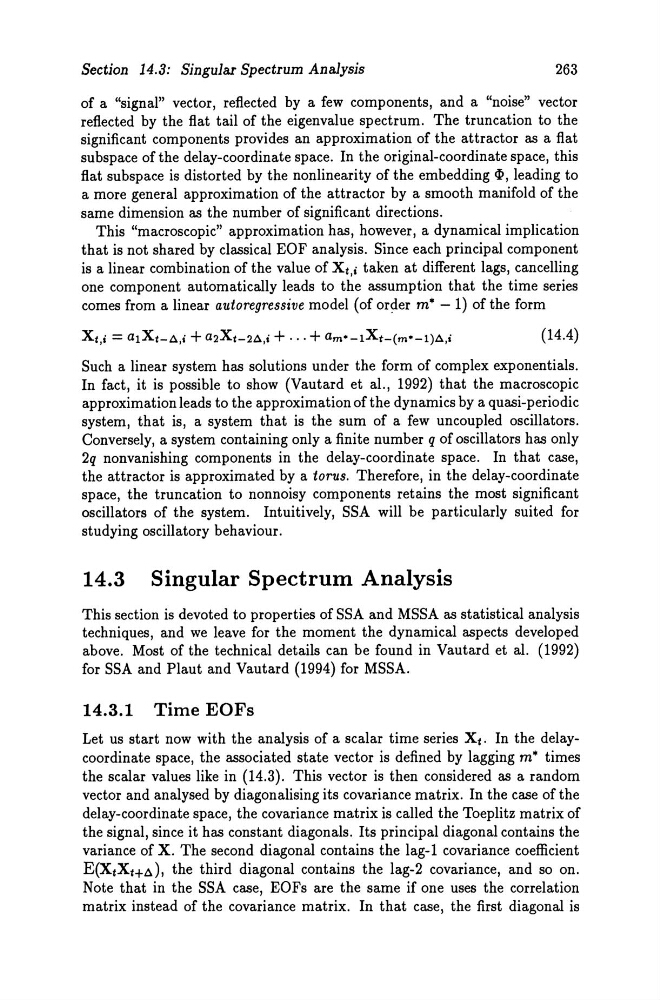
comes from a linear autoregressive model (of or~er m* - 1) of the form
(14.4)
Such a linear system has solutions under the form of complex exponentials.
In fact, it is possible to show (Vautard et al. , 1992) that the macroscopic
approximation leads to the approximation of the dynamics by a quasi-periodic
system, that is, a system that is the sum of a few uncoupled oscillators.
Conversely, a system containing only a finite number q of oscillators has only
2q nonvanishing components in the delay-coordinate space. In that case,
the attractor is approximated by a torus. Therefore, in the delay-coordinate
space, the truncation to nonnoisy components retains the most significant
oscillators of the system. Intuitively, SSA will be particularly suited for
studying oscillatory behaviour.
14.3 Singular Spectrum Analysis
This section is devoted to properties of SSA and MSSA as statistical analysis
techniques, and we leave for the moment the dynamical aspects developed
above. Most of the technical details can be found in Vautard et al. (1992)
for SSA and Plaut and Vautard (1994) for MSSA.
14.3.1 Time EOFs
Let us start now with the analysis of a scalar time series X t . In the delaycoordinate space, the associated state vector is defined by lagging m* times
the scalar values like in (14.3). This vector is then considered as a random
vector and analysed by diagonalising its covariance matrix. In the case of the
delay-coordinate space, the covariance matrix is called the Toeplitz matrix of
the signal, since it has constant diagonals. Its principal diagonal contains the
variance of X. The second diagonal contains the lag-1 covariance coefficient
E(XtXt+t.), the third diagonal contains the lag-2 covariance, and so on.
Note that in the SSA case, EOFs are the same if one uses the correlation
matrix instead of the covariance matrix. In that case, the first diagonal is
263
of a "signal" vector, reflected by a few components, and a "noise" vector
reflected by the flat tail of the eigenvalue spectrum. The truncation to the
significant components provides an approximation of the attractor as a flat
subspace of the delay-coordinate space. In the original-coordinate space, this
flat subspace is distorted by the nonlinearity of the embedding IP, leading to
a more general approximation of the attractor by a smooth manifold of the
same dimension as the number of significant directions.
This "macroscopic" approximation has, however, a dynamical implication
that is not shared by classical EOF analysis. Since each principal component
is a linear combination of the value of Xt,i taken at different lags, cancelling
one component automatically leads to the assumption that the time series
comes from a linear autoregressive model (of or~er m* - 1) of the form
(14.4)
Such a linear system has solutions under the form of complex exponentials.
In fact, it is possible to show (Vautard et al. , 1992) that the macroscopic
approximation leads to the approximation of the dynamics by a quasi-periodic
system, that is, a system that is the sum of a few uncoupled oscillators.
Conversely, a system containing only a finite number q of oscillators has only
2q nonvanishing components in the delay-coordinate space. In that case,
the attractor is approximated by a torus. Therefore, in the delay-coordinate
space, the truncation to nonnoisy components retains the most significant
oscillators of the system. Intuitively, SSA will be particularly suited for
studying oscillatory behaviour.
14.3 Singular Spectrum Analysis
This section is devoted to properties of SSA and MSSA as statistical analysis
techniques, and we leave for the moment the dynamical aspects developed
above. Most of the technical details can be found in Vautard et al. (1992)
for SSA and Plaut and Vautard (1994) for MSSA.
14.3.1 Time EOFs
Let us start now with the analysis of a scalar time series X t . In the delaycoordinate space, the associated state vector is defined by lagging m* times
the scalar values like in (14.3). This vector is then considered as a random
vector and analysed by diagonalising its covariance matrix. In the case of the
delay-coordinate space, the covariance matrix is called the Toeplitz matrix of
the signal, since it has constant diagonals. Its principal diagonal contains the
variance of X. The second diagonal contains the lag-1 covariance coefficient
E(XtXt+t.), the third diagonal contains the lag-2 covariance, and so on.
Note that in the SSA case, EOFs are the same if one uses the correlation
matrix instead of the covariance matrix. In that case, the first diagonal is