

Section 14.2: Reconstruction and Approximation of Attractors
261
or, equivalently, initially elose-by states diverge exponentially with time. For
such systems, the limit set of possible states after a long time of integration,
called the attractor, has a complex topological structure. A complete picture of the attractor, which is possible only for low-order systems such as
the Lorenz (1963) system, provides considerable insight into the system's dynamics. In order to compute this attractor, one is left with two possibilities.
Either one uses approximate equations, which is the modeler's job, or we use
observations, which is the analyser's job.
There has been recently a considerable interest in the second possibility,
that is, the reconstruction of the nonlinear dynamics from time series of
observations. This interest has been motivated by the Takens (1981) theory,
based on the less recent Whitney embedding theorem: If one disposes of an
infinite series of successive values of a single coordinate of Xt, say Xi,t, it is
possible to define astate vector Y t that has the same topological properties
as Xt. That is to say, only one variable suffices to reconstruct the attractor.
In fact, the theorem is more general: For almost every measurement function,
Le., function of the variables only, the vector Y t can be constructed, and has
the same topology as Xt • N aturally, if one is unlucky by measuring a quantity
that is not coupled to the full system, the theorem fails. This situation has a
zero prob ability to occur, however. Therefore, in principle, the global elimate
could be completely reconstructed by an infinite series of measurements at a
given location. This new state vector is defined by embedding the time series
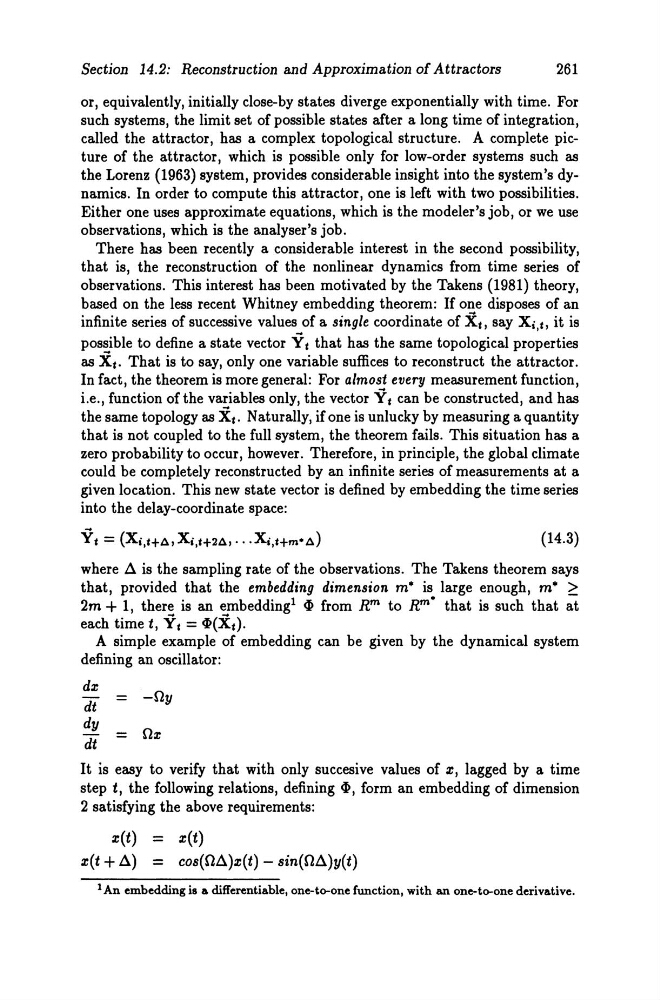
into the delay-coordinate space:
(14.3)
where Ll is the sampling rate of the observations. The Takens theorem says
that, provided that the embedding dimension m· is large enough, m· ;:::
2m + 1, there is an embedding 1 ~ from R m to R m • that is such that at
each time t, Yt = CJ.>(Xt ).
A simple example of embedding can be given by the dynamical system
defining an oscillator:
dx
dt
dy
dt
It is easy to verify that with only succesive values of x, lagged by a time
step t, the following relations, defining ~, form an embedding of dimension
2 satisfying the above requirements:
x(t) = x(t)
x(t + Ll) = cos(OLl)x(t) - sin(OLl)y(t)
1 An embedding is a differentiable, one-to-one function, with an one-to-one derivative.
261
or, equivalently, initially elose-by states diverge exponentially with time. For
such systems, the limit set of possible states after a long time of integration,
called the attractor, has a complex topological structure. A complete picture of the attractor, which is possible only for low-order systems such as
the Lorenz (1963) system, provides considerable insight into the system's dynamics. In order to compute this attractor, one is left with two possibilities.
Either one uses approximate equations, which is the modeler's job, or we use
observations, which is the analyser's job.
There has been recently a considerable interest in the second possibility,
that is, the reconstruction of the nonlinear dynamics from time series of
observations. This interest has been motivated by the Takens (1981) theory,
based on the less recent Whitney embedding theorem: If one disposes of an
infinite series of successive values of a single coordinate of Xt, say Xi,t, it is
possible to define astate vector Y t that has the same topological properties
as Xt. That is to say, only one variable suffices to reconstruct the attractor.
In fact, the theorem is more general: For almost every measurement function,
Le., function of the variables only, the vector Y t can be constructed, and has
the same topology as Xt • N aturally, if one is unlucky by measuring a quantity
that is not coupled to the full system, the theorem fails. This situation has a
zero prob ability to occur, however. Therefore, in principle, the global elimate
could be completely reconstructed by an infinite series of measurements at a
given location. This new state vector is defined by embedding the time series
into the delay-coordinate space:
(14.3)
where Ll is the sampling rate of the observations. The Takens theorem says
that, provided that the embedding dimension m· is large enough, m· ;:::
2m + 1, there is an embedding 1 ~ from R m to R m • that is such that at
each time t, Yt = CJ.>(Xt ).
A simple example of embedding can be given by the dynamical system
defining an oscillator:
dx
dt
dy
dt
It is easy to verify that with only succesive values of x, lagged by a time
step t, the following relations, defining ~, form an embedding of dimension
2 satisfying the above requirements:
x(t) = x(t)
x(t + Ll) = cos(OLl)x(t) - sin(OLl)y(t)
1 An embedding is a differentiable, one-to-one function, with an one-to-one derivative.