

242
Ghapter 13: Spatial Patterns: EOFs and GGA
13.3.3 Estimating ,EOFs
The EOFs are parameters of the covariance matrix lJ of a random variable
X. In practical situations, this covariance matrix lJ is unknown. Therefore,
the EOFs have to be estimated from a finite sample {x(l) ... x(n)}. In the
following, estimations are denoted by •. We assurne that the observations
represent anomalies, i.e., deviations from the true mean or from the sample
mean. However, the analysiscan be done in the same way also with data
without prior subtraction of the mean.
'
To estimate EOFs from the finite sampie {x(l) ... x( n)} two different
strategies may be pursued. One strategy considers the finite sampie as a
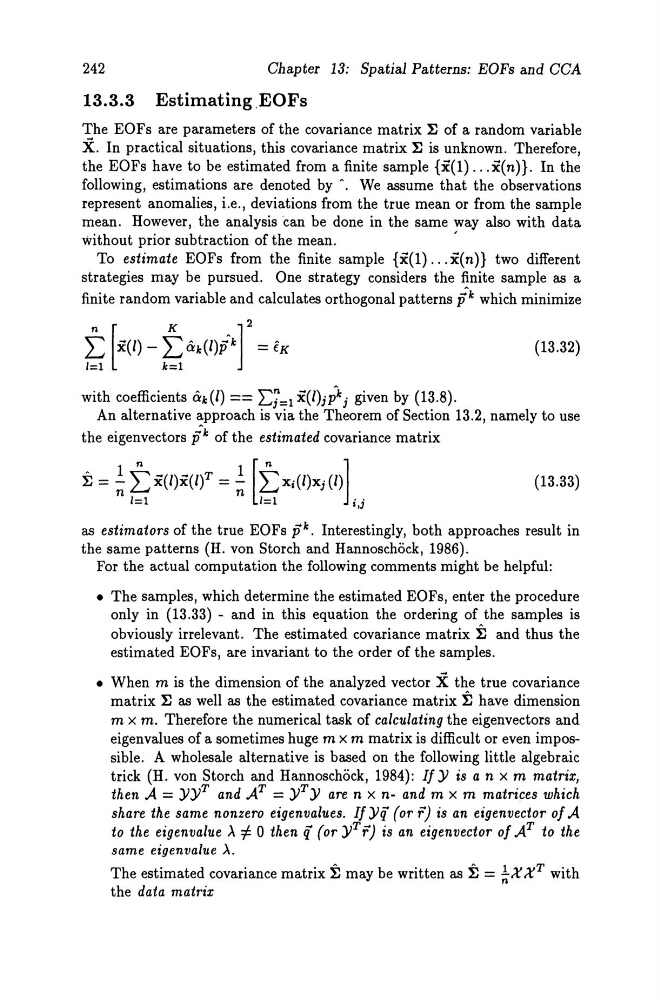
finite random variable and calculates orthogonal patterns j" which minimize
(13.32)
with coefficients ih(l) == 'Ei=l x(l)jp"j given by (13.8).
An alternative approach is via the Theorem of Section 13.2, namely to use
the eigenvectors j" of the estimated covariance matrix
(13.33)
as estimators of the true EOFs p". Interestingly, both approaches result in
the same patterns (H. von Storch and Hannoschöck, 1986).
For the actual computation the following comments might be helpful:
• The sampies, which determine the estimated EOFs, enter the procedure
only in (13.33) - and in this equation the ordering of the sampies is
obviously irrelevant. The estimated covariance matrix:E and thus the
estimated EOFs, are invariant to the order of the sampies.
• When m is the dimension of the analyzed vector X the true covariance
matrix lJ as weH as the estimated covariance matrix :E have dimension
m X m. Therefore the numerical task of calculating the eigenvectors and
eigenvalues of a sometimes huge m X m matrix is difficult or even impossible. A wholesale alternative is based on the foHowing little algebraic
trick (H. von Storch and Hannoschöck, 1984): 1/ y is an X m matrix,
then A = yyT and AT = yTy are n X n- and mx m matrices which
share the same nonzero eigenvalues. 1/ Yij (or r) is an eigenvector 0/ A
to the eigenvalue A f. 0 then ij (or yT r) is an eigenvector 0/ AT to the
same eigenvalue A.
The estimated covariance matrix :E may be written as :E = ~X X T with
the data matrix
Ghapter 13: Spatial Patterns: EOFs and GGA
13.3.3 Estimating ,EOFs
The EOFs are parameters of the covariance matrix lJ of a random variable
X. In practical situations, this covariance matrix lJ is unknown. Therefore,
the EOFs have to be estimated from a finite sample {x(l) ... x(n)}. In the
following, estimations are denoted by •. We assurne that the observations
represent anomalies, i.e., deviations from the true mean or from the sample
mean. However, the analysiscan be done in the same way also with data
without prior subtraction of the mean.
'
To estimate EOFs from the finite sampie {x(l) ... x( n)} two different
strategies may be pursued. One strategy considers the finite sampie as a
finite random variable and calculates orthogonal patterns j" which minimize
(13.32)
with coefficients ih(l) == 'Ei=l x(l)jp"j given by (13.8).
An alternative approach is via the Theorem of Section 13.2, namely to use
the eigenvectors j" of the estimated covariance matrix
(13.33)
as estimators of the true EOFs p". Interestingly, both approaches result in
the same patterns (H. von Storch and Hannoschöck, 1986).
For the actual computation the following comments might be helpful:
• The sampies, which determine the estimated EOFs, enter the procedure
only in (13.33) - and in this equation the ordering of the sampies is
obviously irrelevant. The estimated covariance matrix:E and thus the
estimated EOFs, are invariant to the order of the sampies.
• When m is the dimension of the analyzed vector X the true covariance
matrix lJ as weH as the estimated covariance matrix :E have dimension
m X m. Therefore the numerical task of calculating the eigenvectors and
eigenvalues of a sometimes huge m X m matrix is difficult or even impossible. A wholesale alternative is based on the foHowing little algebraic
trick (H. von Storch and Hannoschöck, 1984): 1/ y is an X m matrix,
then A = yyT and AT = yTy are n X n- and mx m matrices which
share the same nonzero eigenvalues. 1/ Yij (or r) is an eigenvector 0/ A
to the eigenvalue A f. 0 then ij (or yT r) is an eigenvector 0/ AT to the
same eigenvalue A.
The estimated covariance matrix :E may be written as :E = ~X X T with
the data matrix