

Section 13.2: Empirical Orthogonal Functions
235
non-trivial since the functionals are nonlinear. Numerical algorithms to approximate the solutions require the number of involved dimensions K to be
not too large.
A widely used method is the "varimax" , which generates a set of orthogonal
patterns which minimize the joint "simplicity" measure
K
FR(pA· .. pI{) = L IR(pA)
(13.13)
k=l
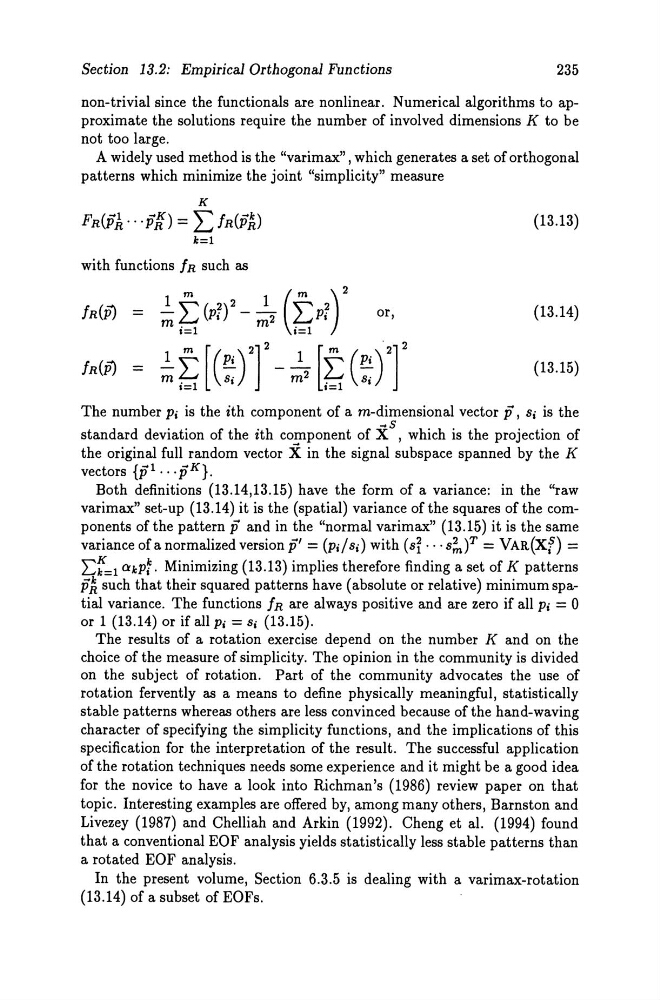
with functions IR such as
(13.14)
(13.15)
The number Pi is the ith component of a rn-dimensional vector p, Si is the
~S
standard deviation of the ith component of X , which is the projection of
the original fuIl random vector X in the signal subspace spanned by the K
t
{ ~1
~K}
vec ors P ... p .
Both definitions (13.14,13.15) have the form of a variance: in the "raw
varimax" set-up (13.14) it is the (spatial) variance ofthe squares ofthe components of the pattern p and in the "normal varimax" (13.15) it is the same
variance ofa normalized version p' = (pd Si) with (si, .. s~)T = VAR,(Xf) =
2:f=l (kkpf· Minimizing (13.13) implies therefore finding a set of K patterns
pA such that their squared patterns have (absolute or relative) minimumspatial variance. The functions IR are always positive and are zero if aIl Pi = 0
or 1 (13.14) or if all Pi = Si (13.15).
The results of a rotation exercise depend on the number K and on the
choice of the measure of simplicity. The opinion in the community is divided
on the subject of rotation. Part of the community advocates the use of
rotation fervently as a means to define physicaIly meaningful, statisticaIly
stable patterns whereas others are less convinced because of the hand-waving
character of specifying the simplicity functions, and the implications of this
specification for the interpretation of the result. The successful application
of the rotation techniques needs some experience and it might be a good idea
for the novice to have a look into Richman's (1986) review paper on that
topic. Interesting examples are offered by, among many others, Barnston and
Livezey (1987) and CheIliah and Arkin (1992). Cheng et al. (1994) found
that a conventional EOF analysis yields statisticaIly less stable patterns than
a rotated EOF analysis.
In the present volume, Section 6.3.5 is dealing with a varirnax-rotation
(13.14) of a subset of EOFs.
235
non-trivial since the functionals are nonlinear. Numerical algorithms to approximate the solutions require the number of involved dimensions K to be
not too large.
A widely used method is the "varimax" , which generates a set of orthogonal
patterns which minimize the joint "simplicity" measure
K
FR(pA· .. pI{) = L IR(pA)
(13.13)
k=l
with functions IR such as
(13.14)
(13.15)
The number Pi is the ith component of a rn-dimensional vector p, Si is the
~S
standard deviation of the ith component of X , which is the projection of
the original fuIl random vector X in the signal subspace spanned by the K
t
{ ~1
~K}
vec ors P ... p .
Both definitions (13.14,13.15) have the form of a variance: in the "raw
varimax" set-up (13.14) it is the (spatial) variance ofthe squares ofthe components of the pattern p and in the "normal varimax" (13.15) it is the same
variance ofa normalized version p' = (pd Si) with (si, .. s~)T = VAR,(Xf) =
2:f=l (kkpf· Minimizing (13.13) implies therefore finding a set of K patterns
pA such that their squared patterns have (absolute or relative) minimumspatial variance. The functions IR are always positive and are zero if aIl Pi = 0
or 1 (13.14) or if all Pi = Si (13.15).
The results of a rotation exercise depend on the number K and on the
choice of the measure of simplicity. The opinion in the community is divided
on the subject of rotation. Part of the community advocates the use of
rotation fervently as a means to define physicaIly meaningful, statisticaIly
stable patterns whereas others are less convinced because of the hand-waving
character of specifying the simplicity functions, and the implications of this
specification for the interpretation of the result. The successful application
of the rotation techniques needs some experience and it might be a good idea
for the novice to have a look into Richman's (1986) review paper on that
topic. Interesting examples are offered by, among many others, Barnston and
Livezey (1987) and CheIliah and Arkin (1992). Cheng et al. (1994) found
that a conventional EOF analysis yields statisticaIly less stable patterns than
a rotated EOF analysis.
In the present volume, Section 6.3.5 is dealing with a varirnax-rotation
(13.14) of a subset of EOFs.