

Section 11.4: Stochastic Precipitation Models
205
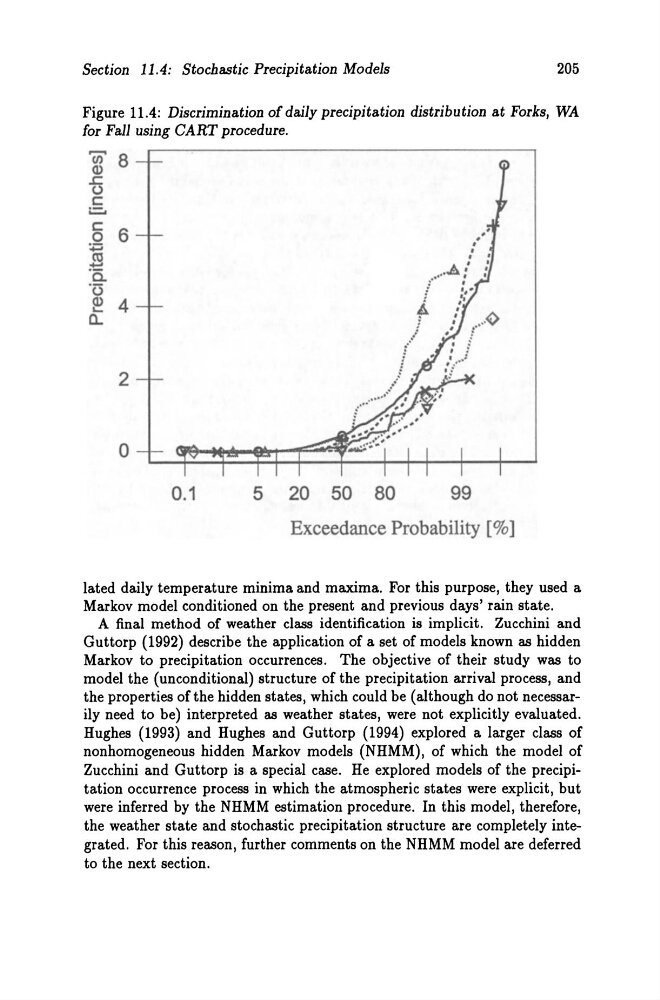
Figure 11.4: Discrimination of daily precipitation distribution at Forks, WA
for Fall using CART procedure.
Ui'8 Q)
J:
U
c:
2
o
0.1
5 20 50 80
99
Exceedance Probability [%]
lated daily temperature minima and maxima. For this purpose, they used a
Markov model conditioned on the present and previous days' rain state.
A final method of weather dass identification is implicit. Zucchini and
Guttorp (1992) describe the application of a set of models known as hidden
Markov to precipitation occurrences. The objective of their study was to
model the (unconditional) structure of the precipitation arrival process, and
the properties of the hidden states, which could be (although do not necessarily need to be) interpreted as weather states, were not explicitly evaluated.
Hughes (1993) and Hughes and Guttorp (1994) explored a larger dass of
nonhomogeneous hidden Markov models (NHMM), of which the model of
Zucchini and Guttorp is a special case. He explored models of the precipitation occurrence process in which the atmospheric states were explicit, but
were inferred by the NHMM estimation procedure. In this model, therefore,
the weather state and stochastic precipitation structure are completely integrated. For this reason, further comments on the NHMM model are deferred
to the next section.
205
Figure 11.4: Discrimination of daily precipitation distribution at Forks, WA
for Fall using CART procedure.
Ui'8 Q)
J:
U
c:
2
o
0.1
5 20 50 80
99
Exceedance Probability [%]
lated daily temperature minima and maxima. For this purpose, they used a
Markov model conditioned on the present and previous days' rain state.
A final method of weather dass identification is implicit. Zucchini and
Guttorp (1992) describe the application of a set of models known as hidden
Markov to precipitation occurrences. The objective of their study was to
model the (unconditional) structure of the precipitation arrival process, and
the properties of the hidden states, which could be (although do not necessarily need to be) interpreted as weather states, were not explicitly evaluated.
Hughes (1993) and Hughes and Guttorp (1994) explored a larger dass of
nonhomogeneous hidden Markov models (NHMM), of which the model of
Zucchini and Guttorp is a special case. He explored models of the precipitation occurrence process in which the atmospheric states were explicit, but
were inferred by the NHMM estimation procedure. In this model, therefore,
the weather state and stochastic precipitation structure are completely integrated. For this reason, further comments on the NHMM model are deferred
to the next section.