

202
Chapter 11: Stochastic Modeling of Precipitation
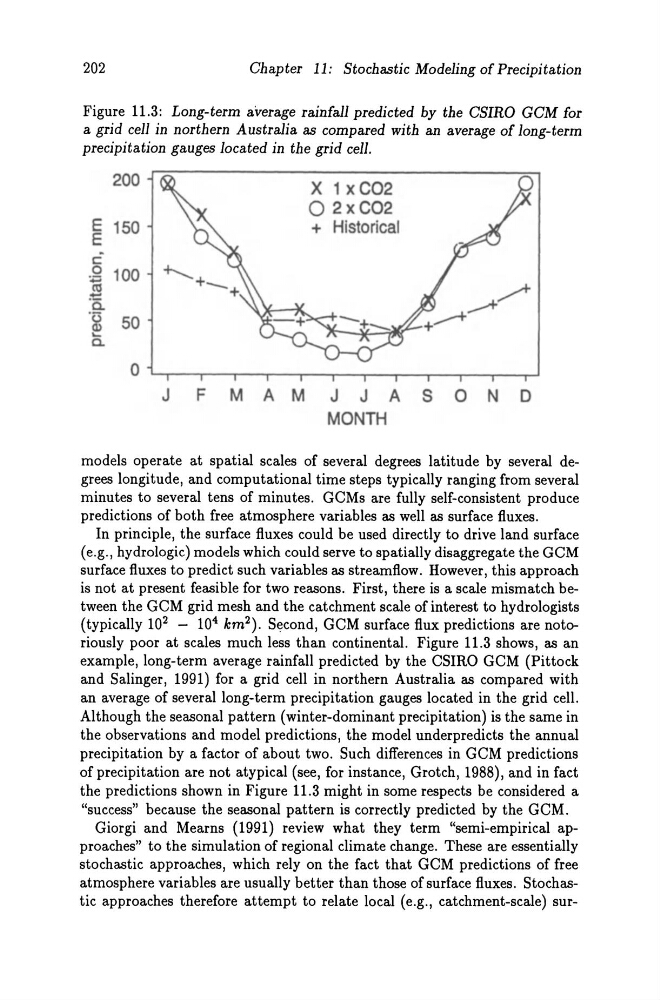
Figure 11.3: Long-term average rainfall predicted by the CSIRO GCM for
a grid cell in northern Australia as compared with an average of long-term
precipitation gauges located in the grid cello
200
E 150
E
c
~ 100
;t:
Q.
'g 50
... Q.
o
X 1 xC02
o 2xC02
+ Historical
J FM AM J J A S 0 ND
MONTH
models operate at spatial scales of several degrees latitude by several degrees longitude, and computational time steps typically ranging from several
minutes to several tens of minutes. GCMs are fully self-consistent produce
predictions of both free atmosphere variables as weIl as surface fluxes.
In principle, the surface fluxes could be used directly to drive land surface
(e.g., hydrologic) models which could serve to spatially dis aggregate the GCM
surface fluxes to predict such variables as streamflow. However, this approach
is not at present feasible for two reasons. First, there is a scale mismatch between the GCM grid mesh and the catchment scale of interest to hydrologists
(typically 10 2 - 10 4 km 2 ). Second, GCM surface flux predictions are notariously poor at scales much less than continental. Figure 11.3 shows, as an
example, long-term average rainfall predicted by the CSIRO GCM (Pittock
and Salinger, 1991) for a grid cell in northern Australia as compared with
an average of several long-term precipitation gauges located in the grid cello
Although the seasonal pattern (winter-dominant precipitation) is the same in
the observations and model predictions, the model underpredicts the annual
precipitation by a factor of ab out two. Such differences in GCM predictions
of precipitation are not atypical (see, for instance, Grotch, 1988), and in fact
the predictions shown in Figure 11.3 might in some respects be considered a
"success" because the seasonal pattern is correctly predicted by the GCM.
Giorgi and Mearns (1991) review wh at they term "semi-empirical approaches" to the simulation of regional climate change. These are essentially
stochastic approaches, which rely on the fact that GCM predictions of free
atmosphere variables are usually better than those of surface fluxes. Stochastic approaches therefore attempt to relate local (e.g., catchment-scale) sur-
Chapter 11: Stochastic Modeling of Precipitation
Figure 11.3: Long-term average rainfall predicted by the CSIRO GCM for
a grid cell in northern Australia as compared with an average of long-term
precipitation gauges located in the grid cello
200
E 150
E
c
~ 100
;t:
Q.
'g 50
... Q.
o
X 1 xC02
o 2xC02
+ Historical
J FM AM J J A S 0 ND
MONTH
models operate at spatial scales of several degrees latitude by several degrees longitude, and computational time steps typically ranging from several
minutes to several tens of minutes. GCMs are fully self-consistent produce
predictions of both free atmosphere variables as weIl as surface fluxes.
In principle, the surface fluxes could be used directly to drive land surface
(e.g., hydrologic) models which could serve to spatially dis aggregate the GCM
surface fluxes to predict such variables as streamflow. However, this approach
is not at present feasible for two reasons. First, there is a scale mismatch between the GCM grid mesh and the catchment scale of interest to hydrologists
(typically 10 2 - 10 4 km 2 ). Second, GCM surface flux predictions are notariously poor at scales much less than continental. Figure 11.3 shows, as an
example, long-term average rainfall predicted by the CSIRO GCM (Pittock
and Salinger, 1991) for a grid cell in northern Australia as compared with
an average of several long-term precipitation gauges located in the grid cello
Although the seasonal pattern (winter-dominant precipitation) is the same in
the observations and model predictions, the model underpredicts the annual
precipitation by a factor of ab out two. Such differences in GCM predictions
of precipitation are not atypical (see, for instance, Grotch, 1988), and in fact
the predictions shown in Figure 11.3 might in some respects be considered a
"success" because the seasonal pattern is correctly predicted by the GCM.
Giorgi and Mearns (1991) review wh at they term "semi-empirical approaches" to the simulation of regional climate change. These are essentially
stochastic approaches, which rely on the fact that GCM predictions of free
atmosphere variables are usually better than those of surface fluxes. Stochastic approaches therefore attempt to relate local (e.g., catchment-scale) sur-