

144
Chapter 8: Statistical Analysis of GCM Output
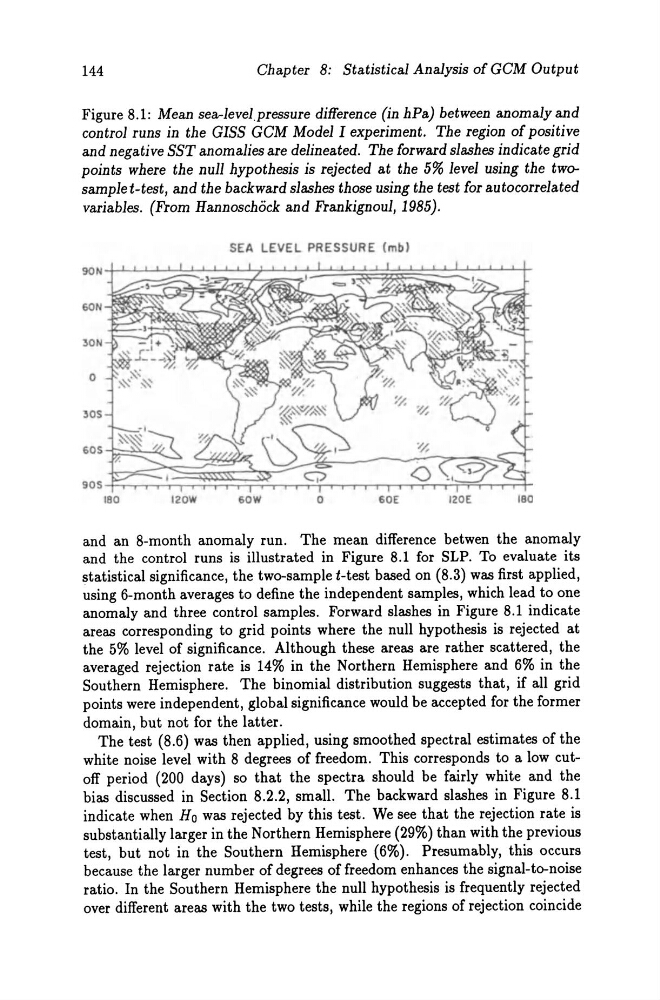
Figure 8.1: Mean sea-level,pressure difference (in hPa) between anomalyand
control runs in tbe GISS GCM Model I experiment. The region of positive
and negative SST anomalies are delineated. Tbe forward slasbes indicate grid
points wbere tbe null bypothesis is rejected at the 5% level using the twosamplet-test, and the back ward slashes those using the test for autocorrelated
variables. (From Hannoschöck and Frankignoul, 1985).
SEA LEVEL PRESSURE (mb)
90N
60N
~ON
0
lOS
60S
90S
180
120W
60W
0
60E
IZOE
180
and an 8-month anomaly run. The mean difference betwen the anomaly
and the control runs is illustrated in Figure 8.1 for SLP. To evaluate its
statistical significance, the two-sample t-test based on (8.3) was first applied,
using 6-month averages to define the independent sampIes, which lead to one
anomaly and three control sampIes. Forward slashes in Figure 8.1 indicate
areas corresponding to grid points where the null hypothesis is rejected at
the 5% level of significance. Although these areas are rather scattered, the
averaged rejection rate is 14% in the Northern Hemisphere and 6% in the
Southern Hemisphere. The binomial distribution suggests that, if all grid
points were independent, global significance would be accepted for the former
domain, but not for the latter.
The test (8.6) was then applied, using smoothed spectral estimates of the
white noise level with 8 degrees of freedom. This corresponds to a low cutoff period (200 days) so that the spectra should be fairly white and the
bias discussed in Section 8.2.2, smalI. The backward slashes in Figure 8.1
indicate when Ho was rejected by this test . We see that the rejection rate is
substantially larger in the Northern Hemisphere (29%) than with the previous
test, but not in the Southern Hemisphere (6%). Presumably, this occurs
because the larger number of degrees of freedom enhances the signal-to-noise
ratio. In the Southern Hemisphere the null hypothesis is frequently rejected
over different areas with the two tests, while the regions of rejection coincide
Chapter 8: Statistical Analysis of GCM Output
Figure 8.1: Mean sea-level,pressure difference (in hPa) between anomalyand
control runs in tbe GISS GCM Model I experiment. The region of positive
and negative SST anomalies are delineated. Tbe forward slasbes indicate grid
points wbere tbe null bypothesis is rejected at the 5% level using the twosamplet-test, and the back ward slashes those using the test for autocorrelated
variables. (From Hannoschöck and Frankignoul, 1985).
SEA LEVEL PRESSURE (mb)
90N
60N
~ON
0
lOS
60S
90S
180
120W
60W
0
60E
IZOE
180
and an 8-month anomaly run. The mean difference betwen the anomaly
and the control runs is illustrated in Figure 8.1 for SLP. To evaluate its
statistical significance, the two-sample t-test based on (8.3) was first applied,
using 6-month averages to define the independent sampIes, which lead to one
anomaly and three control sampIes. Forward slashes in Figure 8.1 indicate
areas corresponding to grid points where the null hypothesis is rejected at
the 5% level of significance. Although these areas are rather scattered, the
averaged rejection rate is 14% in the Northern Hemisphere and 6% in the
Southern Hemisphere. The binomial distribution suggests that, if all grid
points were independent, global significance would be accepted for the former
domain, but not for the latter.
The test (8.6) was then applied, using smoothed spectral estimates of the
white noise level with 8 degrees of freedom. This corresponds to a low cutoff period (200 days) so that the spectra should be fairly white and the
bias discussed in Section 8.2.2, smalI. The backward slashes in Figure 8.1
indicate when Ho was rejected by this test . We see that the rejection rate is
substantially larger in the Northern Hemisphere (29%) than with the previous
test, but not in the Southern Hemisphere (6%). Presumably, this occurs
because the larger number of degrees of freedom enhances the signal-to-noise
ratio. In the Southern Hemisphere the null hypothesis is frequently rejected
over different areas with the two tests, while the regions of rejection coincide