

Section 8.2: Univariate Analysis
141
2
1 ~(
-)2
S = - - L J Xi- X
n-1 i=l
(8.2)
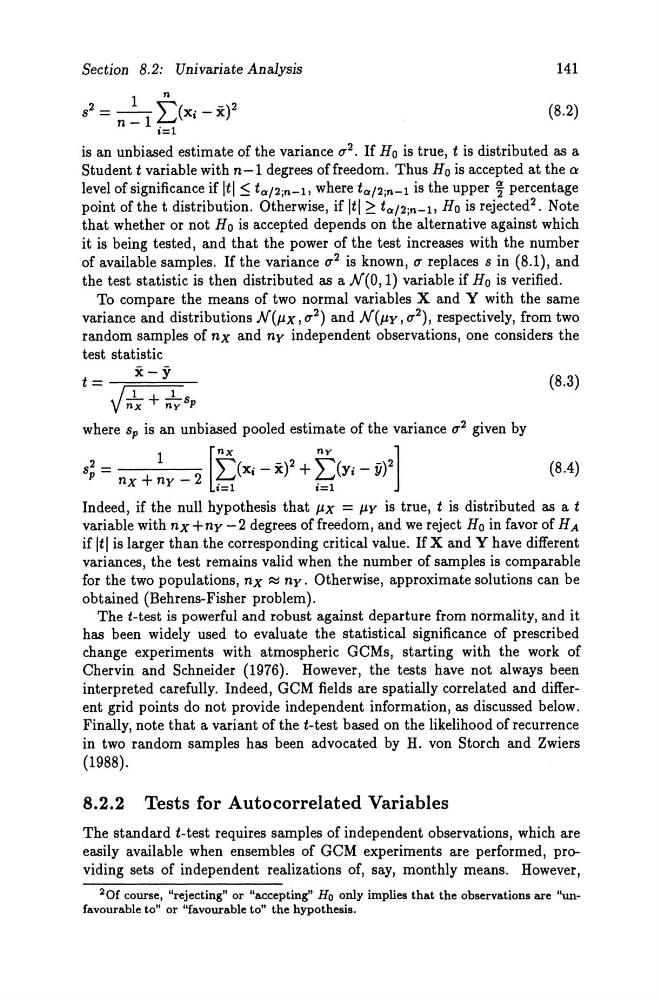
is an unbiased estimate of the variance 0'2. If Ho is true, t is distributed as a
Student t variable with n-1 degrees offreedom. Thus Ho is accepted at the Cl:
level of significance if It I ~ t a !2;n-l, where t a !2;n-l is the upper ~ percentage
point of the t distribution. Otherwise, if Itl ~ t a !2;n-b Ho is rejected 2 . Note
that whether or not Ho is accepted depends on the alternative against which
it is being tested, and that the power of the test increases with the number
of available sampies. If the variance 0'2 is known, 0' replaces S in (8.1), and
the test statistic is then distributed as a N(O, 1) variable if Ho is verified.
To compare the means of two normal variables X and Y with the same
variance and distributions N(J.Lx, 0'2) and N(J.LY, 0'2), respectively, from two
random sampies of nx and ny independent observations, one considers the
test statistic
x-y
t = -;=====-J n~ + n1ysp
(8.3)
where sp is an unbiased pooled estimate of the variance 0'2 given by
1
[n x
ny
1
s; = + _ 2 L(Xi - x)2 + L(Yi - y)2
nx ny
i=l
i=l
(8.4)
Indeed, if the null hypothesis that J.LX = J.Ly is true, t is distributed as at
variable with nx +ny -2 degrees offreedom, and we reject Ho in favor of HA
if Itl is larger than the corresponding critical value. If X and Y have different
variances, the test remains valid when the number of sampies is comparable
for the two populations, nx ~ ny. Otherwise, approximate solutions can be
obtained (Behrens-Fisher problem).
The i-test is powerful and robust against departure from normality, and it
has been widely used to evaluate the statistical significance of prescribed
change experiments with atmospheric GCMs, starting with the work of
Chervin and Schneider (1976). However, the tests have not always been
interpreted carefully. Indeed, GCM fields are spatially correlated and different grid points do not provide independent information, as discussed below.
Finally, note that a variant of the t-test based on the likelihood of recurrence
in two random sampies has been advocated by H. von Storch and Zwiers
(1988).
8.2.2 Testsfor Autocorrelated Variables
The standard t-test requires sampies of independent observations, which are
easily available when ensembles of GCM experiments are performed, provi ding sets of independent realizations of, say, monthly means. However,
20f course, "rejecting" or "accepting" Ho only implies that the observations are "unfavourable to" or "favourable to" the hypothesis.
141
2
1 ~(
-)2
S = - - L J Xi- X
n-1 i=l
(8.2)
is an unbiased estimate of the variance 0'2. If Ho is true, t is distributed as a
Student t variable with n-1 degrees offreedom. Thus Ho is accepted at the Cl:
level of significance if It I ~ t a !2;n-l, where t a !2;n-l is the upper ~ percentage
point of the t distribution. Otherwise, if Itl ~ t a !2;n-b Ho is rejected 2 . Note
that whether or not Ho is accepted depends on the alternative against which
it is being tested, and that the power of the test increases with the number
of available sampies. If the variance 0'2 is known, 0' replaces S in (8.1), and
the test statistic is then distributed as a N(O, 1) variable if Ho is verified.
To compare the means of two normal variables X and Y with the same
variance and distributions N(J.Lx, 0'2) and N(J.LY, 0'2), respectively, from two
random sampies of nx and ny independent observations, one considers the
test statistic
x-y
t = -;=====-J n~ + n1ysp
(8.3)
where sp is an unbiased pooled estimate of the variance 0'2 given by
1
[n x
ny
1
s; = + _ 2 L(Xi - x)2 + L(Yi - y)2
nx ny
i=l
i=l
(8.4)
Indeed, if the null hypothesis that J.LX = J.Ly is true, t is distributed as at
variable with nx +ny -2 degrees offreedom, and we reject Ho in favor of HA
if Itl is larger than the corresponding critical value. If X and Y have different
variances, the test remains valid when the number of sampies is comparable
for the two populations, nx ~ ny. Otherwise, approximate solutions can be
obtained (Behrens-Fisher problem).
The i-test is powerful and robust against departure from normality, and it
has been widely used to evaluate the statistical significance of prescribed
change experiments with atmospheric GCMs, starting with the work of
Chervin and Schneider (1976). However, the tests have not always been
interpreted carefully. Indeed, GCM fields are spatially correlated and different grid points do not provide independent information, as discussed below.
Finally, note that a variant of the t-test based on the likelihood of recurrence
in two random sampies has been advocated by H. von Storch and Zwiers
(1988).
8.2.2 Testsfor Autocorrelated Variables
The standard t-test requires sampies of independent observations, which are
easily available when ensembles of GCM experiments are performed, provi ding sets of independent realizations of, say, monthly means. However,
20f course, "rejecting" or "accepting" Ho only implies that the observations are "unfavourable to" or "favourable to" the hypothesis.