

136
Chapter 7: The Simulation of Weather Types in GCMs
longer spells, while MPI appears to overestimate all spells. Both models reproduce A speIls quite weIl, except for the longest speIl lengths which they
would not be expected to reproduce given the comparatively short output
sample (only 10 years).
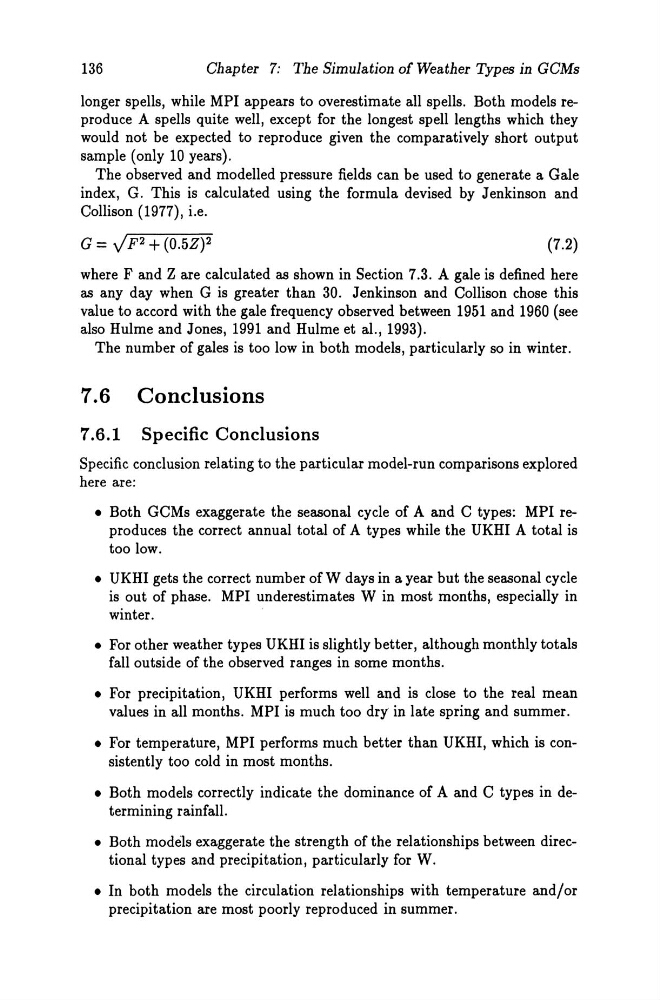
The observed and modelled pressure fields can be used to generate a Gale
index, G. This is calculated using the formula devised by J enkinson and
Collison (1977), i.e.
G = J F2 + (0.5Z)2
(7.2)
where Fand Z are calculated as shown in Section 7.3. A gale is defined here
as any day when G is greater than 30. Jenkinson and Collison chose this
value to accord with the gale frequency observed between 1951 and 1960 (see
also Hulme and Jones, 1991 and Hulme et al., 1993).
The number of gales is too low in both models, particularly so in winter.
7.6 Conclusions
7.6.1 Specific Conclusions
Specific condusion relating to the particular model-run comparisons explored
here are:
• Both GCMs exaggerate the seasonal cyde of A and C types: MPI reproduces the correct annual total of A types while the UKHI A total is
too low.
• UKHI gets the correct number of W days in a year but the seasonal cyde
is out of phase. MPI underestimates W in most months, especially in
winter.
• For other weather types UKHI is slightly better, although monthly totals
fall outside of the observed ranges in some months.
• For precipitation, UKHI performs well and is dose to the real mean
values in all months. MPI is much too dry in late spring and summer.
• For temperature, MPI performs much better than UKHI, which is consistently too cold in most months.
• Both models correctly indicate the dominance of A and C types in determining rainfall.
• Both models exaggerate the strength of the relationships between directional types and precipitation, particularly for W.
• In both models the circulation relationships with temperature and/or
precipitation are most poorly reproduced in summer.
Chapter 7: The Simulation of Weather Types in GCMs
longer spells, while MPI appears to overestimate all spells. Both models reproduce A speIls quite weIl, except for the longest speIl lengths which they
would not be expected to reproduce given the comparatively short output
sample (only 10 years).
The observed and modelled pressure fields can be used to generate a Gale
index, G. This is calculated using the formula devised by J enkinson and
Collison (1977), i.e.
G = J F2 + (0.5Z)2
(7.2)
where Fand Z are calculated as shown in Section 7.3. A gale is defined here
as any day when G is greater than 30. Jenkinson and Collison chose this
value to accord with the gale frequency observed between 1951 and 1960 (see
also Hulme and Jones, 1991 and Hulme et al., 1993).
The number of gales is too low in both models, particularly so in winter.
7.6 Conclusions
7.6.1 Specific Conclusions
Specific condusion relating to the particular model-run comparisons explored
here are:
• Both GCMs exaggerate the seasonal cyde of A and C types: MPI reproduces the correct annual total of A types while the UKHI A total is
too low.
• UKHI gets the correct number of W days in a year but the seasonal cyde
is out of phase. MPI underestimates W in most months, especially in
winter.
• For other weather types UKHI is slightly better, although monthly totals
fall outside of the observed ranges in some months.
• For precipitation, UKHI performs well and is dose to the real mean
values in all months. MPI is much too dry in late spring and summer.
• For temperature, MPI performs much better than UKHI, which is consistently too cold in most months.
• Both models correctly indicate the dominance of A and C types in determining rainfall.
• Both models exaggerate the strength of the relationships between directional types and precipitation, particularly for W.
• In both models the circulation relationships with temperature and/or
precipitation are most poorly reproduced in summer.