

Section 7.3: An "Objective" Lamb Classification
123
used this classification and there is a large literature describing both it and
the relationships between the "Lamb type" frequencies and meteorological
statistics (e.g., see relevant sections in Barryand Perry, 1973; and Yarnal,
1993).
7.3 An "Objective" Lamb Classification
In order to overcome the inherent subjectivity involved in any manual classification and to expedite the necessarily laborious process of classifying GCMgenerated daily pressure fields it is desirable to automate the classification
using some objective criteria that can form the basis of a computerized approach. Such ascheme, for automatie classification of daily mean sea level
press ure maps in terms of the Lamb catalogue has been suggested by Jenkinson and Collison (1977). These authors devised a set of simple rules appropriate to the classification of pressure charts stored in gridded form on a
50 latitude by 10 0 longitude grid, the synoptic climatology grid held at U.K.
Meteorological Office. Identifying particular gridpoint press ure data with
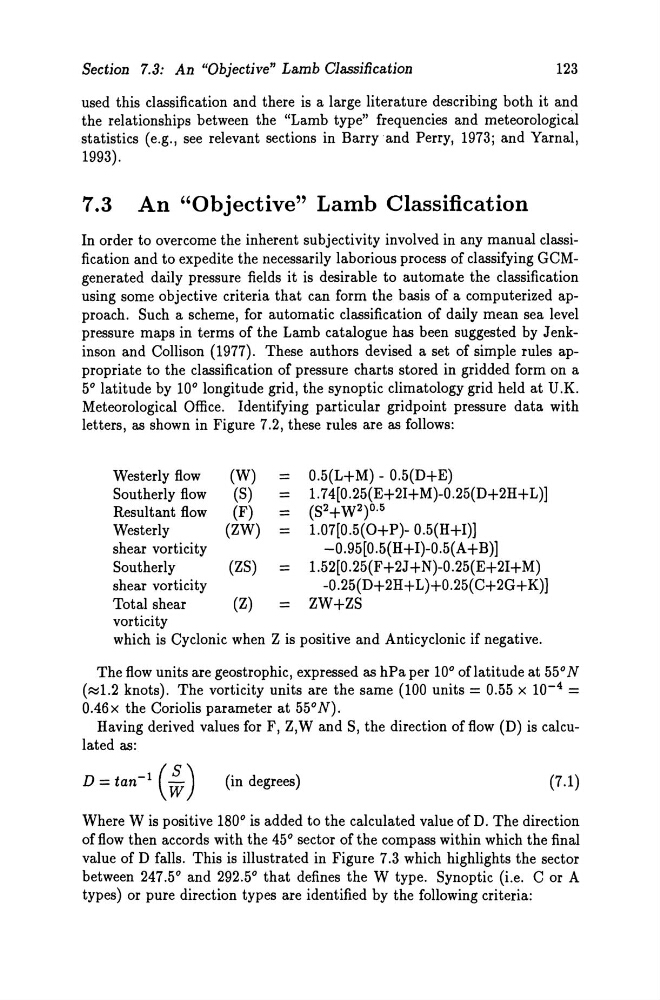
letters, as shown in Figure 7.2, these rules are as follows:
Westerly flow
(W)
= O.5(L+M) - O.5(D+E)
Southerly flow
(S)
1.74[O.25(E+2I+M)-O.25(D+2H+L)]
Resultant flow
(F)
= (S2+W 2 )O.5
Westerly
(ZW)
l.07[O.5(O+P)- O.5(H+I)]
shear vorticity
-O.95[O.5(H+I)-0.5(A+B)]
Southerly
(ZS)
1.52[0.25(F+2J+N)-0.25(E+2I+M)
shear vorticity
-0.25(D+2H+L)+0.25(C+2G+K)]
Total shear
(Z)
ZW+ZS
vorticity
which is Cyclonic when Z is positive and Anticyclonic if negative.
The flow units are geostrophic, expressed as hPa per 10 0 oflatitude at 55 0 N
(~1.2 knots). The vorticity units are the same (100 units = 0.55 x 10- 4 =
0.46x the Coriolis parameter at 55 0 N).
Having derived values for F, Z,W and S, the direction offlow (D) is calculated as:
(in degrees)
(7.1)
Where W is positive 180 0 is added to the calculated value of D. The direction
of flow then accords with the 45 0 sector of the compass within which the final
value of D falls. This is illustrated in Figure 7.3 which highlights the sector
between 247.5 0 and 292.5 0 that defines the W type. Synoptic (i.e. C or A
types) or pure direction types are identified by the following criteria:
123
used this classification and there is a large literature describing both it and
the relationships between the "Lamb type" frequencies and meteorological
statistics (e.g., see relevant sections in Barryand Perry, 1973; and Yarnal,
1993).
7.3 An "Objective" Lamb Classification
In order to overcome the inherent subjectivity involved in any manual classification and to expedite the necessarily laborious process of classifying GCMgenerated daily pressure fields it is desirable to automate the classification
using some objective criteria that can form the basis of a computerized approach. Such ascheme, for automatie classification of daily mean sea level
press ure maps in terms of the Lamb catalogue has been suggested by Jenkinson and Collison (1977). These authors devised a set of simple rules appropriate to the classification of pressure charts stored in gridded form on a
50 latitude by 10 0 longitude grid, the synoptic climatology grid held at U.K.
Meteorological Office. Identifying particular gridpoint press ure data with
letters, as shown in Figure 7.2, these rules are as follows:
Westerly flow
(W)
= O.5(L+M) - O.5(D+E)
Southerly flow
(S)
1.74[O.25(E+2I+M)-O.25(D+2H+L)]
Resultant flow
(F)
= (S2+W 2 )O.5
Westerly
(ZW)
l.07[O.5(O+P)- O.5(H+I)]
shear vorticity
-O.95[O.5(H+I)-0.5(A+B)]
Southerly
(ZS)
1.52[0.25(F+2J+N)-0.25(E+2I+M)
shear vorticity
-0.25(D+2H+L)+0.25(C+2G+K)]
Total shear
(Z)
ZW+ZS
vorticity
which is Cyclonic when Z is positive and Anticyclonic if negative.
The flow units are geostrophic, expressed as hPa per 10 0 oflatitude at 55 0 N
(~1.2 knots). The vorticity units are the same (100 units = 0.55 x 10- 4 =
0.46x the Coriolis parameter at 55 0 N).
Having derived values for F, Z,W and S, the direction offlow (D) is calculated as:
(in degrees)
(7.1)
Where W is positive 180 0 is added to the calculated value of D. The direction
of flow then accords with the 45 0 sector of the compass within which the final
value of D falls. This is illustrated in Figure 7.3 which highlights the sector
between 247.5 0 and 292.5 0 that defines the W type. Synoptic (i.e. C or A
types) or pure direction types are identified by the following criteria: