

96
Chapter 6: Analysing the Boreal Summer Relationship
climate variability. So this chapter is particularly well-suited for illustrating
an application of statistics in climatology.
Section 6.2 discusses the physical basis for the impact of the ocean on the
atmosphere. Section 6.3 discusses some of the observed sea-surface temperature (SST) variability, and identifies three modes of SST variations. The
statistical relationship between each of these modes and the near-surface marine atmosphere is described in Section 6.4. It is believed that SST variability
affects atmospheric variability over continentalland masses as weH as the 10cal marine atmosphere. Statistical evidence for this is provided in Section
6.5, which describes the statistical relationship of rainfall in the Sahel region
of Africa with the mo des of variability discussed in Sections 6.3 and 6.4.
6.2 Physical Basis for Sea-Surface Temperature Forcing of the Atmosphere
6.2.1 Tropics
Lindzen and Nigam (1987) developed a simple model (hereafter referred to
as the LN model) assuming that the tropical marine boundary layer was weIl
mixed. They therefore argued that temperature gradients in the atmospheric
boundary layer would reflect SST gradients. To look solely at the component
of forcing of the boundary layer circulation from this effect of SST gradients,
as opposed to forcing from upper level circulations, they set the top of the
boundary layer fixed. It then follows from the hydrostatic relation that surface pressure gradients simply reflect SST gradients. Neglecting some smaller
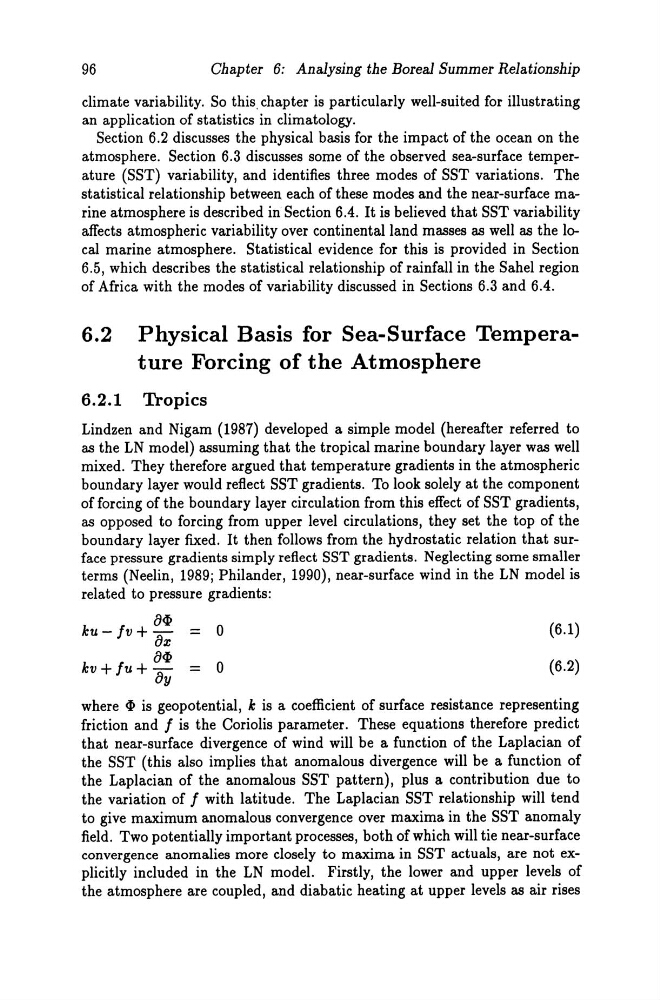
terms (Neelin, 1989; Philander, 1990), near-surface wind in the LN model is
related to pressure gradients:
k
/
oCf>
0
1.1 -
V + ox
(6.1)
oCf>
kv + /1.1 + oy = 0
(6.2)
where Cf> is geopotential, k is a coefficient of surface resistance representing
friction and / is the Coriolis parameter. These equations therefore predict
that near-surface divergence of wind will be a function of the Laplacian of
the SST (this also implies that anomalous divergence will be a function of
the Laplacian of the anomalous SST pattern), plus a contribution due to
the variation of / with latitude. The Laplacian SST relationship will tend
to give maximum anomalous convergence over maxima in the SST anomaly
field. Two potentially important processes, both of which will tie near-surface
convergence anomalies more closely to maxima in SST actuals, are not explicitly included in the LN model. Firstly, the lower and upper levels of
the atmosphere are coupled, and diabatic heating at upper levels as air rises
Chapter 6: Analysing the Boreal Summer Relationship
climate variability. So this chapter is particularly well-suited for illustrating
an application of statistics in climatology.
Section 6.2 discusses the physical basis for the impact of the ocean on the
atmosphere. Section 6.3 discusses some of the observed sea-surface temperature (SST) variability, and identifies three modes of SST variations. The
statistical relationship between each of these modes and the near-surface marine atmosphere is described in Section 6.4. It is believed that SST variability
affects atmospheric variability over continentalland masses as weH as the 10cal marine atmosphere. Statistical evidence for this is provided in Section
6.5, which describes the statistical relationship of rainfall in the Sahel region
of Africa with the mo des of variability discussed in Sections 6.3 and 6.4.
6.2 Physical Basis for Sea-Surface Temperature Forcing of the Atmosphere
6.2.1 Tropics
Lindzen and Nigam (1987) developed a simple model (hereafter referred to
as the LN model) assuming that the tropical marine boundary layer was weIl
mixed. They therefore argued that temperature gradients in the atmospheric
boundary layer would reflect SST gradients. To look solely at the component
of forcing of the boundary layer circulation from this effect of SST gradients,
as opposed to forcing from upper level circulations, they set the top of the
boundary layer fixed. It then follows from the hydrostatic relation that surface pressure gradients simply reflect SST gradients. Neglecting some smaller
terms (Neelin, 1989; Philander, 1990), near-surface wind in the LN model is
related to pressure gradients:
k
/
oCf>
0
1.1 -
V + ox
(6.1)
oCf>
kv + /1.1 + oy = 0
(6.2)
where Cf> is geopotential, k is a coefficient of surface resistance representing
friction and / is the Coriolis parameter. These equations therefore predict
that near-surface divergence of wind will be a function of the Laplacian of
the SST (this also implies that anomalous divergence will be a function of
the Laplacian of the anomalous SST pattern), plus a contribution due to
the variation of / with latitude. The Laplacian SST relationship will tend
to give maximum anomalous convergence over maxima in the SST anomaly
field. Two potentially important processes, both of which will tie near-surface
convergence anomalies more closely to maxima in SST actuals, are not explicitly included in the LN model. Firstly, the lower and upper levels of
the atmosphere are coupled, and diabatic heating at upper levels as air rises