

66
J.D. Albertson, G. Kiely and M.B. Parlange
for the slightly unstable flows, with an equality approached for more strongly convective flows.
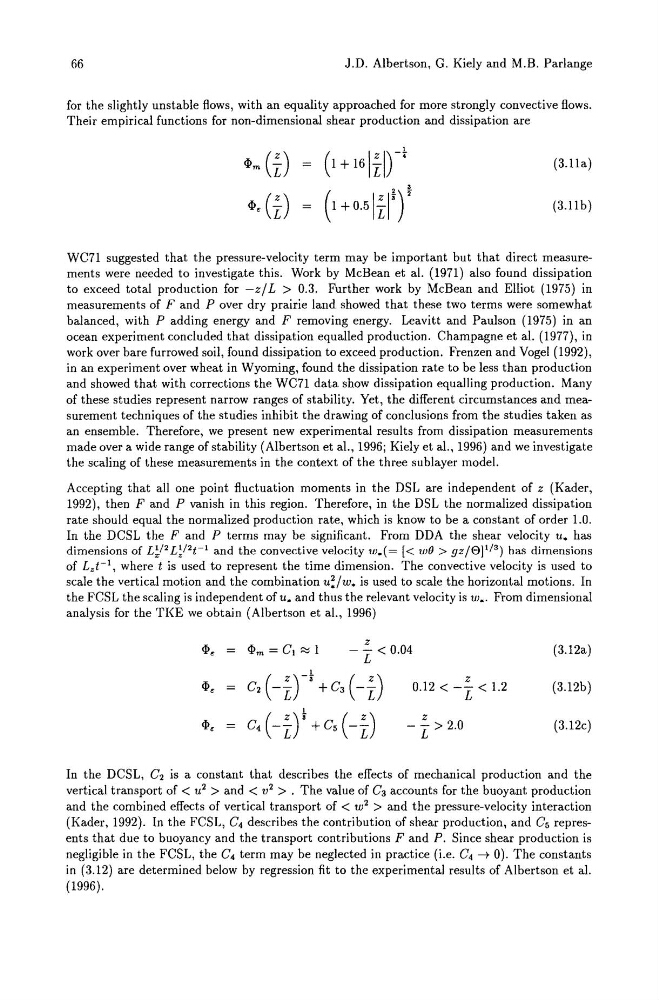
Their empirical functions for non-dimensional shear production and dissipation are
(1+16!±I)-t
(3.lla)
(1 +0.5!±n ~
(3.llb)
WC71 suggested that the pressure-velocity term may be important but that direct measurements were needed to investigate this. Work by McBean et al. (1971) also found dissipation
to exceed total production for -z/ L > 0.3. Further work by McBean and Elliot (1975) in
measurements of F and P over dry prairie land showed that these two terms were somewhat
balanced, with P adding energy and F removing energy. Leavitt and Paulson (1975) in an
ocean experiment concluded that dissipation equalled production. Champagne et al. (1977), in
work over bare furrowed soil, found dissipation to exceed production. Frenzen and Vogel (1992),
in an experiment over wheat in Wyoming, found the dissipation rate to be less than production
and showed that with corrections the WC71 data show dissipation equalling production. Many
of these studies represent narrow ranges of stability. Yet, the different circumstances and measurement techniques of the studies inhibit the drawing of conclusions from the studies taken as
an ensemble. Therefore, we present new experimental results from dissipation measurements
made over a wide range of stability (Albertson et aI., 1996; Kiely et aI., 1996) and we investigate
the scaling of these measurements in the context of the three sublayer model.
Accepting that all one point fluctuation moments in the DSL are independent of z (Kader,
1992), then F and P vanish in this region. Therefore, in the DSL the normalized dissipation
rate should equal the normalized production rate, which is know to be a constant of order 1.0.
In the DCSL the F and P terms may be significant. From DDA the shear velocity u. has
dimensions of L!/2L~/2t-l and the convective velocity w.(= [< wO > gz/0j1/3) has dimensions
of Lzt- 1 , where t is used to represent the time dimension. The convective velocity is used to
scale the vertical motion and the combination u~/w. is used to scale the horizontal motions. In
the FCSL the scaling is independent of u. and thus the relevant velocity is w •. From dimensional
analysis for the TKE we obtain (Albertson et aI., 1996)
- r; < 0.04
(3.12a)
z
0.12 < -r; < 1.2
(3.12b)
z
- r; > 2.0
(3.12c)
In the DCSL, C2 is a constant that describes the effects of mechanical production and the
vertical transport of < u 2 > and < v 2 > . The value of C3 accounts for the buoyant production
and the combined effects of vertical transport of < w 2 > and the pressure-velocity interaction
(Kader, 1992). In the FCSL, C4 describes the contribution of shear production, and Cs represents that due to buoyancy and the transport contributions F and P. Since shear production is
negligible in the FCSL, the C4 term may be neglected in practice (i.e. C4 -+ 0). The constants
in (3.12) are determined below by regression fit to the experimental results of Albertson et al.
(1996).
J.D. Albertson, G. Kiely and M.B. Parlange
for the slightly unstable flows, with an equality approached for more strongly convective flows.
Their empirical functions for non-dimensional shear production and dissipation are
(1+16!±I)-t
(3.lla)
(1 +0.5!±n ~
(3.llb)
WC71 suggested that the pressure-velocity term may be important but that direct measurements were needed to investigate this. Work by McBean et al. (1971) also found dissipation
to exceed total production for -z/ L > 0.3. Further work by McBean and Elliot (1975) in
measurements of F and P over dry prairie land showed that these two terms were somewhat
balanced, with P adding energy and F removing energy. Leavitt and Paulson (1975) in an
ocean experiment concluded that dissipation equalled production. Champagne et al. (1977), in
work over bare furrowed soil, found dissipation to exceed production. Frenzen and Vogel (1992),
in an experiment over wheat in Wyoming, found the dissipation rate to be less than production
and showed that with corrections the WC71 data show dissipation equalling production. Many
of these studies represent narrow ranges of stability. Yet, the different circumstances and measurement techniques of the studies inhibit the drawing of conclusions from the studies taken as
an ensemble. Therefore, we present new experimental results from dissipation measurements
made over a wide range of stability (Albertson et aI., 1996; Kiely et aI., 1996) and we investigate
the scaling of these measurements in the context of the three sublayer model.
Accepting that all one point fluctuation moments in the DSL are independent of z (Kader,
1992), then F and P vanish in this region. Therefore, in the DSL the normalized dissipation
rate should equal the normalized production rate, which is know to be a constant of order 1.0.
In the DCSL the F and P terms may be significant. From DDA the shear velocity u. has
dimensions of L!/2L~/2t-l and the convective velocity w.(= [< wO > gz/0j1/3) has dimensions
of Lzt- 1 , where t is used to represent the time dimension. The convective velocity is used to
scale the vertical motion and the combination u~/w. is used to scale the horizontal motions. In
the FCSL the scaling is independent of u. and thus the relevant velocity is w •. From dimensional
analysis for the TKE we obtain (Albertson et aI., 1996)
- r; < 0.04
(3.12a)
z
0.12 < -r; < 1.2
(3.12b)
z
- r; > 2.0
(3.12c)
In the DCSL, C2 is a constant that describes the effects of mechanical production and the
vertical transport of < u 2 > and < v 2 > . The value of C3 accounts for the buoyant production
and the combined effects of vertical transport of < w 2 > and the pressure-velocity interaction
(Kader, 1992). In the FCSL, C4 describes the contribution of shear production, and Cs represents that due to buoyancy and the transport contributions F and P. Since shear production is
negligible in the FCSL, the C4 term may be neglected in practice (i.e. C4 -+ 0). The constants
in (3.12) are determined below by regression fit to the experimental results of Albertson et al.
(1996).