

64
J.D. Albertson, G. Kiely and M.B. Parlange
as the Dynamic Sublayer (DSL) in which buoyant action is negligible compared to mechanical
production. The uppermost sublayer of the ASL, governed by buoyancy only, is termed the
Free Convection Sublayer (FCSL). Between these two is a sublayer, driven by both mechanical
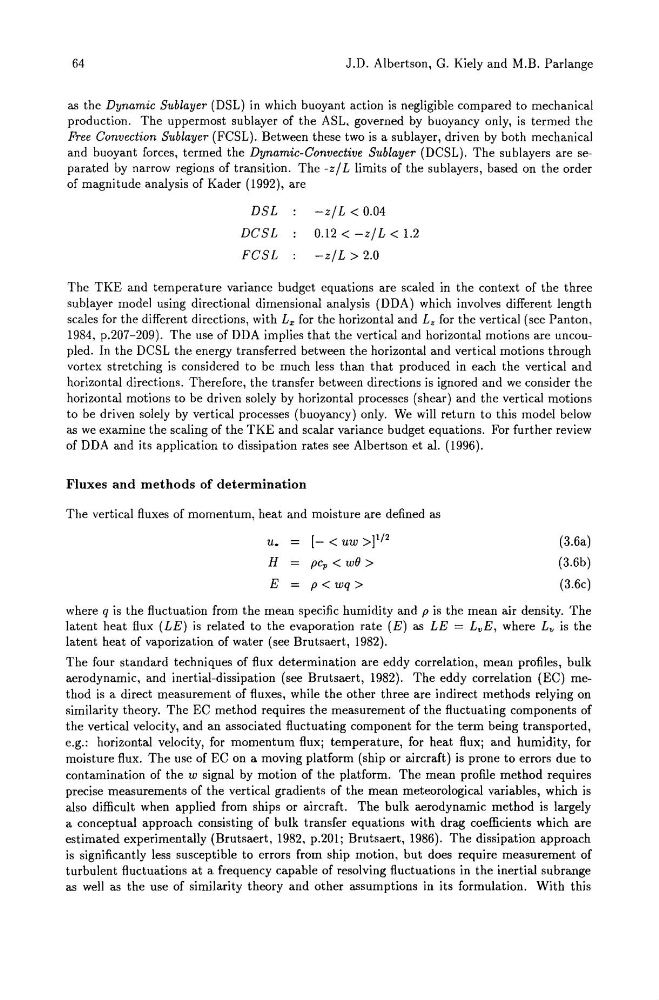
and buoyant forces, termed the Dynamic-Convective Sublayer (DCSL). The sublayers are separated by narrow regions of transition. The -z/ L limits of the sublayers, based on the order
of magnitude analysis of Kader (1992), are
DSL
DCSL
FCSL
-z/ L < 0.04
0.12 < -z/ L < 1.2
-z/L > 2.0
The TKE and temperature variance budget equations are scaled in the context of the three
sublayer model using directional dimensional analysis (DDA) which involves different length
scales for the different directions, with Lx for the horizontal and Lz for the vertical (see Panton,
1984, p.207-209). The use of DDA implies that the vertical and horizontal motions are uncoupled. In the DCSL the energy transferred between the horizontal and vertical motions through
vortex stretching is considered to be much less than that produced in each the vertical and
horizontal directions. Therefore, the transfer between directions is ignored and we consider the
horizontal motions to be driven solely by horizontal processes (shear) and the vertical motions
to be driven solely by vertical processes (buoyancy) only. We will return to this model below
as we examine the scaling of the TKE and scalar variance budget equations. For further review
of DDA and its application to dissipation rates see Albertson et al. (1996).
Fluxes and methods of determination
The vertical fluxes of momentum, heat and moisture are defined as
u.
H
E
[_ < uw >P/2
pCp < w() >
p < wq >
(3.6a)
(3.6b)
(3.6c)
where q is the fluctuation from the mean specific humidity and p is the mean air density. The
latent heat flux (LE) is related to the evaporation rate (E) as LE = LvE, where Lv is the
latent heat of vaporization of water (see Brutsaert, 1982).
The four standard techniques of flux determination are eddy correlation, mean profiles, bulk
aerodynamic, and inertial-dissipation (see Brutsaert, 1982). The eddy correlation (EC) method is a direct measurement of fluxes, while the other three are indirect methods relying on
similarity theory. The EC method requires the measurement of the fluctuating components of
the vertical velocity, and an associated fluctuating component for the term being transported,
e.g.: horizontal velocity, for momentum flux; temperature, for heat flux; and humidity, for
moisture flux. The use of EC on a moving platform (ship or aircraft) is prone to errors due to
contamination of the w signal by motion of the platform. The mean profile method requires
precise measurements of the vertical gradients of the mean meteorological variables, which is
also difficult when applied from ships or aircraft. The bulk aerodynamic method is largely
a conceptual approach consisting of bulk transfer equations with drag coefficients which are
estimated experimentally (Brutsaert, 1982, p.201; Brutsaert, 1986). The dissipation approach
is significantly less susceptible to errors from ship motion, but does require measurement of
turbulent fluctuations at a frequency capable of resolving fluctuations in the inertial subrange
as well as the use of similarity theory and other assumptions in its formulation. With this
J.D. Albertson, G. Kiely and M.B. Parlange
as the Dynamic Sublayer (DSL) in which buoyant action is negligible compared to mechanical
production. The uppermost sublayer of the ASL, governed by buoyancy only, is termed the
Free Convection Sublayer (FCSL). Between these two is a sublayer, driven by both mechanical
and buoyant forces, termed the Dynamic-Convective Sublayer (DCSL). The sublayers are separated by narrow regions of transition. The -z/ L limits of the sublayers, based on the order
of magnitude analysis of Kader (1992), are
DSL
DCSL
FCSL
-z/ L < 0.04
0.12 < -z/ L < 1.2
-z/L > 2.0
The TKE and temperature variance budget equations are scaled in the context of the three
sublayer model using directional dimensional analysis (DDA) which involves different length
scales for the different directions, with Lx for the horizontal and Lz for the vertical (see Panton,
1984, p.207-209). The use of DDA implies that the vertical and horizontal motions are uncoupled. In the DCSL the energy transferred between the horizontal and vertical motions through
vortex stretching is considered to be much less than that produced in each the vertical and
horizontal directions. Therefore, the transfer between directions is ignored and we consider the
horizontal motions to be driven solely by horizontal processes (shear) and the vertical motions
to be driven solely by vertical processes (buoyancy) only. We will return to this model below
as we examine the scaling of the TKE and scalar variance budget equations. For further review
of DDA and its application to dissipation rates see Albertson et al. (1996).
Fluxes and methods of determination
The vertical fluxes of momentum, heat and moisture are defined as
u.
H
E
[_ < uw >P/2
pCp < w() >
p < wq >
(3.6a)
(3.6b)
(3.6c)
where q is the fluctuation from the mean specific humidity and p is the mean air density. The
latent heat flux (LE) is related to the evaporation rate (E) as LE = LvE, where Lv is the
latent heat of vaporization of water (see Brutsaert, 1982).
The four standard techniques of flux determination are eddy correlation, mean profiles, bulk
aerodynamic, and inertial-dissipation (see Brutsaert, 1982). The eddy correlation (EC) method is a direct measurement of fluxes, while the other three are indirect methods relying on
similarity theory. The EC method requires the measurement of the fluctuating components of
the vertical velocity, and an associated fluctuating component for the term being transported,
e.g.: horizontal velocity, for momentum flux; temperature, for heat flux; and humidity, for
moisture flux. The use of EC on a moving platform (ship or aircraft) is prone to errors due to
contamination of the w signal by motion of the platform. The mean profile method requires
precise measurements of the vertical gradients of the mean meteorological variables, which is
also difficult when applied from ships or aircraft. The bulk aerodynamic method is largely
a conceptual approach consisting of bulk transfer equations with drag coefficients which are
estimated experimentally (Brutsaert, 1982, p.201; Brutsaert, 1986). The dissipation approach
is significantly less susceptible to errors from ship motion, but does require measurement of
turbulent fluctuations at a frequency capable of resolving fluctuations in the inertial subrange
as well as the use of similarity theory and other assumptions in its formulation. With this