

TRMM: The Tropical Rainfall Measuring Mission
559
currently elude both conventional thermal infrared and passive microwave techniques. VIRS
contains channels at 1.61 and 3.75 11m to test the utility of this approach.
For, modelers, it is important to know not only the total rainfall, but the partitioning between
convective and stratiform components, for several reasons: (1) Convective and stratiform rain
are produced by different physical processes (instability vs. forced uplift), even though both
can occur in a single mesoscale convective cluster, and thus are predicted by different physics
subroutines in GCMs. (2) Budget studies (Gamache and Houze, 1983) of convective clusters
suggest that both stratiform and convective precipitation contribute significantly to the total
rain, but the former consists of modest rain rates over large areas and many hours while the
IZ
W
~
w
a.
STRATIFORM PERCENT OF TOTAL PRECIPITATION
100~amm~~M~~~------------________________ ~~
90
80
70
60
50
40
30
20
10
O'-'--r-'-'~~~~-.-'--'-'-~
-90 -75 -60 -45 -30 -15 0 15 30 45 60 75 90
lJ\TITUDE
JANUARY
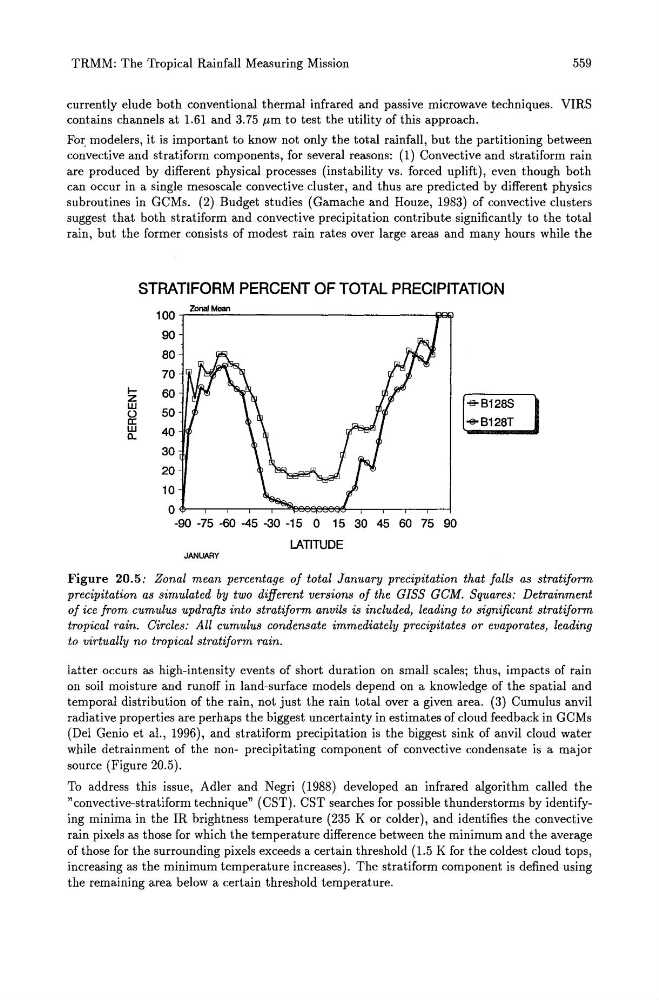
Figure 20.5: Zonal mean percentage of total January precipitation that falls as stratiform
precipitation as simulated by two different versions of the GISS GCM. Squares: Detrainment
of ice from cumulus updrafts into stratiform anvils is included, leading to significant stratiform
tropical rain. Circles: All cumulus condensate immediately precipitates or evaporates, leading
to virtually no tropical stratiform rain.
latter occurs as high-intensity events of short duration on small scales; thus, impacts of rain
on soil moisture and runoff in land-surface models depend on a knowledge of the spatial and
temporal distribution of the rain, not just the rain total over a given area. (3) Cumulus anvil
radiative properties are perhaps the biggest uncertainty in estimates of cloud feedback in GCMs
(Del Genio et al., 1996), and stratiform precipitation is the biggest sink of anvil cloud water
while detrainment of the non- precipitating component of convective condensate is a major
source (Figure 20.5).
To address this issue, Adler and Negri (1988) developed an infrared algorithm called the
"convective-stratiform technique" (CST). CST searches for possible thunderstorms by identifying minima in the IR brightness temperature (235 K or colder), and identifies the convective
rain pixels as those for which the temperature difference between the minimum and the average
of those for the surrounding pixels exceeds a certain threshold (1.5 K for the coldest cloud tops,
increasing as the minimum temperature increases). The stratiform component is defined using
the remaining area below a certain threshold temperature.