

TRMM: The Tropical Rainfall Measuring Mission
land: e ~ 0.9
:.Tbs-Ts
1
cloud water
emission
Tb (rain) - Tbs
I
ice scattering
I( decreases T b)
I
557
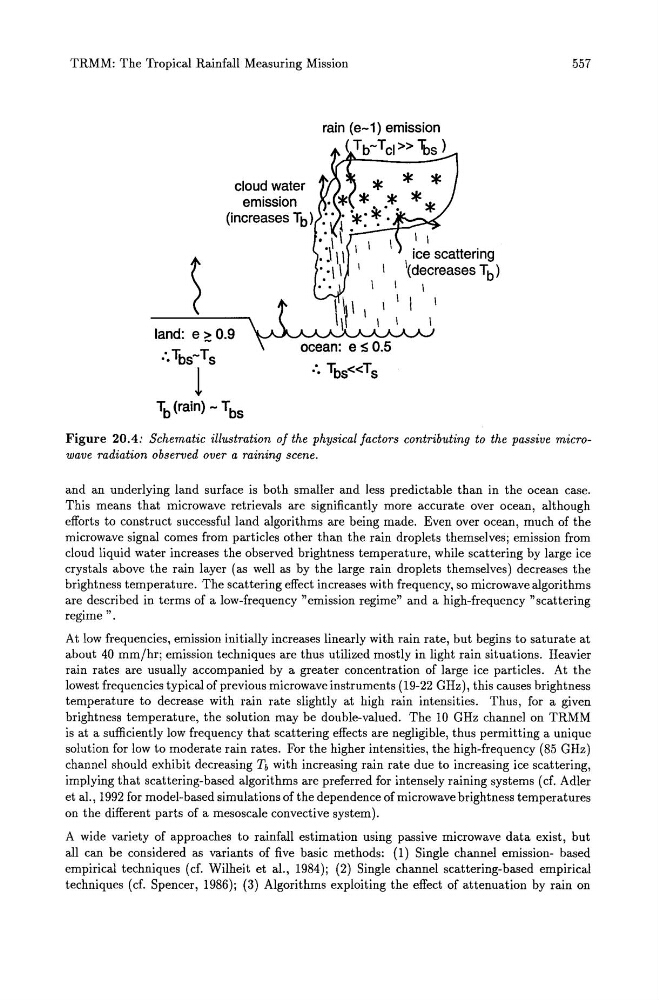
Figure 20.4: Schematic illustration of the physical factors contributing to the passive microwave radiation observed over a raining scene.
and an underlying land surface is both smaller and less predictable than in the ocean case.
This means that microwave retrievals are significantly more accurate over ocean, although
efforts to construct successful land algorithms are being made. Even over ocean, much of the
microwave signal comes from particles other than the rain droplets themselves; emission from
cloud liquid water increases the observed brightness temperature, while scattering by large ice
crystals above the rain layer (as well as by the large rain droplets themselves) decreases the
brightness temperature. The scattering effect increases with frequency, so microwave algorithms
are described in terms of a low-frequency "emission regime" and a high-frequency "scattering
regime ".
At low frequencies, emission initially increases linearly with rain rate, but begins to saturate at
about 40 mm/hr; emission techniques are thus utilized mostly in light rain situations. Heavier
rain rates are usually accompanied by a greater concentration of large ice particles. At the
lowest frequencies typical of previous microwave instruments (19-22 GHz), this causes brightness
temperature to decrease with rain rate slightly at high rain intensities. Thus, for a given
brightness temperature, the solution may be double-valued. The 10 GHz channel on TRMM
is at a sufficiently low frequency that scattering effects are negligible, thus permitting a unique
solution for low to moderate rain rates. For the higher intensities, the high-frequency (85 GHz)
channel should exhibit decreasing n with increasing rain rate due to increasing ice scattering,
implying that scattering-based algorithms are preferred for intensely raining systems (d. Adler
et al., 1992 for model-based simulations of the dependence of microwave brightness temperatures
on the different parts of a mesoscale convective system).
A wide variety of approaches to rainfall estimation using passive microwave data exist, but
all can be considered as variants of five basic methods: (1) Single channel emission- based
empirical techniques (d. Wilheit et al., 1984); (2) Single channel scattering-based empirical
techniques (d. Spencer, 1986); (3) Algorithms exploiting the effect of attenuation by rain on