

538
m
~
6r----------------------------,
Farrnand
-e-Clear Cut
-e-i 2 f--------+-lflii--l--":\---"-L--f---
c:
"I:
--eFot_eog
--ei 0
Pine II
--OJ
C
~ .2~--~~I~-----4~--+-~ne=w ln --.~
~
---6-.
u
NaSnow
-6 LL......!:F==Ground= ~L----..:: W.:::eI===-__ .l...-__ ----'LJ
M. Hallikainen
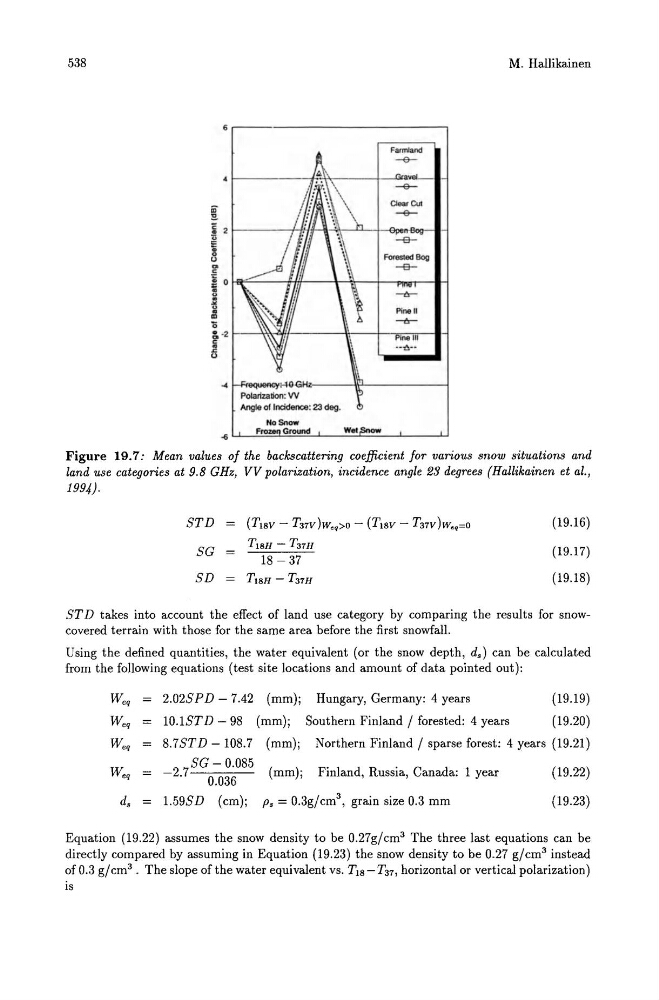
Figure 19.7: Mean values of the backscattering coefficient for various snow situations and
land use categories at 9.8 GHz, VV polarization, incidence angle 23 degrees (Hallikainen et al.,
1994)·
STD
SG
SD
(TI8V - T37V )W,.>o - (TI8V - T37V )W,.=o
TI8H - T37H
18 - 37
TI8H - T37H
(19.16)
(19.17)
(19.18)
ST D takes into account the effect of land use category by comparing the results for snowcovered terrain with those for the same area before the first snowfall.
Using the defined quantities, the water equivalent (or the snow depth, ds) can be calculated
from the following equations (test site locations and amount of data pointed out):
Weq
2.02SPD -7.42 (mm); Hungary, Germany: 4 years
(19.19)
Weq
10.lSTD - 98 (mm); Southern Finland / forested: 4 years
(19.20)
Weq
8.7STD -108.7 (mm); Northern Finland / sparse forest: 4 years (19.21)
Weq
_2.7SG - 0.085
0.036
(mm); Finland, Russia, Canada: 1 year
(19.22)
ds
1.59SD (em); ps = 0.3g/cm 3 , grain size 0.3 mm
(19.23)
Equation (19.22) assumes the snow density to be 0.27g/cm 3 The three last equations can be
directly compared by assuming in Equation (19.23) the snow density to be 0.27 g/cm 3 instead
of 0.3 g/cm 3 . The slope of the water equivalent vs. TI8 -T37, horizontal or vertical polarization)
IS