

Retrieval of Sea Ice and Snow Parameters ...
529
Ca)
Cb)
66
66
64
64
€ 62
~ 62
0
z
z
~
~
;)
.2
go
go
.3
.3
60
60
58
58
58
58
14
14
Latitude. East
Lati1ude. Eas1
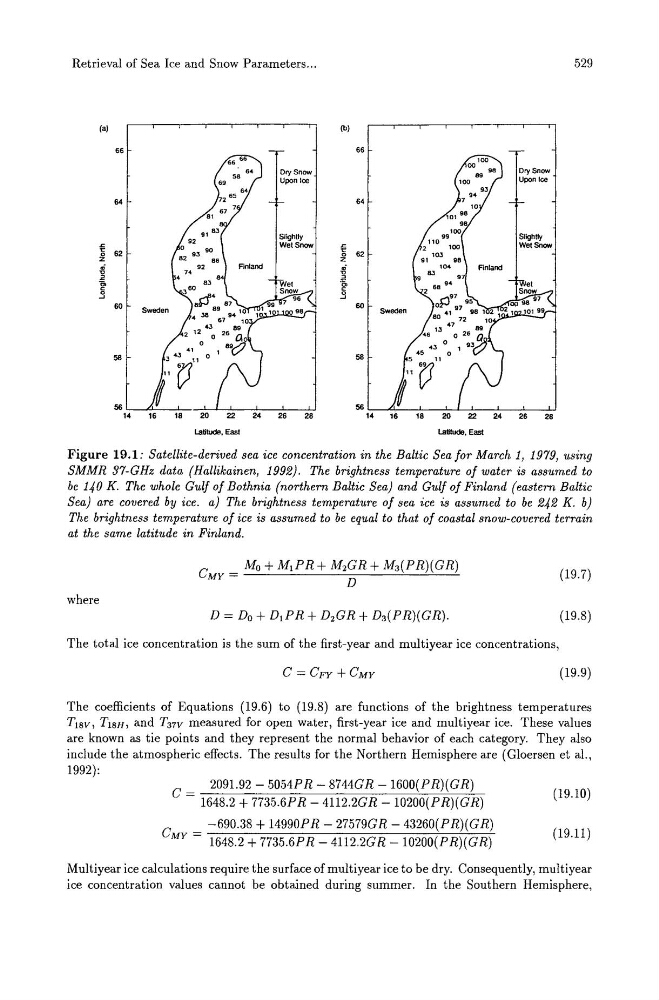
Figure 19.1: Satellite-derived sea ice concentration in the Baltic Sea for March 1, 1979, using
SMMR 37-GHz data (Hallikainen, 1992). The brightness temperature of water is assumed to
be 140 K. The whole Gulf of Bothnia (northern Baltic Sea) and Gulf of Finland (eastern Baltic
Sea) are covered by ice. a} The brightness temperature of sea ice is assumed to be 242 K. b)
The brightness temperature of ice is assumed to be equal to that of coastal snow-covered terrain
at the same latitude in Finland.
where
C MY = Mo +M1PR+M2GR+M3 (PR)(GR)
D
(19.7)
(19.8)
The total ice concentration is the sum of the first-year and multiyear ice concentrations,
(19.9)
The coefficients of Equations (19.6) to (19.8) are functions of the brightness temperatures
T18V , T18H, and T37V measured for open water, first-year ice and multiyear ice. These values
are known as tie points and they represent the normal behavior of each category. They also
include the atmospheric effects. The results for the Northern Hemisphere are (Gloersen et al.,
1992):
C = 2091.92 - 5054P R - 87 44G R - 1600( P R)( G R)
1648.2 + 7735.6PR - 4112.2GR -10200(PR)(GR)
C
_ -690.38+ 14990PR-27579GR-43260(PR)(GR)
MY -
1648.2 + 7735.6PR - 4112.2GR -10200(PR)(GR)
(19.10)
(19.11)
Multiyear ice calculations require the surface of multiyear ice to be dry. Consequently, multiyear
ice concentration values cannot be obtained during summer. In the Southern Hemisphere,