

494
M. Hallikainen
1000
1000
100
weight
r~tio
g/kg
10
. ,o .... .p
\~\)
p .... .p
w
!:!
,~\)" . w -?(\
'0.
~
1: .,
~
Cac~ 6Hp
, a~O,. Hp
~O
f>eC1·2 r,u .t"", .a;;"·
100
10
0.1
CI-~
~\.Or\
-~
--~
-. .. - ... _~
..
Na+
til
'.
1\
' \1
----'"'
.....
rlso ....... _- : " - :-':::::- :", \
Mg+ +Ca+-t K+ + r 51
\. i'-?: tr
0.1
0.01
r am
a -10 -20 -30 -l,() -50 -60
l/C.
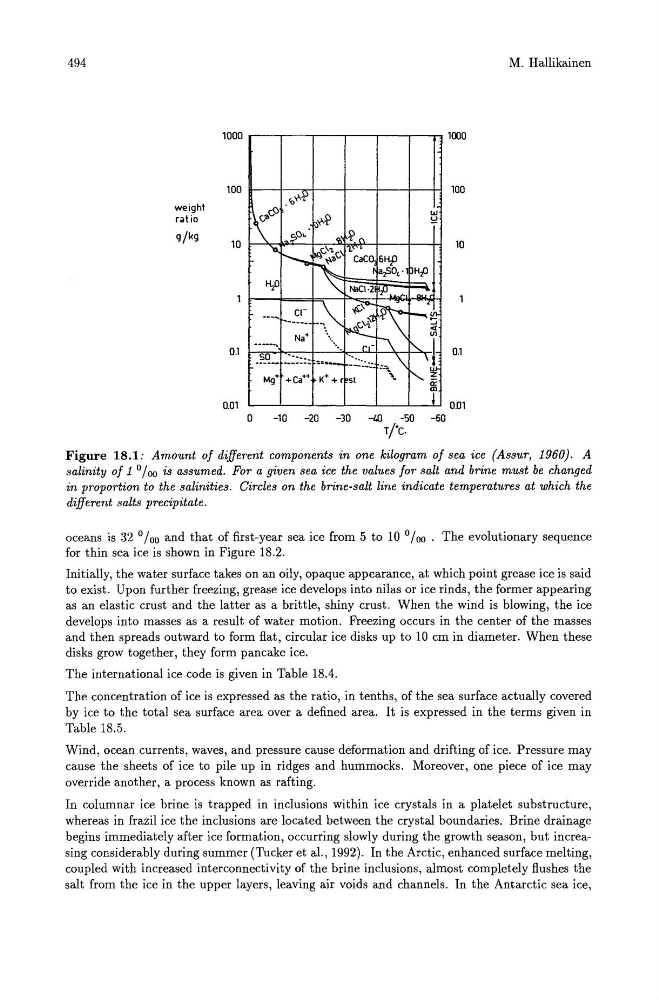
Figure 18.1: Amount of different components in one kilogram of sea ice (Assur, 1960). A
salinity of 1 0/00 is assumed. For a given sea ice the values for salt and brine must be changed
in pmportion to the salinities. Circles on the brine-salt line indicate temperatures at which the
different salts precipitate.
oceans is 32 0/00 and that of first-year sea ice from 5 to 10 0/00 . The evolutionary sequence
for thin sea ice is shown in Figure 18.2.
Initially, the water surface takes on an oily, opaque appearance, at which point grease ice is said
to exist. Upon further freezing, grease ice develops into nilas or ice rinds, the former appearing
as an elastic crust and the latter as a brittle, shiny crust. When the wind is blowing, the ice
develops into masses as a result of water motion. Freezing occurs in the center of the masses
and then spreads outward to form flat, circular ice disks up to 10 cm in diameter. When these
disks grow together, they form pancake ice.
The international ice code is given in Table 18.4.
The concentration of ice is expressed as the ratio, in tenths, of the sea surface actually covered
by ice to the total sea surface area over a defined area. It is expressed in the terms given in
Table 18.5.
Wind, ocean currents, waves, and pressure cause deformation and drifting of ice. Pressure may
cause the sheets of ice to pile up in ridges and hummocks. Moreover, one piece of ice may
override another, a process known as rafting.
In columnar ice brine is trapped in inclusions within ice crystals in a platelet substructure,
whereas in frazil ice the inclusions are located between the crystal boundaries. Brine drainage
begins immediately after ice formation, occurring slowly during the growth season, but increasing considerably during summer (Tucker et aI., 1992). In the Arctic, enhanced surface melting,
coupled with increased interconnectivity of the brine inclusions, almost completely flushes the
salt from the ice in the upper layers, leaving air voids and channels. In the Antarctic sea ice,
M. Hallikainen
1000
1000
100
weight
r~tio
g/kg
10
. ,o .... .p
\~\)
p .... .p
w
!:!
,~\)" . w -?(\
'0.
~
1: .,
~
Cac~ 6Hp
, a~O,. Hp
~O
f>eC1·2 r,u .t"", .a;;"·
100
10
0.1
CI-~
~\.Or\
-~
--~
-. .. - ... _~
..
Na+
til
'.
1\
' \1
----'"'
.....
rlso ....... _- : " - :-':::::- :", \
Mg+ +Ca+-t K+ + r 51
\. i'-?: tr
0.1
0.01
r am
a -10 -20 -30 -l,() -50 -60
l/C.
Figure 18.1: Amount of different components in one kilogram of sea ice (Assur, 1960). A
salinity of 1 0/00 is assumed. For a given sea ice the values for salt and brine must be changed
in pmportion to the salinities. Circles on the brine-salt line indicate temperatures at which the
different salts precipitate.
oceans is 32 0/00 and that of first-year sea ice from 5 to 10 0/00 . The evolutionary sequence
for thin sea ice is shown in Figure 18.2.
Initially, the water surface takes on an oily, opaque appearance, at which point grease ice is said
to exist. Upon further freezing, grease ice develops into nilas or ice rinds, the former appearing
as an elastic crust and the latter as a brittle, shiny crust. When the wind is blowing, the ice
develops into masses as a result of water motion. Freezing occurs in the center of the masses
and then spreads outward to form flat, circular ice disks up to 10 cm in diameter. When these
disks grow together, they form pancake ice.
The international ice code is given in Table 18.4.
The concentration of ice is expressed as the ratio, in tenths, of the sea surface actually covered
by ice to the total sea surface area over a defined area. It is expressed in the terms given in
Table 18.5.
Wind, ocean currents, waves, and pressure cause deformation and drifting of ice. Pressure may
cause the sheets of ice to pile up in ridges and hummocks. Moreover, one piece of ice may
override another, a process known as rafting.
In columnar ice brine is trapped in inclusions within ice crystals in a platelet substructure,
whereas in frazil ice the inclusions are located between the crystal boundaries. Brine drainage
begins immediately after ice formation, occurring slowly during the growth season, but increasing considerably during summer (Tucker et aI., 1992). In the Arctic, enhanced surface melting,
coupled with increased interconnectivity of the brine inclusions, almost completely flushes the
salt from the ice in the upper layers, leaving air voids and channels. In the Antarctic sea ice,