

Applications of Passive and Active Microwave Sensors ...
483
$
5!
~
51 .. :i' g
!
~
g
0
2
rad-'. (DEG LA 1)
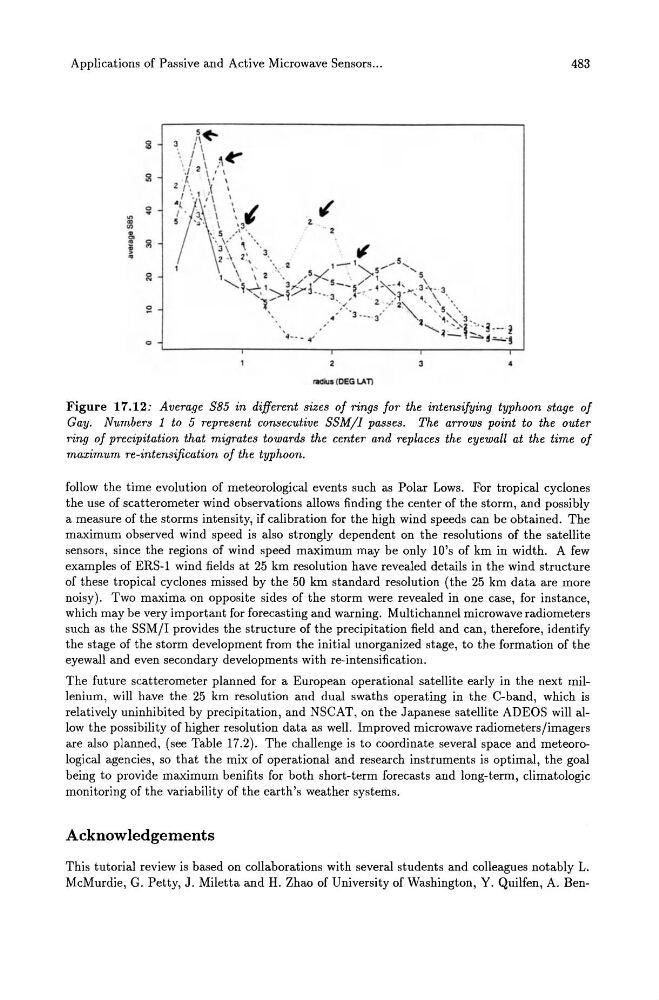
Figure 17.12: Average S85 in different sizes of rings for the intensifying typhoon stage of
Gay. Numbers 1 to 5 represent consecutive SSM/! passes. The arrows point to the outer
ring of precipitation that migrates towards the center and replaces the eyewall at the time of
maximum re-intensification of the typhoon.
follow the time evolution of meteorological events such as Polar Lows. For tropical cyclones
the use of scatterometer wind observations allows finding the center of the storm, and possibly
a measure of the storms intensity, if calibration for the high wind speeds can be obtained. The
maximum observed wind speed is also strongly dependent on the resolutions of the satellite
sensors, since the regions of wind speed maximum may be only lO's of km in width. A few
examples of ERS-1 wind fields at 25 km resolution have revealed details in the wind structure
of these tropical cyclones missed by the 50 km standard resolution (the 25 km data are more
noisy). Two maxima on opposite sides of the storm were revealed in one case, for instance,
which may be very important for forecasting and warning. Multichannel microwave radiometers
such as the SSM/I provides the structure of the precipitation field and can, therefore, identify
the stage of the storm development from the initial unorganized stage, to the formation of the
eyewall and even secondary developments with re-intensification.
The future scatterometer planned for a European operational satellite early in the next millenium, will have the 25 km resolution and dual swaths operating in the C-band, which is
relatively uninhibited by precipitation, and NSCAT, on the Japanese satellite ADEOS will allow the possibility of higher resolution data as well. Improved microwave radiometers/imagers
are also planned, (see Table 17.2). The challenge is to coordinate several space and meteorological agencies, so that the mix of operational and research instruments is optimal, the goal
being to provide maximum benifits for both short-term forecasts and long-term, climatologic
monitoring of the variability of the earth's weather systems.
Acknowledgements
This tutorial review is based on collaborations with several students and colleagues notably L.
McMurdie, G. Petty, J. Miletta and H. Zhao of University of Washington, Y. Quilfen, A. Ben-
483
$
5!
~
51 .. :i' g
!
~
g
0
2
rad-'. (DEG LA 1)
Figure 17.12: Average S85 in different sizes of rings for the intensifying typhoon stage of
Gay. Numbers 1 to 5 represent consecutive SSM/! passes. The arrows point to the outer
ring of precipitation that migrates towards the center and replaces the eyewall at the time of
maximum re-intensification of the typhoon.
follow the time evolution of meteorological events such as Polar Lows. For tropical cyclones
the use of scatterometer wind observations allows finding the center of the storm, and possibly
a measure of the storms intensity, if calibration for the high wind speeds can be obtained. The
maximum observed wind speed is also strongly dependent on the resolutions of the satellite
sensors, since the regions of wind speed maximum may be only lO's of km in width. A few
examples of ERS-1 wind fields at 25 km resolution have revealed details in the wind structure
of these tropical cyclones missed by the 50 km standard resolution (the 25 km data are more
noisy). Two maxima on opposite sides of the storm were revealed in one case, for instance,
which may be very important for forecasting and warning. Multichannel microwave radiometers
such as the SSM/I provides the structure of the precipitation field and can, therefore, identify
the stage of the storm development from the initial unorganized stage, to the formation of the
eyewall and even secondary developments with re-intensification.
The future scatterometer planned for a European operational satellite early in the next millenium, will have the 25 km resolution and dual swaths operating in the C-band, which is
relatively uninhibited by precipitation, and NSCAT, on the Japanese satellite ADEOS will allow the possibility of higher resolution data as well. Improved microwave radiometers/imagers
are also planned, (see Table 17.2). The challenge is to coordinate several space and meteorological agencies, so that the mix of operational and research instruments is optimal, the goal
being to provide maximum benifits for both short-term forecasts and long-term, climatologic
monitoring of the variability of the earth's weather systems.
Acknowledgements
This tutorial review is based on collaborations with several students and colleagues notably L.
McMurdie, G. Petty, J. Miletta and H. Zhao of University of Washington, Y. Quilfen, A. Ben-